









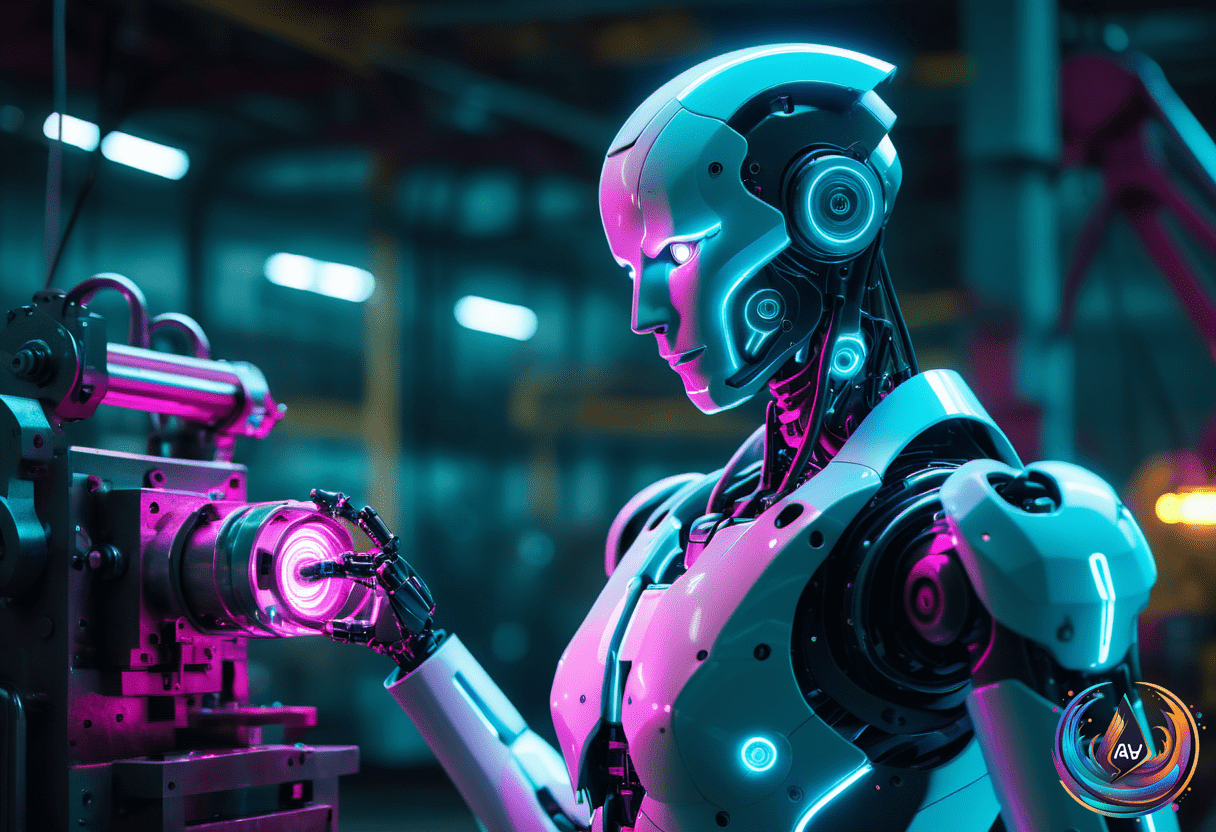
Physical AI Revolution Redefining Robots and Human Interaction
 25
25Robots are evolving fast. But the real breakthrough isn’t about making robots smarter. It’s about making the way humans and robots communicate smarter. Imagine a world where machines don’t just wait for commands. They sense your intent without interrupting your flow. This is the new frontier of Physical AI.
For years, robotics focused on building better machines. More agile. More powerful. More precise. Companies have pushed hardware to astonishing levels. Humanoids now walk factory floors, stack boxes, and even fold laundry. But the interface connecting humans to robots has barely changed. Screens, buttons, and voice commands still dominate. That’s a problem.
Why Interfaces Matter More Than Ever
Think about a technician working on a wind turbine. Their hands are busy. Their eyes are fixed on the job. Stopping to type on a screen or speak aloud doesn’t work. The same goes for warehouse workers or people with assistive devices. They need a way to tell machines what to do without breaking their focus.
This is where smarter interfaces come in. The next leap in Physical AI will put humans as first-class nodes in a connected system. Instead of forcing humans to adapt to machines, machines will adapt to humans. By fusing spatial position, visual context, and gestures, robots will understand intent naturally. Your body becomes the interface.
- Hands-free commands powered by subtle gestures
- Context-aware machines that sense your environment
- Low-latency neural signals enabling instant response
This approach shatters the old assumption that users can pause and give structured commands. It opens new possibilities for seamless collaboration in complex, real-world environments.
The Rise of Physical AI and Embodied Robotics
Physical AI means intelligence that moves off screens and into the real world. Robots don’t just follow scripts anymore. They sense, think, and adapt. Machines learn from experience and adjust instantly. This shift transforms robots from dumb executors into decision-making partners.
Embodied robotics ties AI tightly to a robot’s body and sensors. These robots learn by doing. They observe, simulate, and improve without needing constant reprogramming. That’s why 2026 is a landmark year. Humanoid robots have dropped in price, reaching mass production levels. Companies like Tesla, Boston Dynamics, and Figure have deployed thousands of robots in factories and warehouses.
The breakthrough? Robotics foundation models. These powerful AI models allow robots to understand vision, language, and action all at once. They learn complex tasks through observation, not just coding. This unlocks flexibility and adaptability on a scale never seen before.
What This Means for Businesses and Workers
Robotics is no longer just about automating repetitive tasks. It’s about scaling decision-making in unpredictable environments. Physical AI reshapes supply chains, manufacturing, and labor markets. For businesses, this means redesigning operations for agility, not just efficiency.
Investors are taking note. Robotics ETFs are booming as companies race to fill labor shortages caused by aging populations. Robots have become essential tools for survival in competitive markets. The ecosystem extends beyond robot builders to critical suppliers powering sensors, chips, and AI models.
But the real star is the human-machine partnership. Smarter interfaces let workers stay hands-on and eyes-on their tasks while still commanding robots effortlessly. This boosts productivity and safety. It also makes technology accessible to a wider range of users, from factory floor workers to people with mobility challenges.
Looking Ahead: The Next Steps for Physical AI
The future of robotics lies in the fusion of human intuition and machine precision. Next-gen Physical AI will blend neural signals, gestures, and spatial awareness into natural communication methods. Robots won’t replace humans. They’ll amplify human capabilities.
Expect smarter, more intuitive interfaces that keep humans fully engaged in their work. Imagine assistive devices that respond to your subtle movements or logistics robots that anticipate your needs without a word. The boundary between human and machine will blur.
This revolution is happening now. The moment to rethink robotics is here. It’s not just about building smarter robots. It’s about building smarter ways for humans and robots to work together. The future of Physical AI is a partnership where intelligence lives in both bodies — human and machine.
Based on
- The Future of Physical AI Isn’t Smarter Robots, It’s Smarter Interfaces — spectrum.ieee.org
- Will Robotics Have a Breakthrough ChatGPT Moment? – IEEE Spectrum — spectrum.ieee.org
- From automation to physical AI: Why organisations are rethinking robotics strategies in 2026 – Enterprise IT News — enterpriseit.news
- Physical AI Ecosystem: The 2026 Robotics Shift — The AI Chronicle — theaicronicle.com
- Physical AI & Embodied Robotics 2026: The Real‑World Shift — emergingtechdaily.com
















What do you think?
It is nice to know your opinion. Leave a comment.