









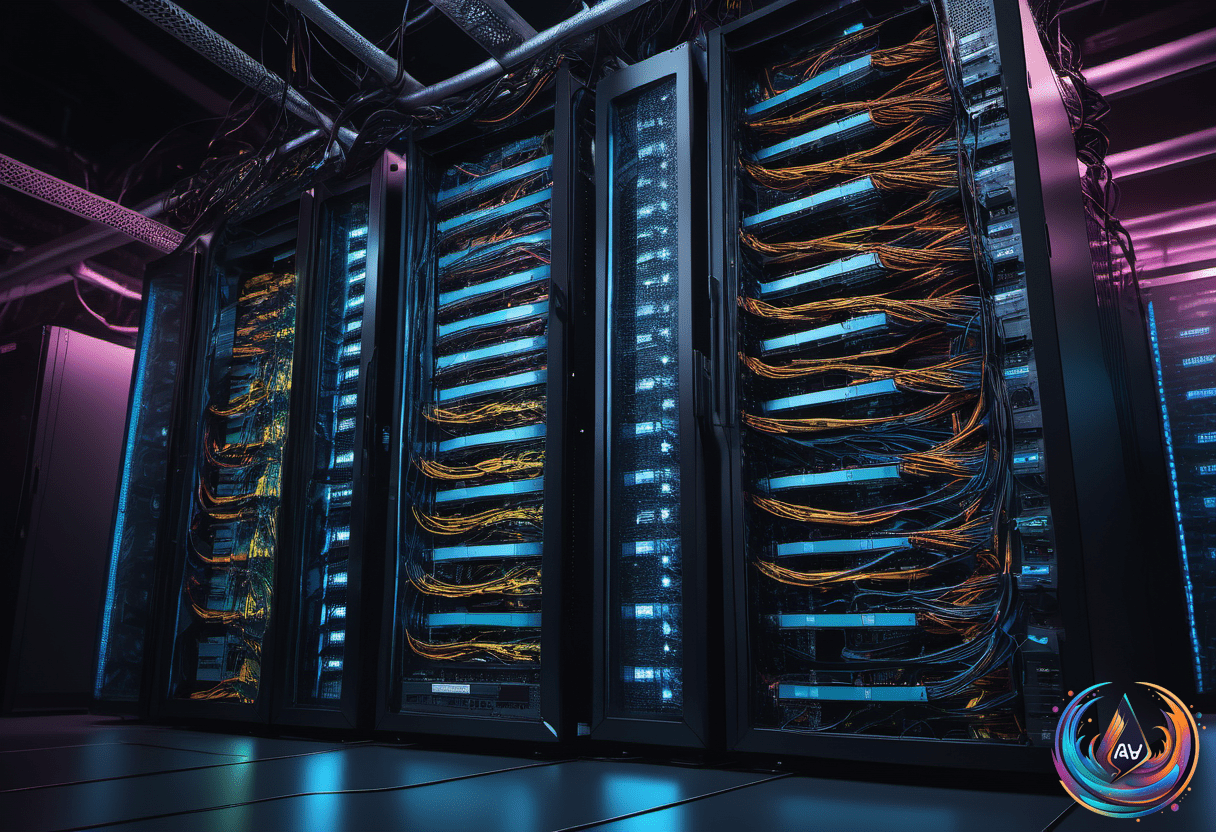
Mastering Exascale AI with NVIDIA GB200 and Slurm Scheduling
 20
20The future of AI just skyrocketed. Imagine unlocking exascale performance inside a single rack. NVIDIA’s GB200 NVL72, packed with 72 Blackwell GPUs, delivers that power right now. But raw hardware is only half the story. The secret lies in how jobs are scheduled to exploit this beast’s full potential.
Exascale Power Packed Into One Rack
The GB200 NVL72 isn’t just a GPU cluster—it’s an exascale powerhouse in a compact form. Seventy-two NVIDIA Blackwell GPUs connect through NVLink, NVIDIA’s ultra-fast GPU interconnect technology. Together, they achieve a staggering 130 terabytes per second of low-latency bandwidth. That’s enough to power real-time AI models with trillions of parameters.
This means AI researchers can train massive models faster and run inference workloads that were unthinkable before. From massive mixture-of-experts training jobs to real-time trillion-parameter inference, this system crushes performance barriers.
But there’s a catch. To get the most from this hardware, scheduling must respect the intricate network topology. Otherwise, the performance gains vanish in communication delays and resource fragmentation.
Topology-Aware Scheduling: The Game Changer
Traditional job schedulers focus on filling available GPUs quickly. But that often scatters jobs across the cluster, ignoring how GPUs physically connect. This wastes NVLink bandwidth and kills efficiency.
Enter the new Slurm topology/block plugin, co-designed by NVIDIA and SchedMD. It understands the GB200 NVL72’s network layout down to NVLink domain boundaries. That means jobs get allocated GPUs grouped tightly within the same NVLink domain. The scheduler avoids scattering jobs across slow network links.
This approach slashes fragmentation. Simulation on a 5,000-node GB200 NVL72 cluster model proves it achieves GPU occupancy within 1% of the theoretical maximum. That’s like fitting every puzzle piece perfectly with no gaps.
Here’s how it works in practice:
- Large jobs (64 GPUs) get scheduled in segments spanning 16 nodes, fully inside one NVLink domain. This keeps GPUs connected by the fastest links.
- Smaller jobs get segments between 2 and 8 nodes, still respecting domain boundaries to avoid performance hits.
- Schedulers continuously monitor fragmentation and adjust segment sizes to keep utilization high over time.
This fine-grained control lets clusters mix big and small AI jobs without losing efficiency or predictability.
Why This Matters for AI and HPC Workloads
AI models keep growing bigger. Training trillion-parameter models isn’t just about raw GPU count. The inter-GPU communication fabric and scheduler intelligence matter equally. The GB200 NVL72’s NVLink fabric provides unmatched bandwidth, but only if the scheduler aligns workloads with its topology.
Topology-aware scheduling unlocks multiple benefits:
- Maximized GPU utilization keeps expensive hardware busy, cutting idle time.
- Reduced network bottlenecks speed up training and inference.
- Improved predictability helps data center operators plan resources confidently.
- Supports fault tolerance by adjusting segment sizes dynamically.
These improvements translate to faster AI research cycles and better return on investment for huge GPU clusters.
Looking Ahead: Smarter Scheduling for Next-Gen AI
The GB200 NVL72 combined with topology-aware Slurm scheduling is just the beginning. As AI models scale further, systems will demand even smarter schedulers that consider topology, workload patterns, and job priorities simultaneously.
Simulation tools will play a growing role in testing scheduling strategies before deploying them. Continuous monitoring and dynamic adaptation will become standard to maintain peak cluster efficiency.
For AI developers and HPC centers, embracing topology-aware scheduling unlocks the true power of exascale GPU clusters. It’s the key to turning raw hardware muscle into real-world AI breakthroughs.
The race for AI supremacy is on. Will your cluster be ready to run at exascale speeds? The future is topology-aware. The future is now.
Based on
- Unlock Exascale Performance on NVIDIA GB200 NVL72 with Slurm Topology-Aware Job Scheduling — developer.nvidia.com
- What Exactly Constitutes A Governance Framework My Gadget Street — stg-r.independent.ie
- Databricks Unity Catalog Security — stg-r.independent.ie
- Who Owns The Foo Fighters Catalog — r-stg.independent.ie
- Nutcracker Coloring Pages Free — stg-r.independent.ie
- Unveiling the Modern Vision: A Deep Dive into David Bednar’s Leadership Philosophy-Alpha Vision Line — il4n.leonardovargast.com

















What do you think?
It is nice to know your opinion. Leave a comment.