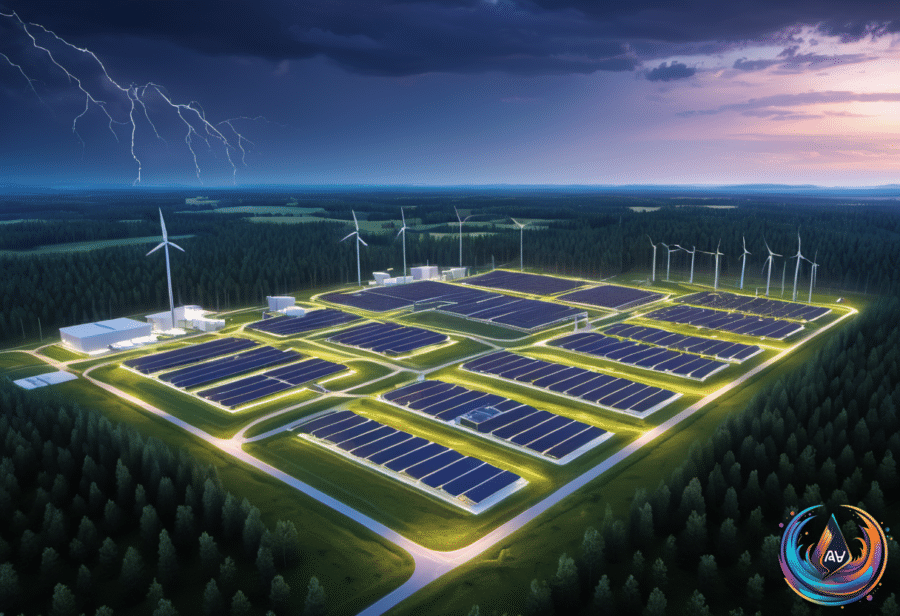
Data centres are moving into places never built for this scale of demand, from rural Queensland farmland to Utah’s desert and Finnish forests. The projects promise jobs, investment and digital power, but they also raise a harder question: how much land, energy and environmental disruption should the AI economy consume?
Three major developments show the pressure building. A proposed facility near Dalby would need 2.16GW at peak capacity, while a Utah project could produce up to 9 gigawatts of gas power. In Finland, Google plans a 13-billion-euro ($15-billion) investment across four locations, including new construction beside major power lines.
Queensland’s 725-Hectare Power Challenge
Near Dalby, Queensland, Singapore-based developer Zerra DC has proposed a 725-hectare datacentre on land now occupied by a feedlot surrounded by gas wells. The project would employ about 1,400 long-term jobs, but its electricity needs would reach about 2.16GW at peak capacity—roughly a quarter of Queensland’s total energy demand.
That scale has stunned local residents. Denver Kanowski described the proposal as “the power of money and the power of greed and shortsighted stupidity.” Dalby travel agent Mordechai Winters said, “I was crushed. You know, it’s very disappointing that the council and also the government would consider it.”
Farmer Liza Balmain is among those living near the proposed site, adding a direct local dimension to a debate often framed around cloud services and AI growth. Anthropic, the AI company developing Claude, represents the kind of technology driving demand for advanced computing, even as the physical infrastructure remains fixed in rural landscapes.
The Queensland proposal turns an abstract energy question into a visible one. A single datacentre would draw power equal to about a quarter of the state’s total energy demand, while occupying 725 hectares of land that already supports agricultural activity and sits among gas wells.
Utah Project Brings Power and Politics Together
In Utah, a proposed project called Wonder Valley would cover roughly 40,000 acres north of Great Salt Lake in Box Elder County. The data centre and power complex would sit on the project’s eastern side, with plans for up to 9 gigawatts of on-site gas generation—more than double Utah’s average electrical load.
The project remained at an early stage as land, power and permits were assembled before an anchor tenant had been secured. Kevin O’Leary announced it on May 11, 2026, claiming it would become the largest data centre in the world. The project was also announced on Fox Business on Oct 1, 2026.
Its approval process involved county commissioners and MIDA, the Military Installation Development Authority in Utah. The process drew controversy over rapid approvals and political decisions, with Utah governor Spencer Cox and county commissioner Lee Perry among the names connected to the wider public debate.
Local residents had heard little about the plan before March 2026, when it was still a rumor in the area. At an April 22, 2026, public meeting, the project faced opposition, and a petition gathered more than 21,500 signatures, mostly from people in the area. Landowner Tim Munns was also part of the local discussion, where one question captured the disbelief surrounding the proposal: “How the heck would anybody think you could build something out here?”
The financial structure added another flashpoint. The Utah project would pay little to no property taxes on servers and equipment, while 80 cents of every dollar collected on land and buildings would go to the developer for infrastructure.
O’Leary later stated: “Recently I appeared on various news programs and would like to clarify that I have no evidence that Alliance for a Better Utah, Elevate Strategies, Gabrielle Finlayson, Taylor Knuth or Josh Kanter are funded by China or the Chinese Communist Party.” Paul Palandjian, CEO and cofounder of O’Leary Digital, is also connected to the project.
Finland’s Investment Meets Forest Concerns
Finland offers a different version of the same expansion. Google plans to build new data centres in Muhos, Kajaani, Vaala and Hamina, where it already operates a data centre, as part of a 13-billion-euro ($15-billion) investment over the next two years. The spending represents Google’s single biggest investment in Europe.
Construction in Muhos involves clearing land and using excavators, with the site next to major power lines. Finland’s government and Prime Minister Petteri Orpo have made attracting data centre investments a priority, linking these facilities to the country’s economic ambitions.
But the Finnish projects have also raised environmental concerns. More than 300 hectares of forest—an area comparable to 420 football fields—were logged without a mandatory environmental impact assessment. The Finnish Supervisory Agency, known as LVV, is investigating whether the clearing complied with legal requirements.
Hanna Halmeenpaa, chair of the Finnish Association for Nature Conservation, represents the environmental pressure surrounding the expansion. Google states that tree-felling activities complied with Forestry Act requirements and that extensive nature surveys were conducted.
Across Queensland, Utah and Finland, the pattern is clear: data centres bring enormous demands for electricity, land and infrastructure before the servers even begin processing data. The promised rewards include jobs, investment and new computing capacity, but communities are now measuring those benefits against power loads, tax structures and forests that cannot be restored overnight.
The next phase of AI will not happen only inside software. It will take shape on feedlots, desert acreage and forest edges, where every gigawatt and hectare becomes part of the public debate.
Based on
- Rural Queenslanders have seen gas projects come and go – but a 725-hectare datacentre poses a whole new level of ‘stupidity’ — theguardian.com
- How ordinary Utahns fought back against the biggest data center in the world | The Verge — theverge.com
- Finnish town braces for change from Google data centres | AFP.com — afp.com