









BMW puts humanoid robots to work in Germany–and Europe’s factories are watching
 123
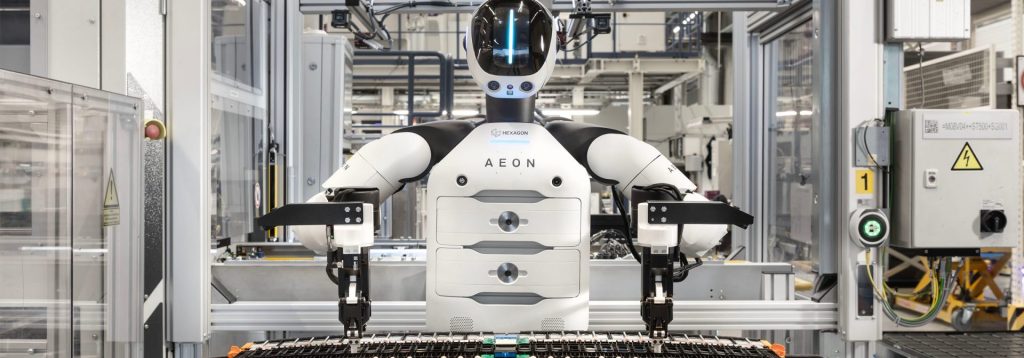
123Europe’s factory floors have a new kind of colleague. BMW Group has deployed humanoid robots in manufacturing in Germany for the first time, launching a pilot project at its Leipzig plant with AEON–a wheeled humanoid built by Hexagon Robotics.
It is the first automotive deployment of AEON anywhere in the world, and it marks something of a line in the sand for European industry: physical AI is no longer a North American or East Asian story.
The announcement, made on March 9, 2026, comes backed by hard data from a prior US trial. In 2025, BMW ran a ten-month pilot at its Spartanburg, South Carolina, plant using Figure AI’s Figure 02 robot. The humanoid supported production of over 30,000 BMW X3s, working 10-hour shifts and moving a total of over 90,000 components.
Leipzig is now the direct heir to those lessons.
A robot built for work, not demos
AEON, developed by Hexagon’s Zurich-based robotics division, is a deliberately industrial machine. Arnaud Robert, President of Hexagon Robotics, made the philosophy plain at a Munich event earlier this month: “We’re not in the dancing business–we’re in the working business.” That ethos is visible in every design decision.

Rather than walking on two legs, AEON moves on wheels–a choice made after extensive testing of locomotion systems, with Hexagon concluding that on factory-grade flat floors, wheels are significantly more efficient in both speed and energy use. It stands 1.65 metres tall, weighs 60 kilograms, reaches 2.5 metres per second, and can autonomously swap its own battery in 23 seconds–enabling around-the-clock operation without human intervention.
Its 22 integrated sensors–peripheral cameras, time-of-flight, infrared, SLAM cameras, and microphones–give it full 360-degree real-time spatial awareness, including the ability to perform quality inspection tasks that conventional stationary robots cannot.
Its human-like torso allows a wide variety of grippers, hand elements, and scanning tools to be flexibly docked, which is precisely what BMW needs for multifunctional deployment across different production environments
Phased rollout, deliberate strategy
AEON’s first test deployment at Leipzig took place in December 2025. A further test run is planned for April 2026, ahead of a full pilot phase launching in summer 2026, where two AEON units will work simultaneously across two use cases–focusing on high-voltage battery assembly and component manufacturing for exterior parts.
Leipzig was not an arbitrary choice. It is BMW’s most technologically comprehensive German plant, combining battery production, injection moulding, press shop, body shop, and final assembly under one roof, meaning a successful deployment there effectively validates physical AI across the full production spectrum.
To anchor this work institutionally, BMW has established a Centre of Competence for Physical AI in Production, consolidating expertise across the group and creating a defined evaluation path for technology partners–from lab testing through to full pilot phases.
As Felix Haeckel, Team Lead for the centre, put it: “We are pooling our expertise to make knowledge on AI and robotics widely usable within the company.”
The infrastructure underneath
What makes BMW’s approach notable is that AEON is not landing on a blank factory floor. BMW has systematically dismantled data silos across its production network, replacing them with a uniform data platform that ensures all information is consistent, standardised, and accessible at all times–the architecture that allows AI agents to operate autonomously and learn continuously.
The humanoid robot is, in effect, the physical layer of a system that has been years in the making. AEON runs on NVIDIA Jetson Orin onboard computers and was trained largely through simulation using NVIDIA’s Isaac platform–a method that allowed Hexagon to develop core locomotion capabilities in weeks rather than months.
The project also involves Microsoft Azure for scalable model development and Maxon’s actuators for locomotion.
Why this matters beyond Leipzig
The broader signal here is one that the enterprise AI world is already tracking closely. Deloitte’s State of AI in the Enterprise 2026 report, surveying over 3,200 senior leaders across 24 countries, found that 58% of companies are already using physical AI in some capacity, with that figure set to reach 80% within two years, with Asia Pacific leading in early implementation.
BMW’s Leipzig pilot is a proof point in that trajectory: that humanoid robots in manufacturing have moved past the lab and the press release, and are being stress-tested against the unforgiving standards of real industrial production. As Milan Nedeljković, BMW’s Board Member for Production, put it: “The symbiosis of engineering expertise and artificial intelligence opens up completely new possibilities in production.”
The question now is not whether humanoid robots belong on the factory floor. It is how fast the rest of the European industry follows.
See also: Ai2: Building physical AI with virtual simulation data

Want to learn more about AI and big data from industry leaders? Check out AI & Big Data Expo taking place in Amsterdam, California, and London. The comprehensive event is part of TechEx and is co-located with other leading technology events including the Cyber Security & Cloud Expo. Click here for more information.
AI News is powered by TechForge Media. Explore other upcoming enterprise technology events and webinars here.
The post BMW puts humanoid robots to work in Germany–and Europe’s factories are watching appeared first on AI News.
Origianl Creator: Dashveenjit Kaur
Original Link: https://www.artificialintelligence-news.com/news/bmw-humanoid-robots-manufacturing-europe-leipzig/
Originally Posted: Fri, 13 Mar 2026 09:00:00 +0000














What do you think?
It is nice to know your opinion. Leave a comment.