









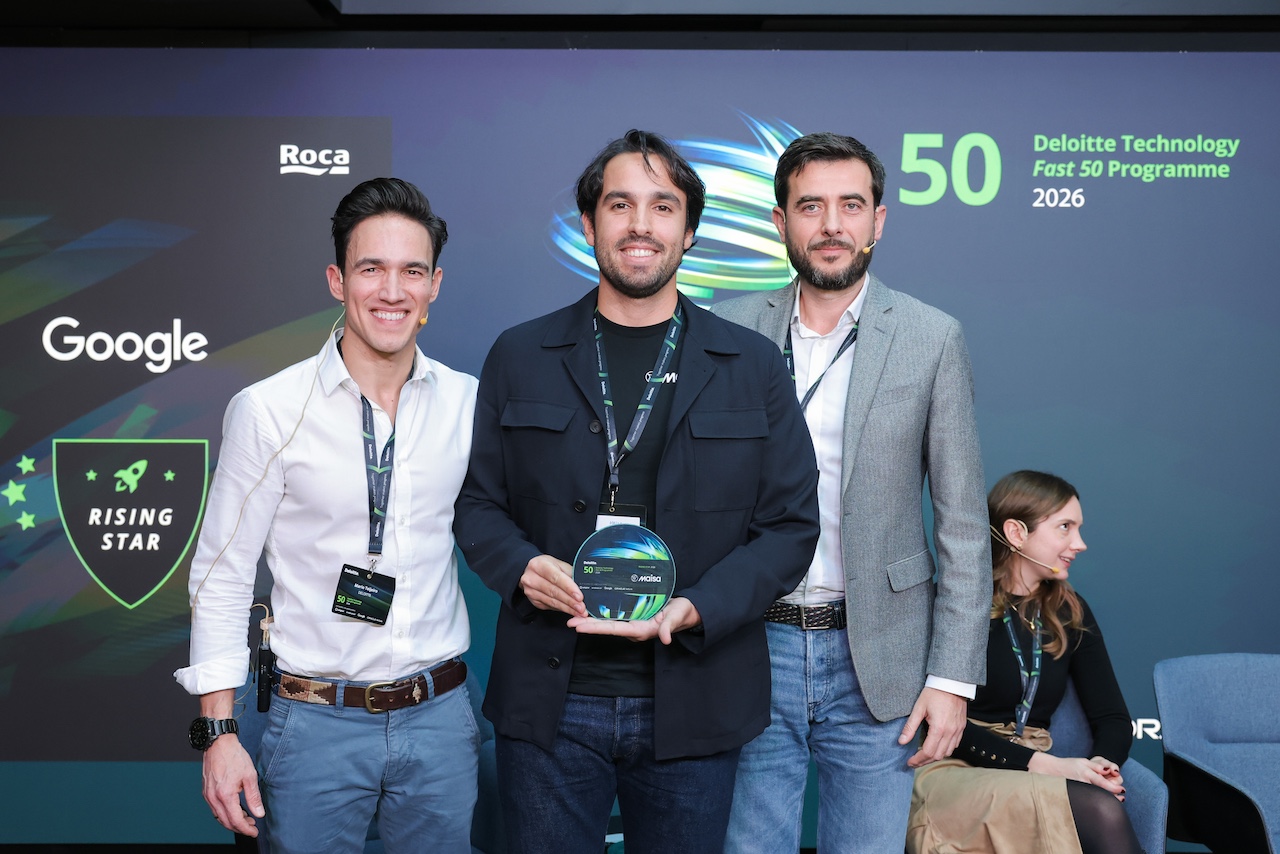
Deloitte Names Maisa Rising Star as Enterprises Shift AI Into Production
 100
100Maisa, an enterprise AI infrastructure company focused on auditable “digital workers,” has reported 400% year-on-year growth and a fivefold increase in client adoption over the past year, as organisations deploy AI beyond pilot projects into business-critical production environments.
The company was named a Rising Star in the Deloitte Technology Fast 50 Programme 2026, an annual ranking of high-growth tech companies showing strong scalability and market momentum.
Bridging experimentation and production
While AI adoption is widespread, industry data shows that a large proportion of enterprise AI initiatives stall at the pilot stage due to governance and operational challenges. Although roughly 88% of organisations now use AI in at least one function, only a minority have scaled those efforts into full production environments with measurable outcomes – a gap driven by governance gaps, limited visibility, and integration complexity.
As regulatory scrutiny and internal risk pressures mount, enterprises increasingly prioritise infrastructure that combines capability with traceability and control.
Auditable “digital workers” for regulated industries
Maisa’s platform is designed to address these requirements by enabling organisations to deploy AI “digital workers” that carry out complex business workflows with step‑by‑step execution transparency. Rather than relying solely on probabilistic outputs, the system structures tasks into deterministic flows, and logs every action in a verifiable Chain of Work, allowing enterprises to understand what was done, why it was done, and how results were reached.
“Innovation alone doesn’t move AI into production, but accountability does. Enterprises are no longer satisfied with impressive pilots. They need systems they can inspect, govern, and defend under audit. Our growth reflects that shift in market expectations.”
David Villalón, Co‑Founder and CEO of Maisa
Early enterprise adoption reflects demand
Global engineering and infrastructure group Elecnor recently deployed Maisa to operationalise internal workflows using AI‑driven execution.
“We have been very happy about Maisa’s adaptation to our needs and helping our team succeed with operationalising our standard operating procedures. Within weeks, we moved from semi‑structured operational guidance to a fully functional digital worker aligned with our business goals.”
Elecnor’s, Director of Digital Transformation & Innovation
Proprietary infrastructure and expansion
Powered by its proprietary Knowledge Processing Unit (KPU), Maisa’s platform combines contextual AI reasoning with deterministic execution logic and built‑in validation at each step, designed to reduce operational risk and ensure results are auditable under regulatory review.
Over the past year, the company has expanded across Europe and the United States, growing its team fivefold and deepening deployments in regulated sectors where documentation‑intensive workflows have traditionally resisted automation.
Maisa is backed by a $25 million seed round led by Creandum, with participation from Forgepoint Capital International via its European joint venture with Santander Bank, as well as NFX and Village Global. The funding will support product development and enterprise expansion as organisations rethink how to deploy AI safely at scale.
Deloitte’s Rising Star recognition underscores a broader trend: as AI deployment matures, infrastructure that delivers transparent, traceable, and accountable outcomes is increasingly essential for production‑grade enterprise AI.
Origianl Creator: Ekaterina Pisareva
Original Link: https://justainews.com/industries/b2b-tech/deloitte-names-maisa-rising-star/
Originally Posted: Thu, 12 Mar 2026 15:27:32 +0000














What do you think?
It is nice to know your opinion. Leave a comment.