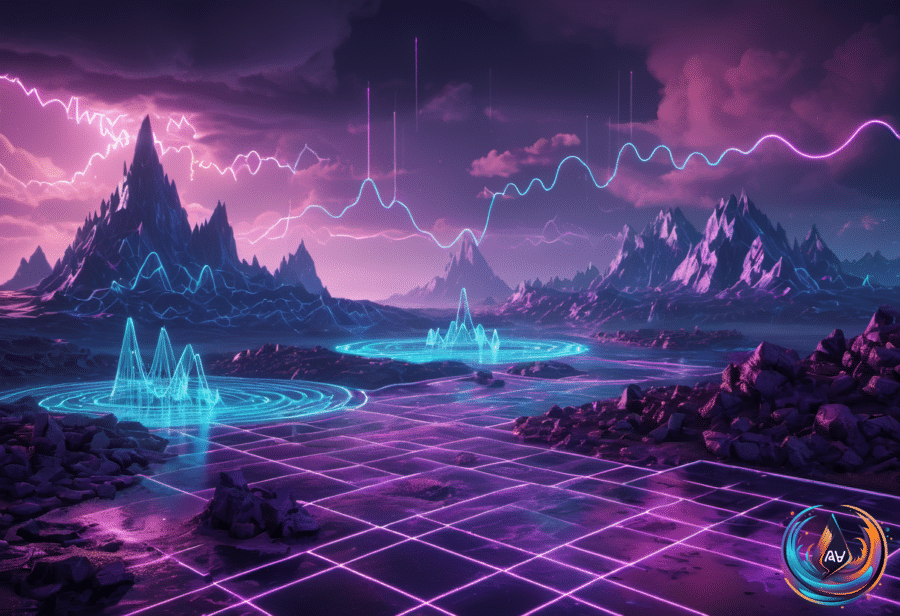
Google DeepMind has opened Genie 4 as a research preview for trusted testers, and this world model pushes interactive generation into new territory. Give it a text or image prompt, then explore the world it creates as the scene responds to your keyboard controls, plain-language instructions, and every new frame.
Genie 4 does not generate a video clip that plays from start to finish. It simulates an interactive environment frame by frame, responding to user input as it arrives while creating the visuals, ambient sound, music, and character dialogue together.
A World That Changes When You Ask
Genie 4 lets users create explorable worlds from text and image prompts in real time, then alter those worlds while the simulation continues. You can change the weather, move the camera, add a person or object, or steer events with a simple instruction typed into the scene.
Keyboard controls handle movement, but prompts provide the bigger leap. A user can guide what happens next without stopping the simulation, turning the model into a space for live exploration, storyboarding, and creative experiments. Every world carries ambient audio, while characters can hold conversations that react to user inputs in real time.
DeepMind describes Genie 4 as natively multimodal, with audio, music, dialogue, and visuals generated as one connected experience. It is also DeepMind’s first real-time world model to generate audio natively, adding a soundscape that matches the simulated world instead of treating sound as a separate layer.
The model can maintain a consistent scene for up to two minutes, double Genie 3’s limit. It also brings better physics, including aerodynamics and collisions, along with human motion that DeepMind calls the biggest leap because characters react to their surroundings.
Gemini Becomes the Simulation’s Planner
Genie 4 borrows from two parts of the Gemini family. Gemini Omni anchors the look and behavior of each world, while other Gemini models handle the reasoning that keeps the simulation coherent as users interact with it.
When a user types a prompt, Gemini adapts the instruction to fit the running scene. Gemini 3.8 Flash breaks a goal into a sequence of steps, reviews incoming frames to confirm that each step succeeded, and revises the plan if the world shifts or the user intervenes.
Between user inputs, Gemini also steers the scene so the world keeps progressing. That tighter connection turns Gemini into a planner and director while Genie 4 creates the visuals and sound. Tejas Kulkarni, research director at Google, described the direction this way: “What we’ll increasingly see in the future are these hybrid world models, where you have a combination of Gemini writing code and text, and Genie ingesting that in real time and simulating reality at different levels of abstraction,”
DeepMind frames Genie 4 as an early step toward hybrid world models. In that design, a language model handles structure and narrative, while Genie renders pixels and sound, creating a division between planning and simulation that could support more complex interactive environments.
From Checkers to Creative Workflows
A research demo tied to Gemini Robotics shows how this combination might work beyond entertainment. In the experiment, Gemini 4 Argon split a checkers task into steps, then Genie 4 received each step as a text caption and simulated Apptronik’s Apollo humanoid playing the game.
The experiment points to a way to test robot scenarios in simulation before they happen in the real world. DeepMind released no benchmark tables for Genie 4, but the demo shows how a reasoning model can break down a task while a world model turns those instructions into an unfolding environment.
Testers so far span creative industries, journalism, education, gaming, and engineering. Reported uses include:
- Filmmakers running multiple live “takes” for pre-visualization.
- Photojournalists turning a single archival photo into a grounded simulation.
- Game developers testing styles and mechanics before writing engine code.
- Enterprise partners generating zero-to-one simulation scenarios.
Diego Rivas, a Google DeepMind engineer, said, “The real time aspect becomes most valuable in the areas where keeping a state of flow in the creativity space becomes incredibly useful,” adding, “For example, in the ideation phase, in the storyboarding phase — anytime you’re kind of in need of rapid ideation.”
Genie 4 succeeds Genie 3, which Google DeepMind announced in August 2025. Genie 3 ran at 720p and 24 frames per second, with visual memory reaching back one minute; Genie 4 extends consistent scene memory to up to two minutes while adding native audio and more realistic worlds.
Who Gets Access to Genie 4?
Genie 4 is live today as a research preview for trusted testers. In the coming weeks, Google DeepMind expects to roll it out to Google AI Ultra subscribers in Project Genie, followed by early access partners of the Gemini API and Google AI Studio.
All Genie 4 video and audio will carry SynthID watermarks. DeepMind also states that it ran internal safety evaluations before the preview, while its team continues to list several open problems for the Genie 4 model.
The next phase will show whether users can turn this early world model into a dependable creative and testing tool. With sound, planning, physics, dialogue, and live steering converging inside one simulation, Genie 4 gives interactive worlds a new question to answer: what happens when the scene can listen, reason, and change while you are still inside it?
Based on
- Meet Google DeepMind’s Genie 4: Real-Time World Model With Native Audio — marktechpost.com
- Google’s Genie 4 world model adds audio, more realistic worlds, and real-time steering | TechCrunch — techcrunch.com
- DeepMind’s Genie 4 world model adds audio and more realistic people to simulations | Ars OpenForum — arstechnica.com
- Genie 4 Expands Google’s AI Capabilities in Interactive Virtual Environments – Bloomberg — bloomberg.com
- From Words To Actions: How LLMs Are Reshaping Robotics — forbes.com