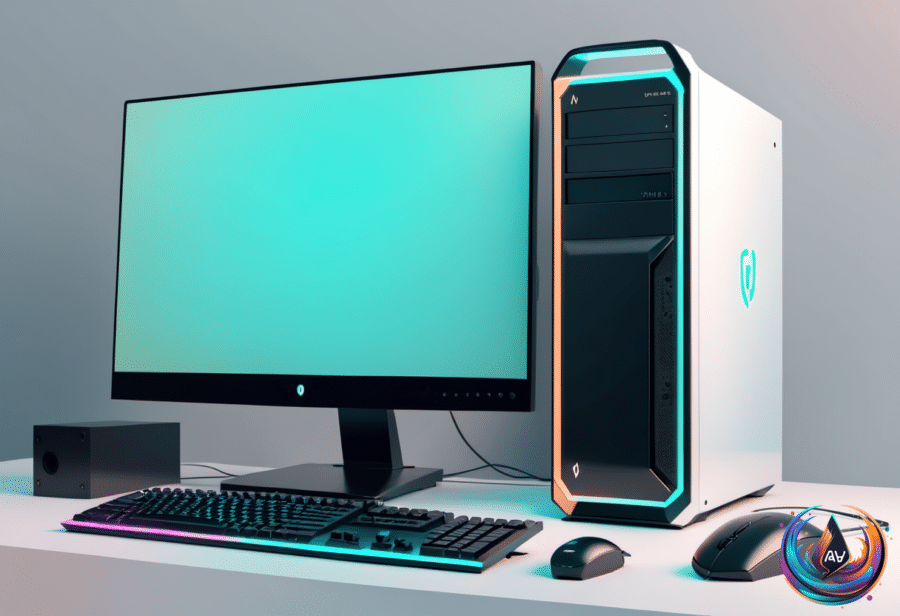
Local AI is getting a permanent address. NVIDIA announced on November 18, 2026, that RTX Spark compact desktops from ASUS, Dell and MSI are available for purchase, bringing local agents, image and video generation, and model fine-tuning to dedicated Windows PCs.
The systems pair a 20-core NVIDIA Grace CPU with a Blackwell RTX GPU containing 6,144 CUDA cores. NVIDIA rates the platform at up to 1 petaflop of AI performance using FP4 precision, with up to 128GB of unified memory and ten-gigabit Ethernet for moving large datasets, model files and creative assets between the desktop and networked storage.
That hardware targets workloads that normally push users toward cloud services. NVIDIA says RTX Spark can run language models with up to 120 billion parameters and a 1-million-token context, render 3D scenes of 90GB or more in real time, and smoothly edit 4:2:2 video.
A desktop that keeps working
The main argument for RTX Spark is persistence. An always-on desktop can keep agents and scheduled tasks running while a laptop travels or handles other work, turning local AI from an occasional experiment into background infrastructure.
For supported tasks processed locally, code and files stay on the PC, and those tasks avoid per-token cloud API charges. That matters for routine work, where sending every small request to a remote service is a remarkably expensive way to automate a checklist.
NVIDIA Switchyard, now available in Hermes, routes agent tasks between local and cloud models. Routine work can run on-device, while advanced reasoning remains available through cloud models when the local system is not the right tool.
Development support includes native CUDA and Linux tools through Windows Subsystem for Linux. Users can configure agents through Hermes Agent or NVIDIA NemoClaw blueprints, while Unsloth provides fine-tuning for supported models.
Creative workflows move onto the same machine
NVIDIA is also positioning RTX Spark as a production tool for creative work rather than a compact box reserved for developers. A Hermes Agent workflow can link Photoshop and ComfyUI, allowing natural-language instructions to turn sketches into rendered images or animations.
The described animation process can run entirely on-device: isolate the subject, define its motion, and generate the finished video. ComfyUI already includes RTX Video Frame Generation and RTX Video HDR, and NVIDIA says a generated clip can be expanded to 60 frames per second and converted to high dynamic range for color grading within one RTX Spark workflow.
Blender 5.3 integrates DLSS 4.5 Ray Reconstruction into the Cycles viewport for interactive ray-traced previews of lighting and reflection. The point is not another benchmark number; it is a machine that can remain available for heavy creative work without tying the user to a cloud queue.
NVIDIA identifies the ASUS ProArt GR1X and MSI EdgeMesa N AI+ Series among the new desktops. They join RTX Spark laptops already on sale, while mini PCs from Acer, GIGABYTE and HP, along with Microsoft’s Surface RTX Spark Dev Box, are listed as coming soon.
ASUS is extending the same local-versus-cloud idea through its Agent Computer initiative, which lets users deploy AI locally, in the cloud or through hybrid models. The company says its AI-ready hardware and software target gamers, creators, developers and enterprise organizations, with control over performance, data privacy and operating costs.
The RTX Spark N1X specifications list Windows 11 support, up to 128GB of LPDDR5X memory and a 140W thermal design power rating. Those numbers describe a compact desktop with serious limits on heat and power, but the platform’s purpose is clear: keep capable AI agents close, available and working—even when the laptop is not.
Based on
- NVIDIA Expands RTX Spark to Compact Desktops for Always-On Local AI — unite.ai
- ASUS Expands Access to Local AI Across DIY PCs, Gaming Systems, Creator Workstations, and Professional Desktops | Markets Insider — markets.businessinsider.com
- NVIDIA Expands Vera CPU Platform to Accelerate Scientific Discovery | Markets Insider — markets.businessinsider.com
- What Does An NPU Do And Why Do So Many Laptops Have Them? — engadget.com