Torus is taking a new route to the AI infrastructure crunch: bring the computing system to available power instead of waiting years for a new campus. On November 11, 2026, the company announced $500 million in growth capital alongside the launch of Foundry, a prefabricated modular infrastructure product built for AI inference.
Magnetar led the financing, with ICONIQ, Origin Ventures, Ridgeline Partners and Trinity Capital also participating. Torus will use the capital to expand its Salt Lake City manufacturing operation and deploy power and compute systems across the United States.
Foundry Puts AI Compute Where Power Already Exists
Foundry integrates power, storage, cooling, networking and compute into one prefabricated unit. Its design starts with unused electrical capacity between substations and existing commercial or industrial buildings, creating a different path from the conventional hyperscale campus.
Each system sits behind the meter, on the customer’s side of the utility connection, and uses available transformer headroom instead of requiring new grid infrastructure. That makes usable capacity on the existing connection the central design constraint for every deployment. Torus argues that prefabrication combined with existing grid connections can compress a schedule that can stretch to years for a conventional hyperscale campus.
Torus founder and CEO Nate Walkingshaw summed up the strategy: “Most providers are bringing power to the chips. Foundry brings the chips to power.”
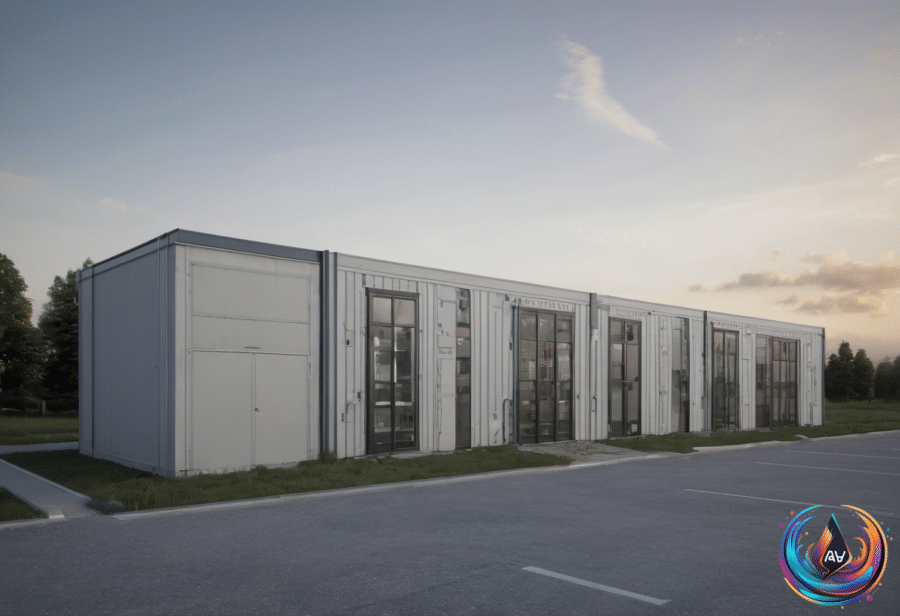
Foundry can supply 1–20 megawatts of inference capacity per site, and Torus says a deployment can move from contract to running AI workloads in 12–16 weeks. The smallest system is roughly the size of a small cargo van, and it requires no building construction.
Site preparation takes about one week, followed by one to two days for installation and commissioning. That footprint and schedule give Foundry a clear role in a market where AI systems demand more power, cooling and specialized infrastructure than traditional data center workloads.
Storage Helps Stretch Every Interconnection
Every Foundry is paired with Torus Reserve, the company’s energy-storage and management product. Battery and inertial flywheel storage operate through predefined dispatch controls that shape demand, cover peaks, support ramping and provide backup power during grid outages.
Torus says this approach allows more compute to operate on the same interconnection. Instead of treating storage as a separate add-on, Foundry uses it as part of the operating system for a power-constrained AI deployment.
The company also provides ongoing operations and maintenance. Torus Protect adds integrated networking and security, giving customers another part of the infrastructure stack through the same system.
Foundry is launching with Hydra Host and another AI cloud provider that Torus did not name. Customers can choose among three deployment models based on how much of the stack they want to take.
- Strategic provides a powered enclosure without GPUs.
- Partner provides a turnkey bare-metal unit with GPUs.
- Direct supplies sovereign inference capacity through single-tenant hardware allocated exclusively to an enterprise’s workloads.
A Factory Built for the AI Infrastructure Race
Torus reports that thousands of GPUs are already deployed in Foundry units, with a target of more than 47,000 by the end of 2027. The scale-up will come from GigaOne, Torus’s 545,000-square-foot Salt Lake City facility, where nearly 400 employees work and key components are built in-house.
The Foundry production line is already online. Torus says it will be capable of producing 500 megawatts of IT capacity, giving the company a manufacturing base for deployments across the United States rather than a model centered on a single large campus.
The timing reflects a basic challenge facing AI infrastructure. AI data center campuses require up to 10 times the total facility power capacity of traditional data centers, while GPU server racks consume 12 to 28 times more power per rack. Thermal density also requires advanced liquid cooling to handle five times the heat generation.
Those demands are driving an unprecedented need for power, and the grid connection can become the bottleneck before the compute hardware even arrives. Foundry’s approach focuses on that constraint directly: find usable capacity, package the infrastructure around it and put inference hardware on the customer’s side of the utility connection.
Torus’s $500 million financing now gives the company room to expand both sides of that plan. The Salt Lake City operation can build more units, while deployments across the United States can test how far modular systems can push AI inference without waiting for new grid infrastructure and building construction.
The next stage will show whether Foundry’s combination of prefabrication, storage, cooling and compute can turn stranded electrical capacity into working AI infrastructure at scale. With thousands of GPUs already deployed and a target above 47,000 by the end of 2027, Torus is betting that the future of inference will be built wherever power is ready to use.
Based on
- Torus Raises $500M Growth Capital to Expand Modular AI Infrastructure — unite.ai
- The Industrial Revolution Of Intelligence: AI Energy Infrastructure — forbes.com
- Sparxity Closes Series A, Bringing Total Funding to $90M | AFP.com — afp.com
- US data center construction to remain strong in 2027 | Semafor — semafor.com
- AIB Advances CLT1 Delivery With Funded Prepayment and Executed Equipment Orders | Markets Insider — markets.businessinsider.com