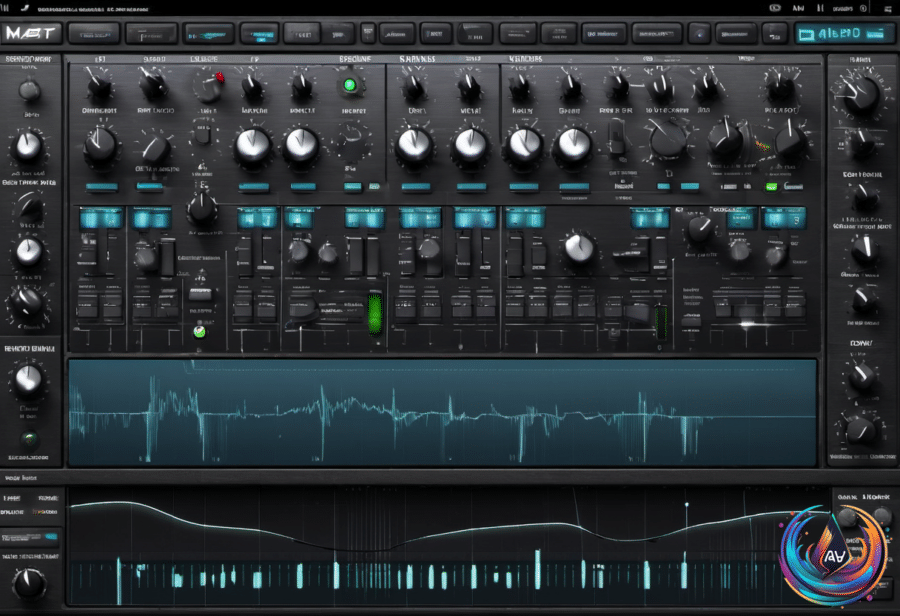
Music software is entering its prompt-driven era. Vibe coding lets people generate code by giving common-language instructions to an AI chatbot, and the practice is becoming common enough to reshape how musicians customize their gear. The result is a flood of plugins, firmware, instruments, and effects that once required expensive teams of specialists.
Plugins let producers add new instruments and effects to a digital audio workstation, but building them has historically been costly and technically difficult. A plugin must often work across operating systems and DAWs, while its creator juggles programming languages, audio engineering, and user-interface development. For musicians who could not code, the alternatives were paying a software team or spending a large amount of time learning advanced development.
That made launching a plugin impractical for most music enthusiasts, no matter how good the idea was. Systems such as SynthEdit and FlowStone gave non-coders visual programming tools for building and sharing synthesizers and other modules, but vibe coding lowers the time barrier in a different way.
Custom Plugins Move From Specialist Work to Open Experiment
Evan Mezeske, a former software engineer at Google, used vibe coding to build Anukari, a synthesizer based on a “fully interactive 3D physics simulation.” He described the process as “a huge thousand-line design essay and then a thousand iterations on that where I gave it feedback and provided direction.” That is less a magic trick than an exhausting new kind of collaboration with software.
Anukari produces sounds ranging from “alien communion” to “spiderweb gong chill time,” which is either a compelling demonstration of creative freedom or a warning about what happens when nobody is guarding the naming committee. The important shift is that one creator could attempt a tool built around complex physical modeling without first assembling a traditional development team.
Musicians, programmers, and companies are now flooding the plugin space with new firmware for grooveboxes, synthesizers, and samplers. Paid and open-source options are appearing on platforms such as GitHub at unprecedented rates, with some predictions placing the plugin market at double its current size by 2033.
Lunacy Audio used AI programs to help its audio engineers build Nova, which the company describes as “like Google Docs for audio.” Nova lets users download “unconventionally beautiful instruments from GRAMMY-winning composers and producers.” Vald Labs’ Tresse, another AI-assisted soft synth, is also attracting positive reviews. Claude subscriptions have entered the discussion around AI plugins, because apparently even the instruments now come with software overhead.
Akai is embracing the modding community with the MPC 3.10.1 and MPC Sample 1.4 firmware updates, which support the new SDKs the company is offering. Anyone can now make custom plugins for the MPC, vibe-coded or otherwise, and the source material describes hacking the devices as trivial.
The Same Technology Is Adding Commentary Nobody Requested
AI is also changing how people consume music, though the results are less harmonious. YouTube Music’s Beyond the Beat is an AI-generated DJ that explains songs and randomly interrupts for about 30 seconds between tracks. YouTube launched the experimental feature in 2025 through YouTube Labs.
Spotify introduced a similar AI DJ in 2023, then expanded the feature in November with more personalities and controls over its commentary. Spotify’s version chooses songs from past listening habits and song requests, calling the result an algorithmically guided experience. The company says it has “80 percent of listeners coming back to DJ week after week.”
Both features are optional and avoidable, which is fortunate for listeners who prefer music without an algorithm explaining its “structural interpretation” every few minutes. Beyond the Beat has already produced commentary that wanders through “nuances of queer dating,” along with a long explanation of a Slayyyter-related track and a bizarre passage about Charli XXC’s supposed touring injuries.
These tools show the split in AI music products. Vibe coding gives creators more control over the tools they use, while AI DJs insert another layer between listeners and the songs they selected. One expands the workshop. The other talks during the record.
Live 13 Adds Long-Requested Production Tools
Ableton has announced Live 13, expected in early 2027, with a proper step sequencer for the desktop app. Earlier versions did not include one, and Live 13 lets producers change velocity, timing, chance, length, and repeats for each step. Each track can also have its own length, playback rate, and direction.
The update adds ARA plugin support, allowing compatible tools to work directly on audio inside the DAW. Melodyne previously required users to import audio from Ableton, process it, and render it back into a track; now it can clean up messy vocal takes inside Live’s interface.
A new mixer view shows loaded devices in a compact vertical layout, with drag-and-drop movement between tracks and copy-and-paste support. That should make a sprawling 30-track session easier to navigate at a glance, which is the sort of feature users appreciate after spending an hour searching for one compressor.
Live 13 also includes Looplet, an experimental looping instrument with four playheads, granular processing, filtering, and pitch and speed controls. Each playhead can route to an individual track, making Looplet suited to ambient and soundtrack work.
A new drum synth offers more than 20 models across nine categories, covering classic drum machines and experimental abstract percussion. Capture now records automation alongside MIDI notes, contextual browsing lets users swap instruments and presets from the device view, and new tools include multiband racks, a transient shaper, envelope clips on return tracks, and racks with up to 32 macros and custom mapping curves. Push 3 gains custom layouts that can combine mixers, note grids, step sequencers, and more.
Beyond Music, the Internet Is Filling With Machine Activity
The dead internet theory holds that most online activity comes from bots and other non-human agents. It emerged as a conspiracy theory on internet forums in the late 2010s and gained a more concrete framework through Agora Road’s 2021 post, “Dead Internet Theory: Most of the Internet Is Fake,” which argued that “the Internet feels empty and devoid of people.”
Followers claimed the internet “died” around 2016, when search engines and social feeds began surfacing more AI-generated content. The theory now has data points that make it harder to dismiss as pure forum mythology: Thales found that bots accounted for 53 percent of all web traffic in 2026, up from 51 percent the year before.
Pew Research found that 33 percent of Americans had used chatbots such as ChatGPT, Gemini, or Copilot in 2024. By 2026, that figure had reached 49 percent, while 25 percent said they used chatbots every day. In March, Meta acquired Moltbook, a social network where AI chatbots communicate with one another and often discuss humans.
OpenAI reported in September 2026 that it had found a solution to the Navier-Stokes problem, while it also began watermarking AI-generated content after the EU AI Act passed. Pangram received $9 million in backing in July 2026 for its AI detection system, and 40 percent of Americans told Pew Research they expect AI to harm society over the next 20 years.
Bots can spread disinformation that causes real harm, and AI chatbots are becoming a source of election disinformation. Government agencies have warned about deepfakes and other AI-powered threats to free elections, but little legislative action addresses the wider problem.
Music software offers the optimistic version of this future: more people building tools tailored to their own work. AI DJs, bot traffic, and synthetic conversation offer the other version—an internet packed with activity that still feels strangely empty.
Based on
- Vibe coding is changing how musicians customize their gear — engadget.com
- Now anyone can make custom plugins for the MPC, vibe-coded or otherwise. | The Verge — theverge.com
- AI DJs Completely Kill My Groove | WIRED — wired.com
- What Is The ‘Dead Internet Theory’ And Should Humanity Be Worried? — engadget.com
- Ableton Live 13 announced with a step sequencer, new drum synth, and more | The Verge — theverge.com