









Lightelligence’s 400% debut is a bet that AI’s next bottleneck is the optical interconnect
 22
22When a company with US$15.5 million in annual revenue debuts on a stock exchange and its market capitalisation briefly hits US$10 billion, the obvious question is: what do investors know that the financials don’t show yet?
In Lightelligence’s case, the answer is optical interconnect and the growing conviction that conventional copper wiring between AI chips is about to become a serious constraint.
Lightelligence, the first mainland Chinese photonics chipmaker to go public in Hong Kong, saw its share price surge by nearly 400% in its trading debut on Tuesday.
The Shanghai-based company opened at HK$880, against an offer price of HK$183.2–the top of its marketed range–having raised HK$2.4 billion (approximately US$310 million) in its IPO. The retail tranche alone was oversubscribed nearly 5,785 times.
What optical interconnect actually does
To understand why investors are this enthusiastic, it helps to understand the problem Lightelligence is trying to solve. Modern AI models, the kind that power large language models and image generators, require massive clusters of chips working in parallel. The faster those chips can transfer data between them, the more efficiently the system runs.
Traditionally, that data travels through copper electrical connections. But as AI clusters grow larger and more power-hungry, copper wiring creates bottlenecks: it generates heat, consumes significant energy, and has limits on how much data it can carry over short distances.
Optical interconnect replaces those electrical signals with light.
Compared with traditional electrical interconnects, optical approaches offer lower latency, higher bandwidth, and improved energy efficiency. Think of it as upgrading from a single-lane road to a motorway–more traffic, faster, with less friction.
Lightelligence’s business spans two segments: optical interconnect, which uses optical signals to connect computing devices within a single server or across multiple servers in a cluster, and optical computing, which involves processing data using photons rather than electrons.
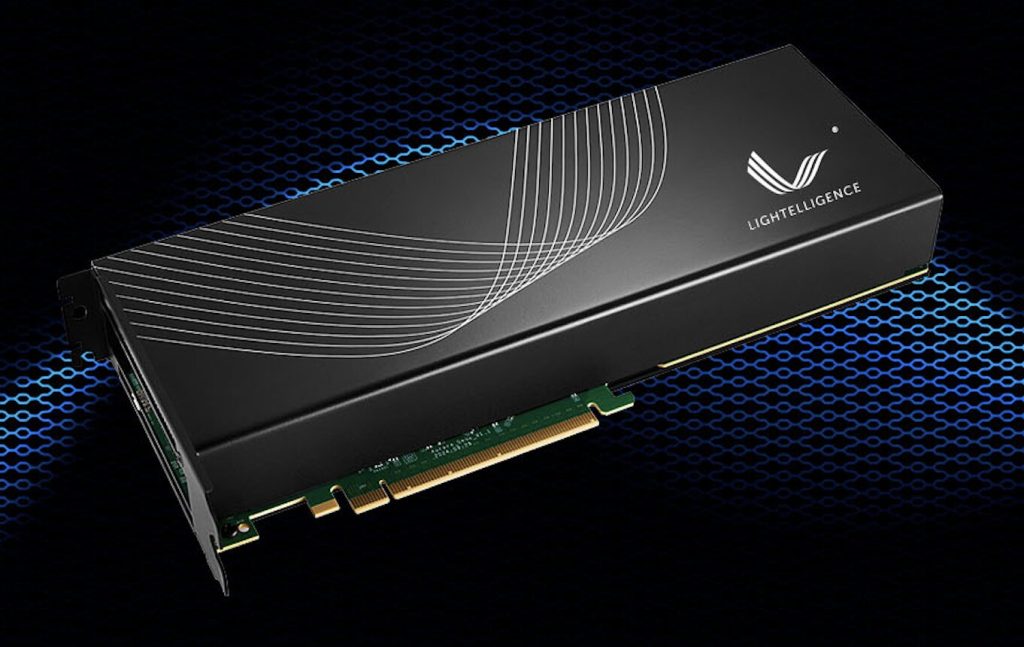
Its flagship optical interconnect product, LightSphere X, is described as the first distributed optical circuit-switching solution for GPU supernode interconnects, with the company reporting that it can increase model FLOPS utilisation by more than 50%, reducing the total cost of ownership for computing workloads.
The market position
According to Frost & Sullivan, Lightelligence is the first company to achieve commercial-scale deployment of optoelectronic hybrid computing, a distinction that matters in a field still largely populated by research labs and pre-revenue startups. As of March 2026, the company held 410 patents, with more than half applicable across both its optical interconnect and optical computing segments.
In China’s scale-up optical interconnect market, the segment connecting chips within a single high-performance computing node, Lightelligence ranked first among independent providers by revenue in 2025, with a market share of 88.3%. The caveat worth noting: Huawei dominates the overall market at 98.4% share, with Lightelligence as the largest third-party supplier.
By the end of 2025, the company had 44 commercial customers, supporting GPU clusters with several thousand cards. Its cornerstone investor list for the IPO included Alibaba, GIC, Temasek, BlackRock, Fidelity International, Schroders, Hillhouse Capital, Lenovo, and ZTE.
What the financials actually say
This is where the picture gets more complicated. Lightelligence reported revenue of RMB 38 million (approximately US$5.6 million) in 2023, RMB 60 million (US$8.8 million) in 2024, and RMB 106 million (US$15.5 million) in 2025–a compound annual growth rate of 66.9%. Revenue is growing fast. The losses are growing faster.
Net losses widened to RMB 1.34 billion in 2025, and the company’s asset-liability ratio stands at 473%, meaning its liabilities far exceed its assets. A single customer accounts for 40.6% of revenue, which is a concentration risk that any enterprise buyer or investor needs to sit with.
The founder’s background is part of what commands the premium.
Yichen Shen published a cover paper in Nature Photonics in 2017 proposing and validating the feasibility of using light in deep learning computation, widely regarded as a milestone in optoelectronic hybrid computing. The company he built from that research now has a public market to fund the next phase.
The global AI computing and interconnect market is forecast by Frost & Sullivan to grow at a 27% compound annual rate by 2031. Whether Lightelligence can scale its revenue to match that trajectory, and close the gap between its losses and its ambitions, is the question investors are essentially paying a US$10 billion premium to answer.
Today’s debut gives that bet its first public price.
(Photo by Lightelligence)
See also:Inside Huawei’s plan to make thousands of AI chips think like one computer
Want to learn more about AI and big data from industry leaders? Check out AI & Big Data Expo taking place in Amsterdam, California, and London. This comprehensive event is part of TechEx and co-located with other leading technology events. Click here for more information.
AI News is powered by TechForge Media. Explore other upcoming enterprise technology events and webinars here.
The post Lightelligence’s 400% debut is a bet that AI’s next bottleneck is the optical interconnect appeared first on AI News.
Origianl Creator: Dashveenjit Kaur
Original Link: https://www.artificialintelligence-news.com/news/lightelligence-ipo-optical-interconnect-ai-infrastructure/
Originally Posted: Tue, 28 Apr 2026 10:00:00 +0000














What do you think?
It is nice to know your opinion. Leave a comment.