









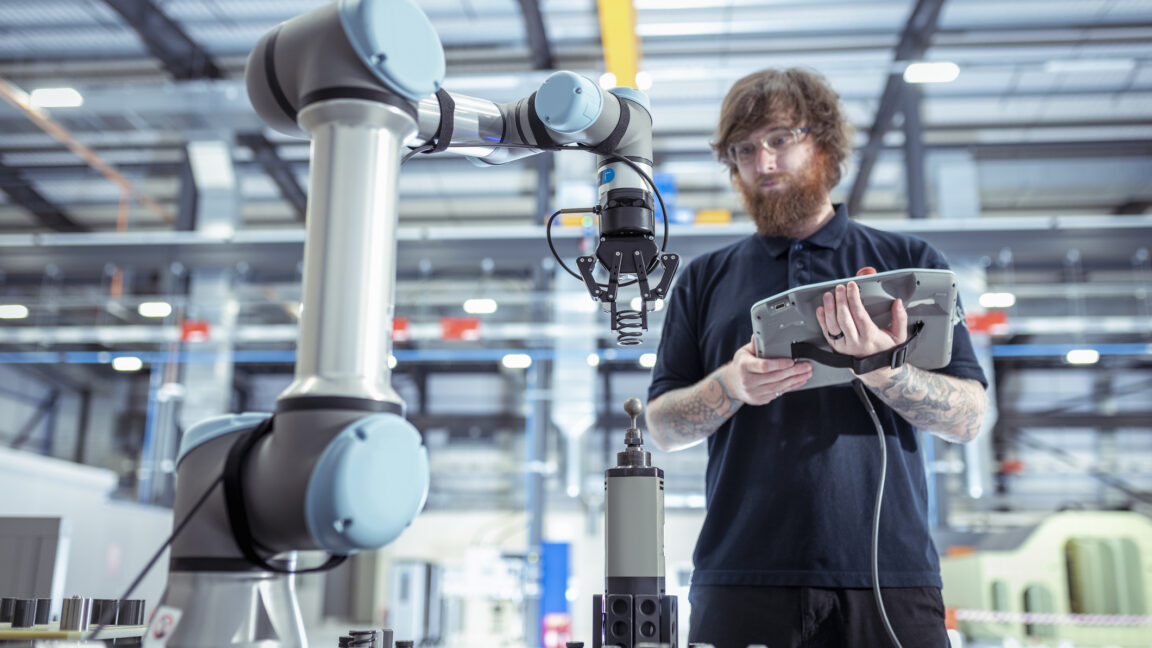
New robotic control software avoids jamming their joints
 21
21Switching from one smartphone to another is mostly a smooth procedure. You log into your accounts and your apps, preferences, and contacts should sync to the new hardware. But in the world of robotics, swapping an old robotic arm for a newer model has meant setting everything up from scratch.
To fix that, a team of researchers at the Swiss École Polytechnique Fédérale de Lausanne (EPFL) has developed what they call Kinematic Intelligence, a framework that makes switching robots work more like switching smartphones. They describe their system in a recent Science Robotics paper.
Demonstrating skills
For years, roboticists have been working on getting robots to learn from demonstration—teaching them new skills by showing them what to do, rather than writing lines of code. The idea is to remotely control or physically guide the robot’s arm to teach it a task like wiping a table, stacking boxes, or welding a car component. The problem is that most of these taught skills end up tied to the specific robot the training was done with.
Origianl Creator:
Jacek Krywko
Original Link: https://arstechnica.com/science/2026/04/kinematic-intelligence-helps-robots-learn-their-limits/
Originally Posted: Sun, 26 Apr 2026 11:09:29 +0000














What do you think?
It is nice to know your opinion. Leave a comment.