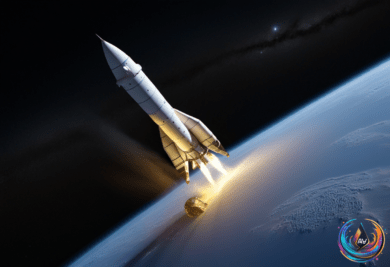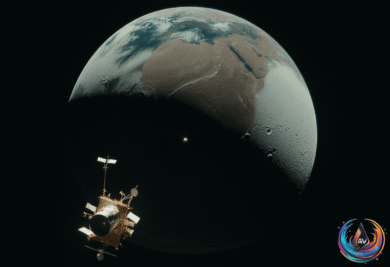
There’s a new race in space, but it’s not about going farther. It’s about flying satellites closer to Earth than ever before.
A UK startup called NewOrbit is stepping into a zone long avoided by commercial satellites. This zone, called Very Low Earth Orbit (VLEO), sits around 200 to 300 kilometers above Earth’s surface. It’s between where airplanes fly and where most satellites orbit, which starts at about 500 kilometers.
For decades, VLEO was considered too harsh for satellites. The air is thin but still thick enough to create drag. This drag pulls satellites down quickly. Satellites there would also face atomic oxygen, a highly corrosive element that eats away at materials and damages sensors. Plus, forces in that space make it hard for satellites to keep their orientation steady. Because of these challenges, no commercial satellite has stayed in VLEO long enough to operate.
NewOrbit, based in Reading, UK, just raised $18.5 million in funding to change that. Their plan is to build satellites that can handle the tough environment and stay operational for years. They designed their first satellite, called NEO-1, with special propulsion systems that continuously boost it to keep altitude. They also engineered materials to resist atomic oxygen corrosion.
The benefits of operating in VLEO are clear. Being closer to Earth means satellites can capture sharper images—think drone-level detail. Communication speeds improve, too, allowing fast data streaming and even direct 5G connections to phones. NewOrbit claims this approach can cut satellite costs by 20 times compared to conventional orbits.
The startup’s production facility is set to open in 2027, with the first commercial launch planned for 2028. Their goal is to scale quickly, eventually producing several satellites per week. Their team includes experts from SpaceX, NASA, Airbus, and Formula 1, showing how seriously they take this challenge.
Building Space Mobility Infrastructure
While NewOrbit focuses on satellites closer to Earth, another company is solving a different problem: moving satellites once they reach orbit. Impulse Space, based in California, just raised $500 million to build in-space mobility vehicles. These “space tugs” help satellites change orbits, dock, or reach farther destinations.
Impulse’s founder, Tom Mueller, helped develop SpaceX’s engines. He now leads efforts to give spacecraft more freedom to move after launch. Their vehicles like Mira and Helios can perform complex maneuvers, deliver payloads quickly, and support missions beyond low Earth orbit. This capability is crucial as space becomes more crowded and satellites need to adjust positions often.
The company’s new funding will expand manufacturing and hiring. Impulse has flown multiple missions showing their tech works. They also have strong contracts with commercial companies and government agencies, including the U.S. Space Force.
Europe’s Quantum Computing Push
On a different frontier, Europe’s quantum computing scene is heating up. French company Quobly raised €115 million to develop silicon-based quantum computers. Their approach uses established semiconductor techniques to build scalable, reliable quantum chips. This could make quantum computing more practical and easier to integrate into existing data centers.
Quobly plans to release its first product, Alloy Pioneer, by the end of 2026. It will be available through the cloud for research and high-performance computing users. Their goal is to move quantum computing from labs into real-world industrial use.
Investors see this as a strategic move to keep Europe competitive in a field dominated by the U.S. and China. The company’s partnerships with major semiconductor firms support their path to mass production.
Together, these stories show how space and computing technologies are evolving fast. NewOrbit is pushing the limits of how close satellites can fly to Earth. Impulse Space is unlocking new ways for satellites to navigate in orbit. Quobly is advancing quantum computing with a focus on industrial scale.
All these moves could reshape industries and open new possibilities in observation, communication, and computing. The space economy is expanding in directions few expected just a few years ago.
Based on
- A UK startup just raised $18.5 million to fly satellites where nobody else can — thenextweb.com
- NewOrbit Raises $18.5M in Series A Funding — finsmes.com
- Quobly raises EUR €115 million in Series A funding — itbrief.co.uk
- Impulse Space Raises $500 Million Series D To Build In-Space Mobility Infrastructure For The Space Economy — pulse2.com
- Impulse Space Raises $500 Million In Series D To Build Critical In-Space Mobility Infrastructure | New Space Economy — newspaceeconomy.ca