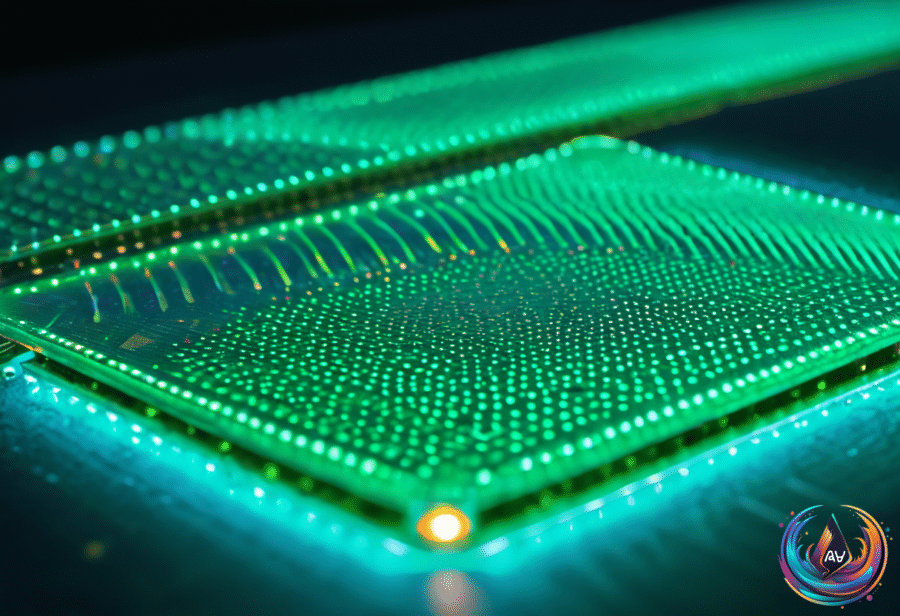
SIMMTECH is putting fresh capital behind the hardware that powers the next wave of AI systems. On November 26, 2026, its board approved two KRW 150 billion private perpetual bond issues, directing the entire KRW 300 billion toward SOCAMM module substrates and high-layer MSAP substrates.
The move gives SIMMTECH a new funding stream for production capacity at a moment when AI hardware demand is pushing advanced components into the spotlight. The filings designate every won as facility funds from December 2026 through December 2027, with no allocation to working capital or debt repayment.
Two Bond Issues, One AI Capacity Push
The approvals came through convertible-bond and bond-with-warrants decisions filed through South Korea’s DART corporate-disclosure system. Series 11 consists of unsecured private perpetual convertible bonds, while Series 12 comprises unsecured, non-detachable private perpetual bonds with warrants.
Subscriptions took place on the approval date, and cash payment is scheduled for December 4, 2026. Both series carry an initial 3% coupon and maturity yield, with maturity set for December 4, 2056.
The structure gives SIMMTECH long-term financing while tying both securities to the company’s AI substrate expansion. The filings make the use of funds clear: facility spending for AI-oriented SOCAMM module substrates and high-layer MSAP substrates, not general corporate needs.
SIMMTECH’s earlier investment plan shows the scale of the broader buildout. On August 25, 2026, the company approved KRW 274.2 billion for a dedicated AI-oriented SOCAMM module-substrate factory and additional high-layer MSAP substrate capacity through December 31, 2027.
That decision cited increasing demand for both product categories and identified internal resources or external financing, excluding a rights offering, as funding sources. The two new bond issues now add a defined financing package to that capacity plan.
Long-Dated Securities With Rising Costs
The bonds offer SIMMTECH flexibility, but they also carry terms that change over time. The Series 11 capital-securities terms and corresponding Series 12 terms allow SIMMTECH to defer interest at its discretion, with unpaid amounts accumulating additional interest.
The company can extend maturity under the same issuance conditions, and holders have no right to demand early redemption. From December 4, 2029, the coupon and maturity yield increase by four percentage points.
After that increase, the coupon and maturity yield rise by one percentage point each year, with those increases capped at 19%. SIMMTECH may redeem either series quarterly beginning on December 4, 2029, creating a future path to manage the securities if business conditions and cash resources support redemption.
The securities also include an equity component. Full conversion of Series 11 or full warrant exercise for Series 12 would produce 1,409,906 common shares at KRW 106,390 per share. For either series, that result equals 3.54% of SIMMTECH’s existing shares.
Conversion and exercise rights open on December 4, 2027, and run through November 4, 2056. The long window gives holders a route into SIMMTECH’s equity while the company builds out the facilities funded by the bond proceeds.
Strong Results Meet a Wider Hardware Surge
SIMMTECH’s financing decision follows preliminary third-quarter 2026 results that showed a strong operating jump. Consolidated revenue reached KRW 535.9 billion, up 43.7% from a year earlier, while operating profit climbed to KRW 101.8 billion, up 721.6%.
That performance gives the substrate expansion a powerful backdrop. At the same time, other semiconductor and display developments are widening the market for advanced packaging and AI-connected hardware.
Seoul Semiconductor Co., Ltd. (KOSDAQ: 046890) announced that its WICOP Pixel technology, developed by Seoul Viosys (KOSDAQ: 092190), has entered full-scale mass production and begun expanding supply to global TV manufacturers. The package-free technology arranges RGB chips at an ultra-fine pitch of several tens of micrometers (µm), rendering tens of thousands of colors.
WICOP Pixel replaces conventional white-light LCD backlights and covers 100% of the DCI-P3 color gamut. It reaches peak brightness of up to 3,000 nits, more than three times the brightness of OLED displays, and offers more than twice the lifespan of OLED.
The technology uses a standard LCD panel while reproducing natural colors and scenes more faithfully than OLED, with stronger immersion in bright settings such as living rooms and public spaces. Seoul Semiconductor’s display-related revenue rose nearly 20% year over year in the third quarter.
Rather than make large new investments, the company plans to convert existing white-backlight light-source capacity to WICOP Pixel production to meet global market needs. It also plans to expand revenue and profit through a global patent licensing program, then invest royalty income in research and development for biotechnology, 3D printing, augmented reality and AI data communications.
Market research firm Omdia expects global RGB TV shipments to reach about 7 million units by 2030, led by the large-screen premium segment. That volume would represent more than 10% of global TV market revenue, while the current white-backlight market of about USD 3 billion is expected to more than double as RGB adoption and Advanced Packaging expand.
Across these moves, one direction stands out: specialized components are becoming the center of the technology race. SIMMTECH is scaling substrate capacity for AI systems, while display companies are redesigning backlights around finer packaging and higher performance. The facilities funded from December 2026 through December 2027 will show how far that hardware momentum can carry the next stage of growth.
Based on
- SIMMTECH Approves Two KRW 150B Perpetual Bonds for AI Substrate Expansion — unite.ai
- Samsung to boost AI data center NAND production in China, China Daily says — markets.businessinsider.com
- Huawei Teases Next-Gen AI Memory Chip to Take On Samsung, Hynix – Bloomberg — bloomberg.com
- Seoul Semiconductor Enables Beyond-OLED Picture Quality with LCD | AFP.com — afp.com