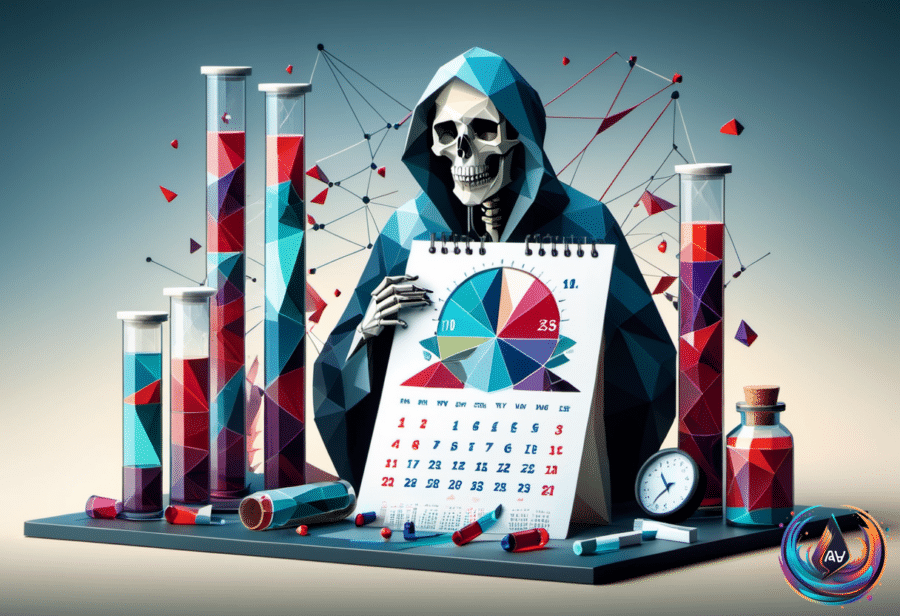
Death Clock put death on the calendar. The AI-powered longevity app told the author they were scheduled to die on August 10, 2060, at age 74, then invited them to hand over blood in pursuit of extra time.
The prediction arrived with theatrical polish. In September, the author saw a smiling grim reaper celebrating the expiration date, followed by the same figure flashing a peace sign while reclining in a doughnut-shaped pool inflatable beneath the giant number 74. Mortality has entered its novelty-gift era.
The author has never resented getting older, but the last four years made the limits of time harder to ignore. Their grandmother and aunt died within 18 months of each other, and since turning 40 in January, daily pains have rotated between their back, neck, and hips; spiritually, they feel young, while their body insists on filing a different report.
A prediction built from habits and blood
Death Clock launched in 2024 to track health habits and help users prolong their lives. The company says its AI trained on 1,200 longevity studies, actuarial data from life insurance companies, and life expectancy tables, then uses medical habits and lifestyle information to predict life expectancy.
After the author completed an initial health questionnaire, a notification forewarned their demise. The app identified three likely causes: cardiovascular disease, a sleep disorder, or cancer, without specifying which type, and said the author had already “completed” more than half of their existence on this mortal plane.
A few days later, the author mentioned a mild family history of diabetes. Death Clock revised the predicted age of death from 74 to 73, leaving the author with the blunt conclusion: they had lost a year.
The author already knew 100 was unlikely, since people in their family die in their early eighties. The question was whether a hyperpersonalized plan could add 10 or even 15 years, which prompted the app to deliver its sales pitch: “You have two paths,” followed by, “We are here to help you achieve the longer one.”
In February, Death Clock announced a feature for ordering biomarker panels. A $69 subscription provides a basic blood panel measuring cholesterol, blood sugars, inflammation, vitamin D, and blood and organ health; nine additional tests cover areas from hormones and micronutrients to the thyroid, costing $780 altogether.
The author chose the routine panel and added the $29 “stress” test, then booked an appointment with Quest Diagnostics, one of the two labs partnered with the company. They willingly gave Death Clock their blood, allowing the app to build the detailed prevention plan it says will extend the time left.
The business of negotiating with mortality
Death Clock sits inside a multitrillion-dollar longevity industry, surrounded by products promising to reshape the relationship between people and their bodies. The author’s inbox fills with pitches for anti-aging fads, including salmon sperm scalp injections and a platelet-rich plasma treatment “Hailey Bieber swears by.”
Threats such as climate change and AI doomerism have intensified existential fears, while large language models promise a new era of personalized medicine for any health issue. That combination makes a countdown app feel less like a novelty and more like a small interface for a much larger anxiety.
Death Clock CEO Brent Franson rejects the fantasy of defeating biology. On the idea of cheating the natural order of time, he says, “That’s a fool errand,” and warns that advocates such as Bryan Johnson—whose “Don’t Die” mantra reads like a rejected Nike slogan—“have to be really careful about inferring immortality when you have something to sell.”
“That’s a dangerous place to be,” Franson says. “The reality is we’re all going to die. It’s a question of when.” The commercial question remains more complicated: how much will people pay to turn uncertainty into a dashboard, a lab order, and a prevention plan?
The longevity market is projected to reach $8 trillion by 2030, and health care may shift from traditional treatment toward personalized AI health services. Doctronic is a HIPAA-compliant platform that works like a personal AI doctor and lets people refill prescriptions without seeing a human physician.
Other services are building the same promise through memberships and clinician-reviewed recommendations. Superpower and Lifeforce offer health insights in that model, while Twin Health purports to create an AI replica of a person’s metabolism.
These services do not remove death from the equation. They package the fear of it, measure it, and offer a longer path for a price. All of it is meant to help us
Based on