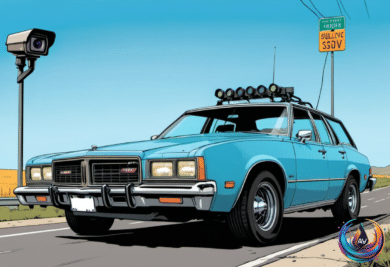
Flock Safety is facing protests, contract cancellations and growing questions about police access to its camera network. The company’s CEO, Garrett Langley, has responded with a striking claim: the backlash against Flock is not real.
That argument is colliding with events in communities that are challenging the technology in public. Residents in Norfolk, Virginia, held a “DeFlock” rally outside Norfolk City Hall on October 13, 2026, calling on the city to end its use of Flock automatic license plate reader cameras.
What Flock cameras collect
Flock Safety, an Atlanta-based company started in 2017, makes AI-driven cameras that scan license plates and record details about passing vehicles. The system captures a vehicle’s location, time, model and bumper stickers, then stores and analyzes that information across a network of roadside cameras.
Flock says its technology helps police connect “vehicle sightings across jurisdictions to uncover patterns, strengthen investigations, and securely collaborate with trusted partners.” That promise has helped the cameras spread across the United States, but it has also fueled bipartisan, citizen-led campaigns against the technology as a 2026 midterm campaign issue.
The debate centers on a basic question: how much movement data should police collect, and who gets to search it? Noah*, a 27-year-old software engineer and coordinator with DeFlock Cherokee, said, “I truly think that this is the most observed that Americans have ever been in political history. And I think that Flock is a massive step into these surveillance states that we have the ability to decide whether or not we are okay with.”
Flock’s critics point to cases where the system was used for personal searches rather than legitimate investigations. In Cherokee County, a county with a population of around 260,000, officials arrested and fired deputy Jerry Shellhouse in August for allegedly misusing Flock license plate readers. The 57-year-old deputy had searched one tag at least 840 times between October 2023 and December 2025.
Authorities had already arrested and fired three other deputies for abusing Flock before an investigative team found Shellhouse’s searches. The county then updated its policy to require multiple audits each year and limit access to authorized users.
In Dallas, a 911 emergency response director was arrested and fired after searching more than 2,500 times for cars belonging to her estranged husband and his new girlfriend. A September report found that at least 100 police department employees across the United States had been charged with or accused of misusing license plate readers for unauthorized purposes.
Former officers have also kept access after leaving their jobs. When Andrae Wright left the Effingham County Sheriff’s Office in 2021, he returned his gun and badge but kept his Flock login credentials, giving him access to a police tool that tracked passing cars across a vast camera network. Police kept access to the system long after they left the force, and some used it to track romantic partners.
Protests, politics and a disputed explanation
Langley made his comments during a private police conference on Sunday at the International Association of Chiefs of Police conference in Orlando, Florida. The event runs from Saturday to Tuesday, and speakers attend alongside more than 16,000 public safety officials.
In leaked audio, Langley said anti-Flock protests around the country were not real, even though many protests have ended with communities canceling contracts and bagging up the cameras. He claimed social media criticism came mostly from paid activity and Russian bots, saying, “Somebody was paying for [the social media posts and] stopped paying for it.”
Langley also said, “Social media chatter on Flock is down about 95 percent from July.” He connected a 50 percent overnight drop to the moment Ukraine bombed a Russian data center with a drone, saying, “It went down 50 percent last week when Ukraine bombed a Russian data center with a drone” and “Literally 50 percent overnight.”
That explanation repeats a disproven theory about Ukraine’s strikes and internet bot activity. Langley added, “It’s anonymous bots, and so it is not real,” then argued that “Inorganic activity has led to organic activity” but protests showed “the same people with the same signs and the same message.” He concluded, “That’s not normal. That’s not organic at all.”
His comments echo another unsubstantiated theory that opposition to Flock comes from a far-left network spreading propaganda at the direction of China. Langley also said his wife told him, “This is crazy, these people are getting paid to say these things,” and said he would prefer never to do interviews with the press again. He said his wife advised him never to apologize.
Langley has also falsely described Flock’s role in tracking a woman who had self-administered an abortion and called coverage of that incident “entirely false.” That dispute has added abortion surveillance to a debate already focused on privacy, police access and the lack of clear limits on data collection.
Local officials face pressure to set the rules
Roseville residents gathered at the Maidu Center for a public forum organized by DeFlock Roseville after the city denied the group’s request for a dedicated town hall. Organizers said residents deserved a greater voice in decisions about privacy and surveillance.
The city said its cameras are not aimed at playgrounds, parks or other public gathering spaces. Instead, they capture vehicle traffic and the rear of passing vehicles. Roseville Mayor Krista Bernasconi defended the program, saying the city has used license plate readers for eight years without any instances of misuse and that the cameras have helped bring justice to victims of serious crimes that might have gone unsolved.
The Roseville Police Department acknowledged the group’s right to hold the forum. Rosanna Harmon of DeFlock Roseville said, “The people deserve a say in this entire system,” while another attendee said, “We have the power to change the narrative.” Harmon added, “As a group, we’re going to move forward. We’re not going to be stopping anytime soon.”
Political leaders are also being pushed to take a position. Keisha Lance Bottoms said she was “not opposed to a moratorium on Flock cameras,” arguing that “the technology has gotten ahead of the policy.” Republican rival Rick Johnson said he “would not put a moratorium” because “I don’t want crime to go up,” and added, “I’m telling you, there’s 15 people at Georgia Tech that can solve this in one week.”
Flock insists it takes misuse allegations seriously and updates its guardrails. But the company changed its systems last year to make officer misuse harder for the public to uncover. Flock public relations manager Paris Lewbel said the company is “committed to setting a baseline for where safeguards and transparency for our industry should be” and welcomes local conversations and regulations.
For residents in Norfolk, Roseville and other communities, the issue is not whether online criticism is organic. It is whether a private company and police departments should control a system that records where people drive, how long that information remains available and who can search it.
Based on
- It’s not the bots, Flock — 404media.co
- ‘Get the Flock out’: Americans respond to AI cameras in bipartisan backlash – France 24 — france24.com
- Benn Jordan’s long-running investigation of Flock culminates in a ‘review’ of the surveillance state. | The Verge — theverge.com
- Roseville residents raise privacy concerns over Flock license plate reader cameras at public forum – CBS Sacramento — cbsnews.com
- Cops left the force. They kept tracking people with a powerful camera network. – The Washington Post — washingtonpost.com