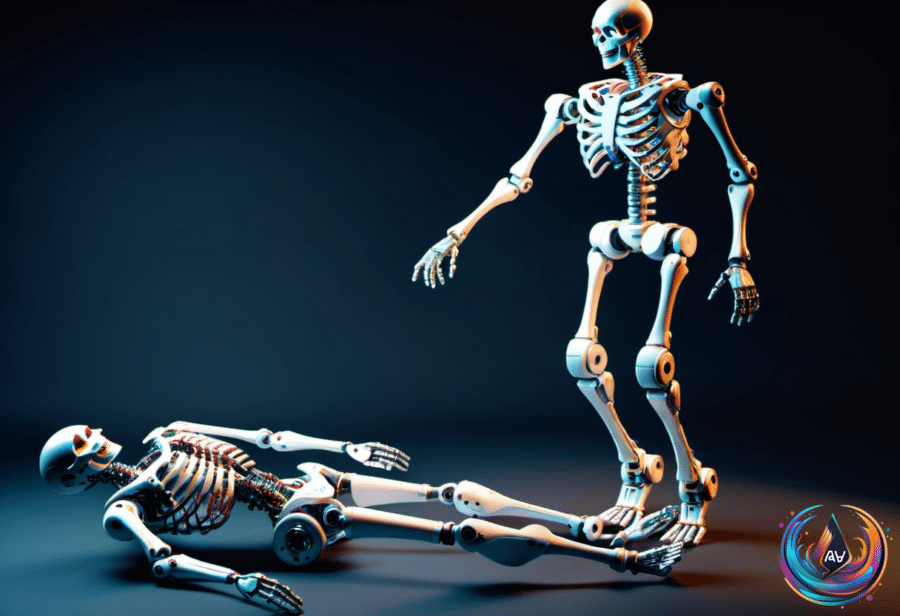
Teaching a humanoid robot to move like a person sounds simple until the robot’s body proportions, joints, and range of motion enter the picture. A human walk cannot be copied frame by frame onto every machine. The motion has to be reshaped for the robot that will perform it.
NVIDIA SOMA Retargeter is an open source tool built for that job. It adapts human motion data to specific humanoid robots through the shared SOMA skeleton representation, turning a human animation into robot targets that match the machine’s structure.
From Human Motion to Robot Trajectory
The process begins with human movement stored as a Biovision Hierarchy, or BVH, animation on the SOMA base skeleton. That movement can come from a motion-capture session, an online dataset, a video, or a generative model. The retargeter then scales the motion targets to the robot, solves inverse kinematics for each frame, and applies post-processing corrections such as foot-plant adjustment.
The inverse-kinematics step uses Newton, a solver built on NVIDIA Warp. This lets the system calculate joint positions that satisfy the configured movement objectives while respecting the robot’s proportions and joint structure. The result is not a human skeleton stretched onto a machine; it is a robot-specific movement trajectory.
That distinction matters because the same action can look different across humanoid embodiments. A robot’s joint angles and foot placement change with its proportions and range of motion, even when the intended action stays the same.
Developers can refine those results with the Robot Configurator and the IK weight optimizer. The configurator helps align reference poses and map skeletons, while the optimizer tunes the priorities assigned to inverse-kinematics objectives. Those settings help produce smoother robot motion during retargeting.
Motion Sources and the SOMA Ecosystem
SOMA Retargeter does not depend on a single way to collect movement. BONES-SEED provides human motion-capture data, while GEM-X reconstructs whole-body 3D human motion from a single video using the SOMA body model. Its demo workflow connects video reconstruction with Unitree G1 retargeting, showing how a recorded action can become a robot motion reference.
Generative models add another route. Kimodo supports motion sequences created from text and pose constraints, while ARDY adds interactive steering as the motion unfolds. Both offer models that generate movement on the SOMA skeleton, giving developers another way to create source animation before adapting it to a robot.
The SOMA Retargeter v0.2 release includes sample motions supplied by Bones from the BONES-SEED dataset. It also includes reference retargeting results and configurations for five humanoid robots: Unitree G1, Unitree H2, Booster T1, AgiBot X2 Ultra, and AgiBot A3T3.
Those reference examples make the differences between robot embodiments easier to inspect. A motion that works for one robot may need changes in joint angles, foot placement, or inverse-kinematics priorities for another. Having configurations and retargeted examples for five machines gives developers a starting point for comparing those changes.
Walking Through a Unitree G1 Example
For the supplied example, developers use the Unitree G1 configuration to retarget a forward walk from the sample motions. After installing SOMA Retargeter, they open a terminal in the repository root and start the viewer with this command:
uv run python app/bvh_to_csv_converter.py –config assets/default_bvh_to_csv_converter_config.json –viewer gl.
The BVH to CSV Converter opens with unitree_g1 selected by default. In Scene Options, the user expands Motion, selects Load on the BVH Motion row, and opens the bundled file. The SOMA human animation then appears in the viewer.
Next, under Scene Options → Motion, the user selects Retarget on the BVH Motion row. The retargeter scales the source targets to G1, solves the configured inverse-kinematics objectives for each frame, and applies the configured post-processing. The viewer displays the resulting robot animation, making it possible to examine how the walk transfers to the G1 body.
Why Exported Motion Matters
SOMA Retargeter outputs a CSV file containing the robot’s root position, orientation, and joint angles for each frame. These trajectories describe the desired movement for a downstream learning or control system, so the result can move beyond a visual demonstration.
Across many clips, the animations can form a motion library for reference preparation and policy training. Retargeted trajectories export as CSV files and can convert into motion-library formats for workflows such as SONIC and ProtoMotions.
That creates a connection between recorded, reconstructed, generated, and learned movement. A motion-capture clip, a single video, or a generated sequence can enter through the SOMA skeleton, pass through robot-specific retargeting, and leave as structured data for downstream policy training.
The practical value is a shared path from human motion to different humanoid platforms. Instead of rebuilding the entire motion pipeline for each robot, developers can use the same representation, adjust the robot configuration, tune inverse-kinematics priorities, and inspect the resulting trajectory before sending it into a learning or control workflow.
Based on
- Adapt Human Motion for Robots with NVIDIA SOMA Retargeter — developer.nvidia.com
- Are We Ready for Robots That Code Their Own Skills? — spectrum.ieee.org
- Training the robots that may take their jobs — dw.com
- Noitom Robotics Releases HiPHI-Hand, Precision Hand Capture Data Used to Train NVIDIA EgoHand, and Demonstrates Real-Time Hand Reconstruction at CoRL 2026 | Markets Insider — markets.businessinsider.com
- Humanoid robots are getting more lifelike — cnbc.com