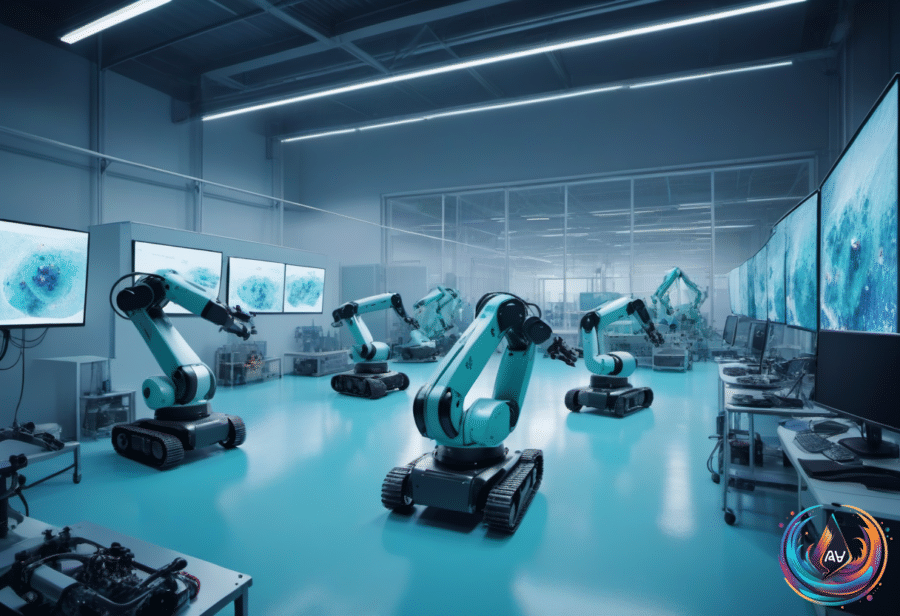
Industrial AI is leaving the pilot phase. LTM, an IT services and consulting company, has launched its BlueVerse Industrial AI Lab in Chennai to test robotics, digital twins, and AI systems before they enter working environments.
The facility targets factories with legacy equipment and limited connectivity—conditions that tend to ruin neat technology demonstrations. Clients, technology partners, and LTM teams can develop, simulate, and validate solutions at the lab before deployment, giving industrial projects a place to confront real engineering constraints.
The lab combines industrial AI solutions, intellectual property, and patents with manufacturing-focused small language models. Its capabilities include multispectral computer vision, edge devices, digital twins, and industrial AI agents, covering the software and hardware layers needed to connect intelligence with physical operations.
A dedicated robotics zone supports autonomous mobile robots, collaborative robots, and drones. Safety remains a key consideration when AI-powered machines operate alongside workers, because “move fast and break things” is a poor manufacturing policy.
“As industrial businesses look to shorten time to market, increase operational availability, improve worker safety and strengthen regulatory compliance, Industrial AI offers powerful levers to achieve these goals,” said Gururaj Deshpande, Chief Delivery Officer at LTM.
One platform for enterprise and industrial AI
LTM also announced BlueVerse™ ValueMesh™, an AI execution fabric designed to help enterprises scale AI across Oracle transformations. LTM developed and validated the platform through its Cloud Services expertise, building it on the company’s Oracle capabilities and BlueVerse™ portfolio.
ValueMesh™ combines AI-native delivery, intelligent automation, AI agents, managed services, intelligent business processes, industry solutions, data, and governance. Its stated goal is to industrialize AI across an enterprise’s Oracle transformation journey—not just add another isolated model to an already crowded technology stack.
The platform has three AI layers. Enterprise AI applies intelligence across Oracle transformation, software engineering, testing, application management, and cloud operations; Business AI embeds intelligent agents into finance, supply chain, human resources, and customer experience; Industrial AI extends intelligence into assets, field operations, and industry-specific workflows.
ValueMesh™ is powered by LTM’s portfolio of AI agents, delivery accelerators, industry solutions, and data management capabilities. Its 4S framework—Sense, Shape, Stand Up, and Sustain—organizes the path from identifying opportunities through operating and maintaining AI capabilities.
The Chennai lab also supports engineering and testing for consumer electronics and medical technology devices. That work covers embedded software, on-device AI, interoperability, reliability, performance, safety, and regulatory requirements, giving the facility a remit beyond factory automation.
Physical AI has adoption momentum but little finish
The need for this kind of testing is reflected in findings from Hitachi, Ltd.’s report, Beyond the Pilot: Industry’s Physical AI Progression. Hitachi surveyed over 200 global decision-makers in mission-critical industrial sectors, finding that 97% use physical AI in industrial use-cases in some capacity today.
Yet only 8% say their operational deployments have reached the continuous optimization and innovation stage. The industry has learned how to start projects; scaling them into durable operational systems remains the more expensive exam.
That gap carries pressure. Eighty-seven percent of respondents associate delaying physical AI adoption with material risk, while more than two-thirds view physical AI as very or extremely important to company goals. Leadership support is present among 75% of respondents, but only 38% believe they are adequately resourced for AI adoption.
Limited AI expertise ranks as a barrier for 43% of respondents, followed by system integration challenges at 31%. AI and machine learning represent the largest internal talent gap for 49%, showing that executive enthusiasm still has to pass through staffing, integration, and operational budgets.
Frontline adoption remains thin. Only 16% report significant AI use by frontline workers and maintenance teams, and nearly half indicate limited AI support for those workers. Most AI solutions in production focus on inspection and predictive maintenance, while investment is shifting toward behavioral analysis, smart CNC machines, and computer vision for safety.
“While many organizations have made meaningful progress with physical AI, scaling those capabilities across complex operational environments remains the next challenge. And one that must be solved to realize physical AI’s true benefits. Our research gives organizations a clearer understanding of where they comparatively sit today and where they can focus to achieve greater operational performance, resilience and long-term value,” said Rio Kurokawa, Chief Lumada Business Officer at Hitachi.
LTM’s lab addresses that scaling problem at the practical level: equipment, connectivity, worker safety, device performance, and validation before deployment. The promise is not another polished pilot—it is a place to discover whether industrial AI survives contact with the factory floor.
Based on