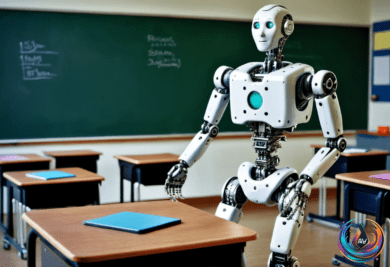
Napster is taking a new role in education. The company has signed a strategic partnership with Gems Education in Dubai to develop AI agents and digital personas for teaching, marking a major shift from its earlier identity as a music-streaming service.
The partnership will begin with proof-of-concept projects at the Gems School of Research and Innovation. Those projects will explore digitalised instructors, gamified learning, AI-assisted content creation, and classroom simulations, giving the two organizations several ways to test how AI can support teachers and students.
Digital twins designed to support learning
One of the central ideas is the creation of digital twins for teachers. These systems will be trained on a teacher’s material, courses, and papers, allowing students to interact with a digital version of that instructor outside class.
Students will be able to ask questions, refine concepts, and learn at their own pace through those digital twins. The tools are designed to extend access to a teacher’s knowledge beyond classroom hours, while keeping the teacher’s own work at the center of the experience.
The system will also give teachers insights into the questions students are asking and the areas where they may need additional support. That creates a feedback loop between classroom learning and the digital tools, with student questions helping teachers understand where more explanation may be needed.
Napster’s education work will also include AI-assisted content creation and classroom simulations. Gamified learning is part of the same first phase, placing several different uses of AI under one partnership rather than focusing on a single classroom tool.
A new direction for Napster
Samuel Huber, CEO of Napster Middle East and Africa, described the education project as part of a broader idea about user control. “The name has always been about giving power to the users,” Huber said.
Napster’s connection to music changed when the company shut down its music-streaming service in January 2026. Infinite Reality purchased Napster for $207 million in 2025, and the company had already acquired Landvault, a UK-based technology company, in 2024.
Huber connects the company’s past with its work in AI. “Twenty-five years ago, it was about music and how music should be owned by people, not the gatekeepers. And now this is the same fight, the same ethos, but it’s about data and intelligence,” he said.
That focus also shapes Napster’s position on AI platforms. “The AI model companies have a lot of power; they’re building incredible models, and we want Napster to be an alternative to that,” Huber said.
Napster plans to use voice and video to make interactions with AI feel more natural, according to Huber. “We’re creating a better experience using voice, using video, to create a better way to interact with AI to make it more natural, so AI becomes more like coworkers rather than a machine or tool that you prompt, and we apply this technology in different verticals.”
Privacy and the role of teachers
Data handling sits at the center of the education plan. Napster does not use user data to train its AI models, and much of the data will remain within the country. If required, the data can also be hosted on a company’s own servers.
Those arrangements are part of the project’s structure as Napster and Gems Education develop the first phase at the Gems School of Research and Innovation. The partnership combines digital teacher twins with controls over where education data is stored and how it is used.
Microsoft has also committed to sweeping AI privacy rules for students, adding another major technology company to the conversation around student data and AI in education. The announcement comes as schools and education organizations explore tools that can answer questions, create content, and support classroom work.
Huber says educators and students need to learn how to use AI properly. “I think it’s absolutely critical for educators, for professors, and for students to learn how to use AI in the right way,” he said.
His view is that AI should add to human work instead of removing the people who do it. “You’re right, there are two paths. We could let AI replace us. But if you’re using it in a smart way, you’re bringing insights, and then you use AI to augment yourself, just like you use word processors to type faster; then AI becomes a tool that augments you, not replaces you.”
Huber also described the limits of current AI systems. “We’re not at the point yet where AI can fully replace humans, and therefore we want to leverage that technology overlaid on top of humans to get the most of it.”
That principle gives the Dubai partnership its clearest purpose: digital twins can answer questions and support practice, while teachers remain central to the learning process. Napster’s return to the spotlight is no longer about distributing music. It is now testing how AI agents and digital personas can work alongside educators.
Based on