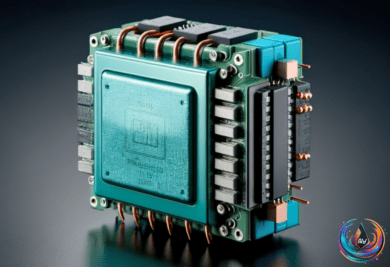
AI hardware is moving toward a split approach: use different processors for different parts of the job instead of asking one chip to handle everything. Two new developments show how that idea is taking shape, with Lumai preparing an optical-computing test at rack scale in the UK and SambaNova working with Supermicro on systems that combine RDU chips with NVIDIA GPUs.
Lumai’s Iris inference servers are set to become the first optical-compute platform deployed by the Scaling Inference Lab, which is backed by the UK’s Advanced Research and Invention Agency, or ARIA. CommonAI CIC runs the lab, which will give researchers a commercial data-center environment for testing the architecture across multiple nodes.
Lumai Brings Optical Computing to Rack-Scale Testing
The planned deployment gives Lumai a new evaluation setting for its AI hardware. The company, an Oxford University spin-out founded in 2021, develops a hybrid architecture that combines optical and digital processing. Its optical engine targets the dense mathematical operations at the heart of AI inference, while electronic components handle the rest of the system.
Lumai’s technical description centers on light. Information is encoded into beams of light and processed through optical components in three-dimensional space, allowing many mathematical operations to run in parallel through light propagation instead of switching transistors for every calculation.
That does not make the Iris server passive or power-free. The complete system still requires light sources, data conversion, memory, digital processing, and control. Lumai describes a wide data interface designed to spread conversion overhead across large workloads, a three-tier memory design for a model’s key-value cache, and hardware-aware quantization.
The company’s approach focuses on the compute-heavy stage of inference rather than trying to optimize the entire pipeline with one processor type. Iris product documentation positions the optical accelerator inside heterogeneous computing systems, including as a prefill processor alongside hardware optimized for decode.
The Scaling Inference Lab evaluation builds on the April launch of Iris Nova. It also marks a move from a product announcement to a multi-node test through a publicly backed testbed. The deployment will test the architecture at rack scale, but it is not a completed, independent benchmark proving Lumai’s headline efficiency claims.
SambaNova and Supermicro Split Inference Across Chips
In a separate announcement, SambaNova said Supermicro is entering a strategic collaboration to develop and sell AI disaggregated inference systems. The initial plan covers 10,000 SN50 RDU chips, with the systems combining Reconfigurable Dataflow Units and GPUs.
Supermicro will work with SambaNova to develop SN50 inference racks that operate alongside NVIDIA GPUs as part of Supermicro’s Data Center Building Block Solutions, or DCBBS. Supermicro will integrate, test, deliver, and support the systems for customers, including on-site service. SambaNova engineers will get models running and tuned on SN50 and help with deployments.
The design assigns different inference tasks to different chips. NVIDIA GPUs read the prompt and run the prefill phase, while SambaNova SN50 chips write the response during the decode phase. That division is intended to improve how systems use their computing capacity when serving large models.
SN50 is SambaNova’s fifth-generation RDU chip, built for high-performance inference. The company says RDUs serve the largest models at high speed and high throughput without requiring extreme rack power density, while working alongside existing NVIDIA GPUs to improve system performance and efficiency.
This setup also addresses a practical limit in AI infrastructure: power and cooling. Operators can add inference capacity without waiting for next-generation data-center build-outs, which face those constraints. SambaNova and Supermicro say their collaboration can deliver substantially more high-performance inference capacity in 2027 than would otherwise be possible.
“Agentic AI is the next wave of inference, and it has to run everywhere,” said Rodrigo Liang, co-founder and CEO of SambaNova. The companies plan to start with NeoClouds and sovereign clouds before expanding to enterprises that operate AI in their own data centers.
Why the UK Is Testing New AI Hardware
Lumai’s evaluation sits inside a broader UK effort to build more domestic AI capability. The government wants to grow the country’s native AI industry and reduce dependence on systems made by foreign companies. In the Budget on October 28, Chancellor John Healey announced £60 million in extra funding for the national Sovereign AI Fund.
The fund launched in April 2026 with a £500 million commitment and operates through the Department for Science, Innovation and Technology. Its purpose is to support promising UK AI companies, making test environments such as the Scaling Inference Lab relevant beyond one hardware project.
The push reflects a wider change in government thinking. The Center for a New American Security recorded one government-backed sovereign AI project in January 2023. By mid-2026, its count had reached 184 projects across 67 countries. IndiaAI Mission had deployed around 38,000 graphics processing units, while three-fifths of the foreign base models identified in the tracked projects came from the US.
Sovereignty does not mean removing every outside dependency. Researchers at Stanford University in California have argued that it is better understood as managing AI dependencies, since even adaptable models still need chips, electricity, and skilled people. Commercial products marketed as “sovereign AI” may also rely on foreign providers.
For the UK, the real test will be whether its Sovereign AI Unit gives the country more freedom to choose and adapt AI technologies as the programme develops. “Sovereign AI” will probably continue to mean different things to different governments, but the label alone says little about how much control a country holds.
Based on
- ARIA Selects Lumai Optical Servers for Rack-Scale AI Inference Testing — unite.ai
- SambaNova SN50 Chips to Power Supermicro’s New Inference Racks, Delivering High-Performance Inference to Data Centers Worldwide | AFP.com — origin-zh9p7m-www.afp.com
- SambaNova SN50 Chips to Power Supermicro’s New Inference Racks, Delivering High-Performance Inference to Data Centers Worldwide | AFP.com — afp.com
- How ‘sovereign AI’ can help the UK cut its dependence on foreign tech | The Independent — independent.co.uk