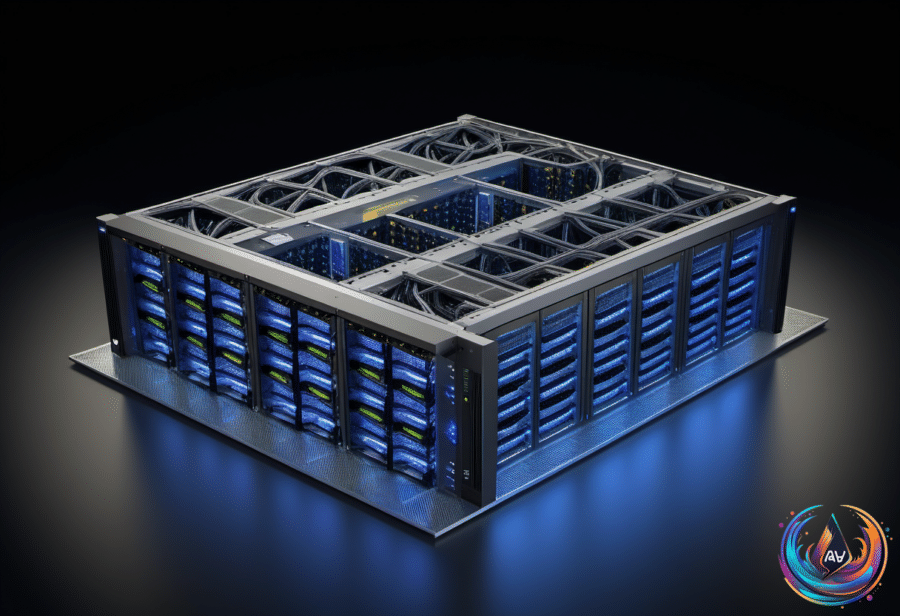
Nvidia is pairing new open models with a reference architecture designed to help enterprises run AI agents with tighter control. The company announced the NVIDIA OpenShell Reference Architecture on Oct. 21, 2026, positioning it as a system for building, containing, observing and enforcing safe agents across enterprise infrastructure and edge systems.
The effort addresses a central challenge in enterprise AI: agents need access to models, tools and computing systems, but organizations also need governance and security around what those agents can do. Nvidia says OpenShell brings those controls into the computing architecture instead of treating them as a separate layer.
OpenShell connects models, processors and security controls
The architecture is built on NVIDIA OpenShell secure runtime software. It brings together NVIDIA Vera Rubin infrastructure for model inference, NVIDIA Vera CPUs for agent harnesses and tool use, and NVIDIA BlueField-4 DPUs running NVIDIA Sentry for in-silicon enforcement.
Nvidia says NVIDIA Vera Rubin NVL72 systems deliver 30x higher throughput per megawatt, while NVIDIA Vera CPUs deliver 2x the performance of x86 processors. NVIDIA Sentry on BlueField-4 can boost agent capacity by up to 20%, giving the architecture separate hardware roles for inference, action and enforcement.
The setup also extends beyond large enterprise systems. OpenShell supports NVIDIA RTX Spark, NVIDIA DGX Spark and NVIDIA DGX Station systems at the edge, giving enterprises a path to run the architecture outside centralized infrastructure. It runs on leading enterprise operating systems, including Canonical, Red Hat, Microsoft Windows and Microsoft Execution Containers.
Jensen Huang, CEO of Nvidia, described the goal in direct terms: “AI capability and safety must advance together.” He said, “As enterprises prepare to deploy billions of AI agents, safety and control must be built into the computing architecture. NVIDIA created OpenShell to give agents the freedom to do useful work within clearly defined boundaries — contained, monitored and under control. With the OpenShell Reference Architecture, agents can think on Rubin, act on Vera and be governed on BlueField.”
Open models target different enterprise workloads
Nvidia launched new open models for agents on Oct. 19, 2026. The lineup includes Nemotron 3.5 Super VL, a 120-billion-parameter model for enterprise agents, along with two smaller Bolt models designed to run locally on AI PCs and workstations.
Bolt 74B-A9B is a 74-billion-parameter model for local agentic tasks, balancing speed with reasoning. Bolt E4B is aimed at conversational agents. Super VL and Bolt 74B-A9B are available now, while Bolt E4B is coming later this month.
Nvidia also claims that the Super VL model can deliver similar accuracy in instruction-following and tool-use tasks as the Nemotron 3 Ultra model, despite having fewer parameters. That gives the company’s model range a clear split: Super VL for larger enterprise agent deployments, Bolt 74B-A9B for local agentic work, and Bolt E4B for conversations.
Kari Briski, Nvidia’s vice president of Open Models and Software, said, “Any organization that wants to run agents on Nvidia infrastructure now has an open, optimized model for their tier without having to choose between capability and deployability.”
A broad partner network surrounds the architecture
Enterprises can run agents from model builders including Anthropic, Cohere, Google, Meta, OpenAI, Perplexity, Reflection and SpaceX Super Intelligence on OpenShell infrastructure. The list gives organizations options across model providers while keeping the runtime and governance layer connected to Nvidia’s systems.
Nvidia is also working with cloud providers AWS and Google Cloud, infrastructure partners Cisco and HPE, and system manufacturer Dell Technologies. The wider group of Nvidia system manufacturers includes Dell Technologies, Cisco, HPE, Lenovo and Supermicro.
Cloud service providers supporting the ecosystem include CoreWeave, Crusoe, Firebird, GMI Cloud, Oracle Cloud Infrastructure and Vultr. Inference and post-training service providers include Baseten, Deepinfra, Fireworks and Together AI.
The architecture also brings in enterprise software and cybersecurity companies. IBM, Meta and Microsoft are enterprise partners, while CrowdStrike and Palo Alto Networks are integrating support for OpenShell. ServiceNow announced ServiceNow Arc integration with Nvidia OpenShell, and SAP is integrating OpenShell with the Joule Studio runtime.
That collection of partners reflects the role Nvidia wants OpenShell to play: not just a model package, but a common operating layer for agents across enterprise systems, cloud services, security tools and edge hardware. The company’s reference architecture puts governance, isolation and enforcement alongside model inference and tool use, giving enterprises one framework for managing how agents operate.
Based on
- Nvidia bets open models can give enterprise AI agents the context they’re missing — thenewstack.io
- NVIDIA Launches OpenShell Reference Architecture for Safe AI Agents | Markets Insider — markets.businessinsider.com
- Nvidia launches new open models to run agents in the enterprise and on PCs | TechCrunch — techcrunch.com