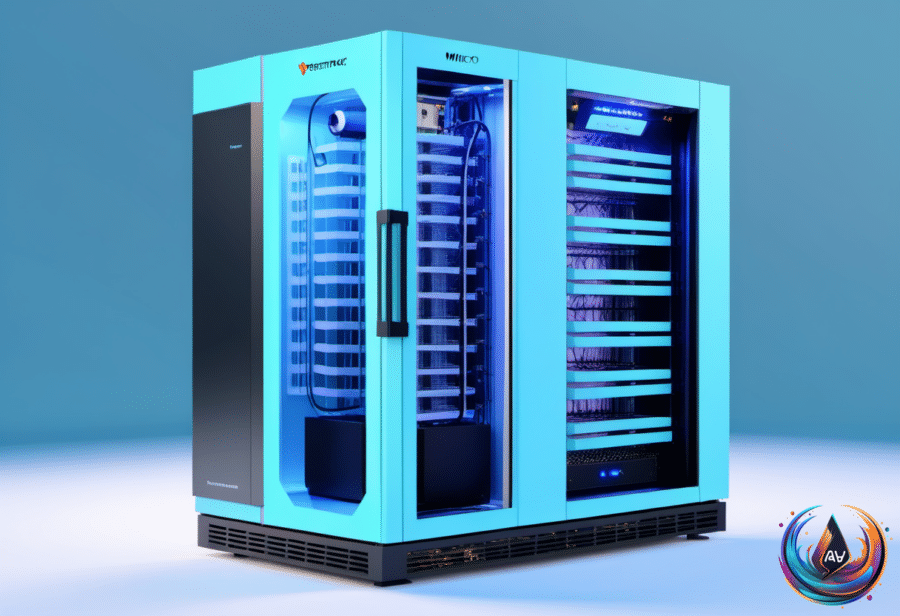
Data center water monitoring is getting a serious upgrade.
Omen AI announced a $16 million cash-and-stock deal to acquire competitor Aquatic Labs, combining two real-time water sensor technologies for monitoring cooling fluids. The goal is simple: help operators understand what is happening inside the liquid before a failing valve, bacteria growth, or clogged system turns into an expensive shutdown.
Omen AI was founded in 2024 to replace a slow process that sends cooling-fluid samples to a laboratory for testing. Results can take several days, which is not an ideal timetable when hot-running chips are depending on that fluid to keep working.
One sensor, a fuller picture
Omen began building a real-time sensor that could determine whether valves were failing or bacteria growth threatened to choke off water flow. Aquatic Labs was pursuing a related problem with a different approach: Omen’s sensors looked for elements in the water, while Aquatic Labs tested its alkalinity.
Combining those technologies should give operators more information from the same sensor. “Much richer picture of the water and the fluid,” Aquatic Labs CEO Allan Adams said.
The deal came together after an investor in the filtration space introduced Omen founder Zach Laberge to Adams. Both startups were building real-time water sensors, and their technology offered a cleaner fit together than another round of corporate optimism usually does.
After raising a $31 million Series A in June, Omen is now adding Aquatic Labs to its team. Adams will serve as chief science officer for the combined company, with the teams working to integrate both technologies into one sensor they expect to bring to market by early next year.
Laberge dropped out of high school to pursue his first company, which performed similar fluid analysis for large construction machines that depend on hydraulics. Adams took a different route, spending much of his career as a physicist developing advanced ocean sensing technology as an MIT professor and Woods Hole Oceanographic Institute researcher before starting Aquatic Labs.
Water savings meet an enormous buildout
U.S. data centers use 17 to 19 billion gallons of water each year to cool their hot-running chips. The Water Foundation expects that number to triple in the next five years, making better monitoring one way to use less water without asking operators to stop building the machines consuming it.
When a fluid system gets out of balance, data center operators often dump the water rather than risk damage to expensive equipment. They may also shut down operations until the system is restored, turning a water-quality problem into an uptime problem with a much larger bill attached.
Monitoring lets operators use the same fluid for longer and minimize cleanup costs. “Water goes into data centers, and then it comes out and gets dumped into municipal water, and you want that whole process to happen in a way that’s as safe and responsible as possible — and that means you got to measure stuff,” Adams said.
Omen’s initial sensors will monitor chips pulling in 250 to 300 MW of power by the end of the year. Laberge described that monitoring opportunity as worth about $5 billion to $7 billion, while Omen hopes to reach the equivalent of 1 GW of chips by the end of 2027.
Adams also wants the combined technology to affect industries outside data centers. For now, though, the data center market offers plenty of room to test whether liquid intelligence can keep pace with silicon ambition.
The broader AI buildout is facing a question that cannot be solved with another keynote: does enough capital exist to finance every spending plan? AI companies once estimated that as much as $4 trillion would be spent on AI infrastructure by 2030, but some investors have grown skeptical, sending hyperscaler stocks plummeting in recent days.
Omen’s team is not worried about that shift because its work begins after a data center has been built. “We’re working customers on stuff they’re building today or have already built, and so it doesn’t really affect us because all of those projects were financed 12 months ago,” Laberge said.
He added: “Our view is, if there’s tightness, this is still going to be the biggest market in human history, even if you sliced it in half.” That confidence is useful, though the financing math around AI has stopped being a background detail.
OpenAI cut the target for its latest funding round to $20 billion from $30 billion after securing about $11 billion in commitments. S&P Global cut Meta’s credit outlook to “negative” from “stable,” citing negative cash flow and uncertainty around capital expenditure plans, while a head of technology, media and telecom lending at a large European bank said the bank was approaching its lending limit to the sector.
A handful of hyperscalers are expected to invest $800 billion this year and more than $1 trillion next year. Gartner estimates data center owners need $8.5 trillion in cumulative revenue by the end of the decade to justify those investments, compared with no more than $3.6 trillion in expected enterprise and consumer AI revenue.
Companies are raising money anyway. Oracle plans to raise $20 billion through stocks and bonds, SpaceX closed $40 billion in debt financing, Meta announced plans to raise $95 billion in equity, and Microsoft raised $25 billion in debt. The federal government also ran a deficit of nearly $2 trillion last fiscal year, putting more pressure on the bond market.
“All those things combined basically means that at the moment we have a shortage of capital, and we have an abundance of good ideas that we need to invest in,” Apollo chief economist Torsten Slok told CNBC.
That tension is visible across the infrastructure stack. Marvell Technology announced a $115 billion acquisition of Lumentum Holdings, whose lasers, circuit switches, and other data center products would help create what Marvell called a “category leader in AI connectivity.” Marvell shares slid more than 1% before the opening bell, while Lumentum fell almost 3% after the all-stock announcement.
Saudi Aramco also acquired a 49% stake in HUMAIN in exchange for AI assets and $2.6 billion, deepening the connection between the company and the Public Investment Fund, which owns the rest of HUMAIN and holds a 16% stake in Aramco. The transferred assets were not disclosed, though Aramco is expected to contribute infrastructure from Aramco Digital, once led by HUMAIN CEO Tareq Amin.
Against that backdrop, Omen’s acquisition is modest in size but practical in purpose. AI infrastructure still needs money, chips, connectivity—and water that does not quietly become a very expensive emergency.
Based on
- Omen AI adds liquid know-how in $16 million Aquatic Labs acquisition — techcrunch.com
- The AI boom is facing another supply crunch. This time it’s the amount of capital available | Fortune — fortune.com
- Marvell Technology to buy Lumentum in $115 billion AI connectivity deal – CBS News — cbsnews.com
- Saudi Arabia turns to Aramco to fuel AI ambitions | Semafor — semafor.com