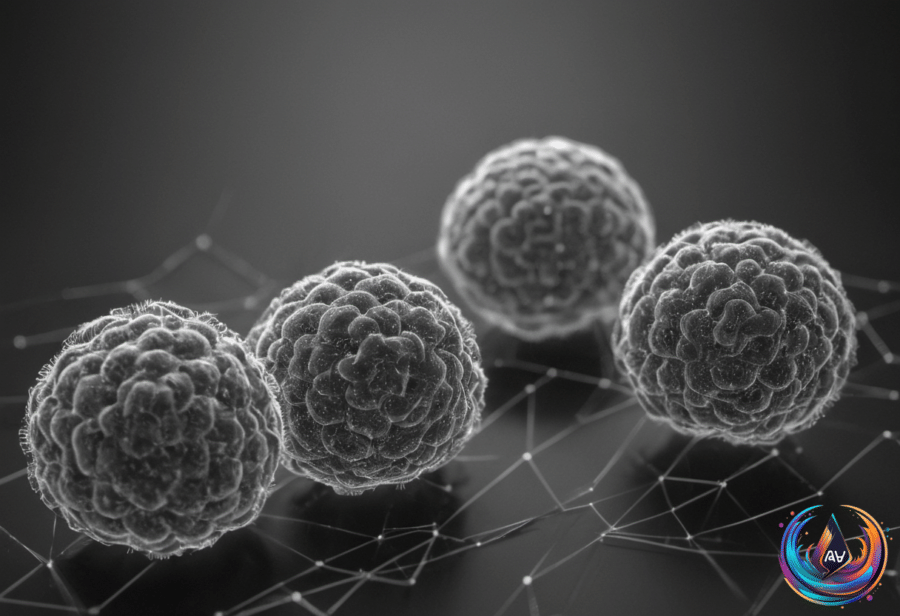
A computer made from living human brain tissue has taken on a task that once belonged only to electronic systems: classifying Braille letters. Human brain organoids, each built from about 10,000 neurons, identified electrical patterns linked to the Braille alphabet, opening a new path for biological neural networks.
A single organoid reached 61 percent accuracy, while a group of three organoids achieved 83 percent accuracy. Those numbers do not show that the tissue understands Braille, but they reveal that living neural networks can process structured information sent through electrical signals.
Three Organoids Outperform One
Researchers transmitted electrical signals corresponding to Braille letters into human brain organoids and measured how accurately the tissue classified them. The single-organoid system identified the letters nearly two thirds of the time, creating a clear signal that the biological network responded to the input in a repeatable way.
The results improved when researchers combined three organoids into an ensemble. That arrangement reached 83 percent accuracy, compared with 61 percent for one organoid, showing how groups of biological networks can produce stronger results than an individual unit.
The work was published on Friday in Frontiers in Artificial Intelligence. Tianyi Liu, a PhD candidate at Bristol University, framed the experiment as an investigation into biological information processing rather than a test of human-like understanding.
“The human brain can perform incredibly complex information processing while consuming relatively little energy, and artificial neural networks were originally inspired by biological nervous systems,” Liu said.
That energy advantage helps explain the excitement around organoid computing. Electronic systems use established components, but biological neural networks offer a different foundation: living neurons that respond to signals and work together as a connected system.
A First Step, Not a Biological Computer Ready for Work
The study used an open-loop experiment. The organoids received initial inputs, but they did not receive feedback from the system after producing their responses. That design allowed researchers to test classification, yet it did not show that the organoids learned Braille or became permanently altered by the experience.
Liu said the goal was not to prove that organoids could read Braille like humans or that they were intelligent enough to understand it. The experiment instead asked whether real biological neural networks could help process information from robotic tactile sensors.
That distinction matters. The organoids classified signal patterns, but the findings do not establish perception, comprehension, or learning in the human sense. The results show a form of biological signal processing, and the next challenge is to connect that processing to an ongoing exchange with the outside world.
“In the future, if we can build closed-loop systems where neural activity from the organoids actually participates in a robot’s perception, decision making, and control, while the results of the robot’s interactions with its environment are fed back to the organoids, we could begin to investigate whether these biological neural networks can adapt to new tasks through ongoing interaction,” Liu said.
Major obstacles remain before that vision can become a working system. Organoids cannot be standardized, so natural differences between samples can complicate results. They also need to stay alive in cultures that are harder to maintain than electronic devices.
Reliability, reproducibility, and scalability pose another barrier. “Compared with established computing chips, organoid systems still have a long way to go in terms of reliability, reproducibility, and scalability,” Liu said.
Human Tissue Also Grows Inside Mouse Brains
A separate line of research adds another striking piece to the picture. Transplantation of human cortical organoids into mouse brains showed that the grafts grew about 4.7-fold between 2 and 3 months after transplantation.
By that point, the grafts accounted for nearly 92% of the combined cortical tissue volume. The finding demonstrates that transplanted human cortical organoids can grow within mouse brain tissue, adding a biological growth dimension to the work on organoids as computing systems.
Together, these studies show two directions for brain organoid research. In one, living neural tissue receives signals and classifies patterns. In the other, human cortical tissue grows inside a mouse brain. Neither result turns organoids into finished computers, but both push researchers toward systems built from living neural networks.
The 83 percent result gives the field a measurable starting point, while the growth findings show that organoids can develop beyond the dish under the conditions tested. The next advances will depend on keeping these systems alive, making their behavior more consistent, and creating closed-loop designs that connect biological activity with perception, decisions, and control.
Based on