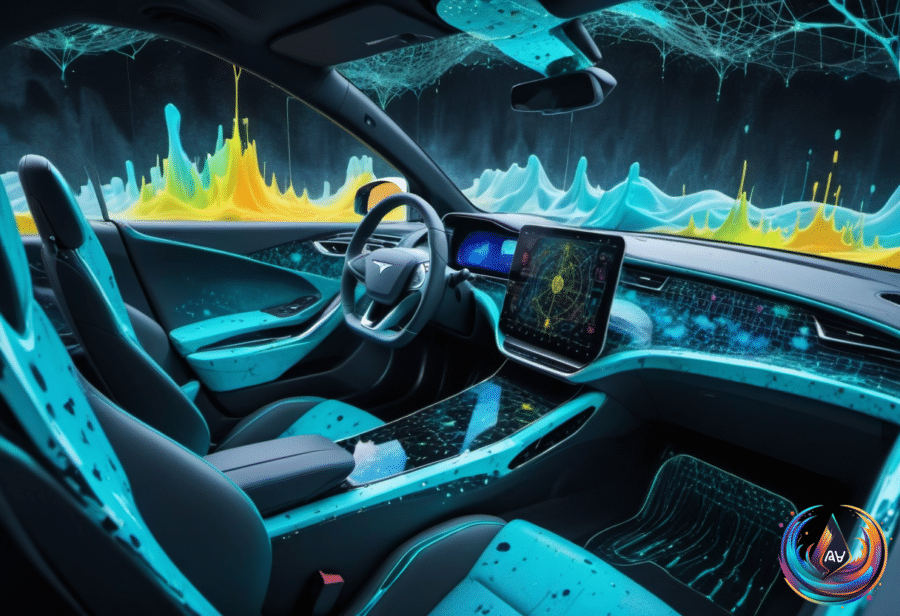
Rivian wants its cars to run other companies’ AI agents. The electric vehicle manufacturer has rolled out an AI assistant that lets drivers and passengers interact with its vehicles by talking to them. Founder and CEO RJ Scaringe said future Rivian cars will support agents made by companies such as Anthropic.
Rivian has not said when that feature will arrive, pointing instead to its “AI & Autonomy Day” event in December. The message is clear enough: Rivian wants the vehicle to become a place where several AI systems can operate, not just a machine running one automaker’s software.
That plan builds on software Rivian developed from the ground up. The company created its own applications, including navigation and integration with Apple Music, then built an in-house agentic framework that understands user commands and routes them to the correct part of the vehicle’s software.
As of May of this year, that agent could reach external apps such as Google Calendar. Scaringe said the next step would be adding products from frontier AI companies, though he acknowledged that integration will be complex. The car cannot simply accept an outside agent and hope for the best; Rivian would need to connect it to context data collected by apps such as Muse.
That context layer is the less glamorous part of the pitch, which is usually where the engineering lives. An outside agent may need access to vehicle software and information gathered by connected applications before it can respond to commands in a useful way. Rivian has not specified the exact design, timeline, or list of supported companies.
Rivian is building beyond the dashboard
The company is pairing its vehicle software work with a push into robotics. RJ Scaringe created Mind Robotics last year, backed by Rivian, to build a full stack for industrial manufacturing. Its robots run on foundation models and are designed to automate tasks at scale.
Mind Robotics has secured more than $1 billion in backing from Accel, Andreessen Horowitz, Eclipse, Kleiner Perkins, and the venture arms of Volkswagen and Salesforce. Rivian is its first customer, using the company as a high-volume manufacturing environment for model training and deployment.
Rivian’s ownership stake in Mind Robotics was diluted to 32.1% as of June 2026. Mind Robotics and Also operate as standalone companies, with Rivian owning about a third of each as of June 30, 2026. That structure gives Rivian a meaningful position without making either venture a simple internal division.
Doug Field brings an unusually crowded résumé
Rivian hired Doug Field as president of Mind Robotics after Scaringe decided the venture needed someone with his background. Field left Ford in April 2026 after five years working on electric vehicle and technology strategies.
Before Ford, Field led Apple’s Project Titan, which Apple canceled in 2024. He served as senior vice president of engineering at Tesla, where he oversaw development of the Model 3, and he was employee No. 1 at Segway. Few résumés collect EVs, robotics, a canceled car project, and Segway in one place. Field’s does.
“Integrating AI and robotics is one of the most important — and difficult — engineering challenges of our time,” Field said. He added, “I’m thrilled to join RJ in building a team, culture, and technology that will redefine what we can make in America.”
Rivian presented the broader strategy at TechCrunch Disrupt 2026, held October 13–15 in San Francisco. Scaringe described the arrival of outside AI agents as the point where “That’s where it becomes magical.” The hard part, naturally, is everything before the magic: connecting agents, vehicle software, external apps, manufacturing systems, and the data each one needs.
Tesla added a feature earlier this year that lets users talk to SpaceX’s Grok chatbot and Grok Bot assistant. Rivian’s approach points toward a more open model, with its own framework handling vehicle commands while outside AI companies provide additional products. The December AI & Autonomy Day event may reveal whether that model has moved from polished promise to working system.
Based on