AI agents are moving from experiments into enterprise software at a speed that will test more than the quality of their data. Gartner predicts that 40% of enterprise applications will include task-specific AI agents by the end of 2026, up from less than 5% in 2025.
That growth raises a practical question: can companies make these systems dependable when several agents must work together? An agent may produce a correct answer on its own, yet the full workflow can still fail when information is handed from one agent to another, shared state changes, or the system cannot decide when to stop.
The rise of specialized agents
Most enterprise work is full of conditional paths, where the right next action depends on current context and previous steps. That makes agents useful for workflows that require more than one response, but it also creates more places where a system can break. An accurate answer is not enough if the next action is wrong.
Gartner predicts that by 2028, 80% of tangible ROI from agentic AI will come from specialized, domain-specific agents. That forecast points toward focused systems built around particular tasks and business rules rather than broad tools expected to handle every kind of work.
Enterprise spending already reflects that interest. Microsoft and Amazon have committed billions to AI initiatives, while Uber and CivicPlu are mentioned as leading firms in AI adoption. McKinsey has shared insights into AI platform support for workflow rules, an area that can decide whether an agent system works in practice.
One company discovered that its AI platform could not support several core workflow rules, leading to delays in launch. The lesson is direct: an AI system needs more than a strong model and useful information. It also needs the structure to carry out the rules that guide the work.
Why handoffs create new failure points
A typical retrieval-augmented generation pipeline can be mapped in a straight line: user query, retriever, retrieved context, generation, and generated answer. Each stage can be evaluated. The retrieved context can be checked, and the generated answer can be measured for quality.
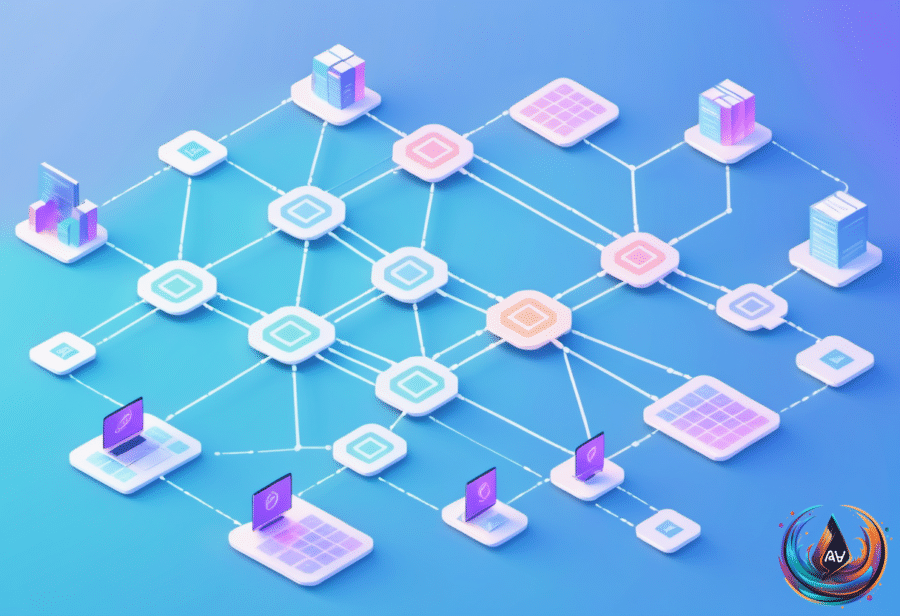
A multi-agent system adds more moving parts: user query, agent A, handoff, agent B, shared state, agent C, verification, and final output. The output of one agent becomes the input or context of another, so a small change in meaning can travel through the rest of the workflow.
As Shuhua Xu put it, “AI agents can be individually correct and still produce a wrong result when they work together.” Information can be lost or misinterpreted during a handoff, shared state can drift, and agents can get stuck in loops or deadlocks.
Shared state acts as the persistent working memory of the entire workflow. It can become stale, contradictory, incomplete, or noisy. A later agent may then rely on information that no longer matches the work already completed, even if the earlier agent performed its own task correctly.
Multi-agent workflows can also enter deadlocks when agents have circular dependencies. Infinite loops, or livelocks, happen when agents continue interacting but never make progress. These failures do not always look like a wrong answer; sometimes the system simply keeps working without reaching a valid result.
Measuring the workflow, not just the answer
Large language models are inherently nondeterministic. The goal is not to make LLMs deterministic, Xu said, but “to make their unpredictable behavior visible, measurable, bounded, and recoverable.” That requires companies to evaluate the path taken by the system, not only the final response.
Workflow progression can be tracked through completion rate, execution time, and average workflow iterations. Coordination needs different measures, including deadlock rate, infinite loop rate, and average agent handoffs. These numbers show whether agents are reaching each other in a useful way or adding extra steps without improving the result.
Termination also needs its own checks. A valid termination rate shows how often a workflow ends correctly, while maximum iterations reached and abandoned workflow rate reveal cases where the system stops because it hits a limit or loses its path.
Context passing can be tested through relevance, recall, and precision. Downstream interpretation requires faithfulness, output relevancy, and response correctness. Interface integrity adds schema validity rate, required field completeness, type validation rate, and handoff success rate.
State evaluation compares the shared state before and after an agent executes. The purpose is to verify information preservation and identify changes that introduce contradictions, omissions, or noise. This gives teams a way to inspect what happened between steps instead of treating the final output as the only evidence.
Adoption will not guarantee business results
The pressure to deploy agents comes with a warning from enterprise AI outcomes. Gary Drenik authored an article noting that 95% of enterprise generative AI pilots generate no bottom-line impact. At the same time, 78% of executives view AI as both software and labor, which places attention on what systems can do inside real workflows.
Those figures help explain why better data alone cannot solve the problem. A system may retrieve relevant information and still pass it through the wrong interface, misread another agent’s output, or fail to terminate. Each handoff creates a point that needs testing.
The central challenge for enterprise agents is therefore coordination. Companies need to know whether workflows complete, whether shared state stays accurate, whether interfaces preserve required fields, and whether failures can be bounded and recovered. As AI agents spread through enterprise applications by the end of 2026, those questions will matter as much as the quality of the model itself.
Based on