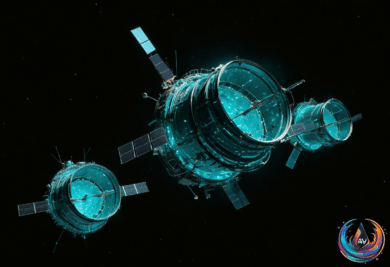
SpaceX is gearing up for its 13th Starship test flight, possibly as soon as Thursday. This flight will be a milestone with 20 Starlink V3 satellites aboard. These satellites will test deployment and how they work together in orbit.
Starship is built to carry a lot. It can hold up to 60 Starlink V3 satellites in one launch. Each satellite weighs about 1.5 metric tons, and Starship’s total payload capacity to low-Earth orbit is over 100 metric tons. That’s a huge leap for satellite deployment.
The flight will last just over an hour. After launch, the rocket will splash down northwest of Australia. The satellites will burn up during reentry. During the mission, the satellites will try to connect with ground stations in South Africa, testing global coverage.
Testing Key Technologies for Reusability
This flight will also put new tech to the test. Starship V3 uses more powerful Raptor engines. It will try to restart its engines mid-flight, something the May test flight did not attempt. Engine restart is critical for future missions.
Another big challenge is the heat shield. It must survive multiple trips through Earth’s atmosphere without needing repairs. Elon Musk said, “The heat shield’s got to make it through the ascent phase without shucking a bunch of tiles.” It also has to protect the ship on return. This flight will test modified heat shield tiles and new ways to attach them.
Orbital Data Centers and AI Satellites
SpaceX plans to start operational missions with Starship later this year. These will support the third-generation Starlink constellation. The network could add 60 terabits per second to global internet capacity. That’s enough to power tens of millions of frontier-class GPUs.
In June 2026, Elon Musk and Ian Dahl, director of satellite engineering at SpaceX, discussed the AI1 satellite. Each AI1 satellite will have solar panels covering about 600 square meters. They can generate 150 kilowatts of peak power and 120 kilowatts on average. These satellites will weigh between 3.5 and 7.5 metric tons, with solar panels weighing 1 to 2 tons.
These AI satellites could bring 120 gigawatts of power to support up to 100 million GPUs. That’s a massive step toward orbital data centers, which some industry leaders call a “hot, hot area” of discussion. Matt Desch, chief executive of Iridium Communications, noted the excitement but also the “massive technical challenges to overcome.”
New Players and Tech in the Launch Industry
The US Space Force is shaking up launch contracts. It has added Impulse Space and Relativity Space to the bidding. Impulse Space is developing the Helios kick stage. Helios can provide up to 9 kilometers per second of delta-V, letting payloads move from low-Earth orbit to geostationary orbit.
Helios works with many rockets, including Falcon 9, ULA boosters, Rocket Lab, and Relativity Space’s Terran R. Impulse Space has shipped a test tank to Mojave, and their Deneb engine is performing well. The company aims to debut Helios in 2027 on a Falcon 9 launch.
Impulse Space’s president, Eric Romo, expects Helios to boost payload capabilities. Greg Smirin of Muon Space explained how Starship is designed for “stackable deployments through the opening without requiring the whole fairing to open.” This kind of innovation could speed up satellite launches and deployment.
Elon Musk summed up the challenge and opportunity: “There’s not some magic that’s necessary that doesn’t exist.” The path forward is tough but clear. SpaceX’s upcoming Starship flight will show how close they are to overcoming these hurdles.
Based on
- How hard is it to build orbital data centers, actually? — arstechnica.com
- Sam Altman’s space data center trash talk is what most experts already believe | TechCrunch — techcrunch.com
- Payloads used to dictate the terms of launch. That’s finally changing. – Ars Technica — arstechnica.com
- SpaceX is gearing up for Starship’s 13th test flight later this week – Ars Technica — arstechnica.com
- The newest entrant in the military’s launch competition isn’t actually a launch company – Ars Technica — arstechnica.com