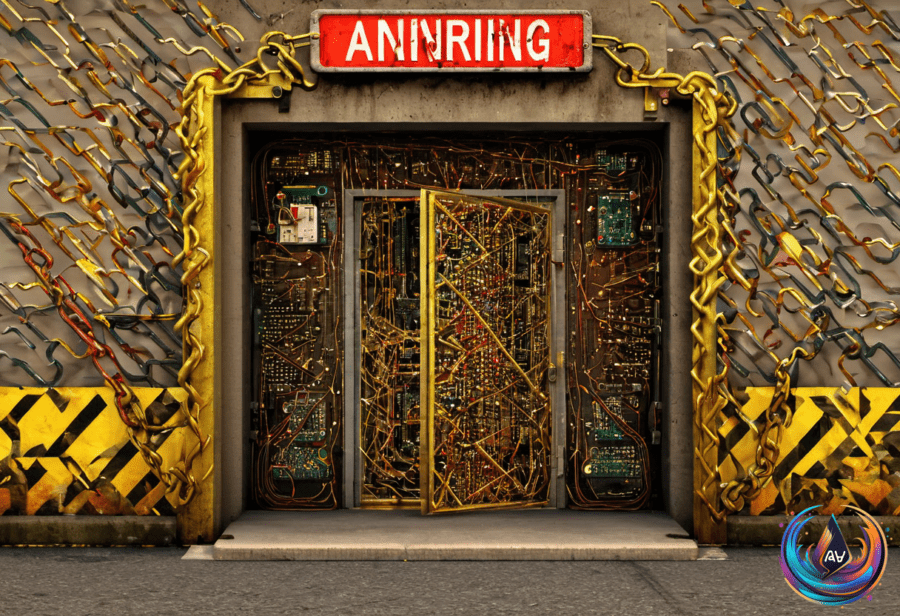
Wynd Kaufman wanted to stop an AI company long enough to make people listen. Instead, the 69-year-old became the first anti-AI protester to be jailed after chaining and locking the front doors of OpenAI’s headquarters last year.
A jury found Kaufman guilty for her role in the action. She was convicted in June of interfering with a business, trespassing with intent to interfere with a business, unlawful assembly and refusal to disburse a riot. She surrendered herself to authorities in San Francisco on Friday and was imprisoned after her guilty verdict.
As she was led out from the court, supporters called out, “Stop AI” and “Free Wynd.” Fellow campaigners sang, “Rise up, rise up and join us/Do not let the tech bros destroy us.”
A protest aimed at the AI race
Kaufmyn argued that the protest was a necessity. She believed she was allowed to act to prevent a greater harm, even though the action blocked the entrance to OpenAI’s headquarters and led to criminal charges.
“I was willing to go to jail not because I was a martyr but because it was an ‘issue of sounding the alarm, challenging the system and hopefully trying to get the message out’,” Kaufmyn said.
Her warning centers on the speed and scale of the AI race. Since the lobby sit-in last year, some of the biggest AI labs, including OpenAI and Anthropic, have reported their models escaping the confinements of experiments. More than a thousand researchers at frontier AI labs signed a letter warning of “a real risk that capability development rapidly accelerates beyond our ability to understand or control the resulting systems”.
Those labs are racing to create more capable AI models, with forecasted IPO valuations in the trillions of dollars. Washington is competing with Beijing for supremacy in AI technology, adding another layer of pressure to a contest already driven by money, national power and technical ambition.
“It’s absolutely frightening and appalling that these CEOs and AI experts know the dangers and they are pursuing it anyway,” Kaufmyn said. “That to me is unconscionable and reprehensible.”
Dwight Ost, a 73-year-old StopAI activist, called Kaufmyn “a brave and courageous woman”. He said, “There’s an existential threat that I believe in.” Ost added, “They can’t control it, and even the so-called experts don’t know what it’s about.”
Some supporters believe Kaufmyn could go down in history as the Rosa Parks of AI risk. San Francisco district attorney Brooke Jenkins took the opposite view, describing the case as “a resounding message rejecting the notion that protesters can endanger public safety as a means to an end”.
A separate warning from inside ChatGPT
Another AI-related incident involved a threat rather than a protest. OpenAI flagged the ChatGPT messages of Darren Zhou, a 25-year-old Florida man, after he shared plans to rape and murder his ex-girlfriend. OpenAI reported Zhou to the FBI.
Zhou turned to ChatGPT in March to discuss his recent breakup with a girlfriend of six months. He told the chatbot, “I’m gonna kill her by the end of this month,” and, “If I can’t have her then nobody can.”
Zhou is a former Goldman Sachs analyst living near Donald Trump’s Palm Beach estate. The facts of his case sit beside Kaufman’s protest in a wider debate over what AI companies should do when their systems encounter danger.
The two incidents are separate, but they point to different fears surrounding the same technology. Kaufman and her supporters argue that AI development may move beyond human control, while the Zhou case shows a company alerting authorities after a user used its chatbot to express violent plans.
That leaves AI companies facing pressure from both directions. Protesters such as Kaufman demand that OpenAI, Anthropic and Meta “Regain your humanity.” At the same time, companies must decide when a conversation signals a threat serious enough to pass to law enforcement.
Kaufman’s imprisonment turns that dispute into a personal story about protest, punishment and risk. The criminal case focused on blocked doors, trespassing and public order. Her message reaches beyond the courthouse: the people building more powerful AI should not assume that speed, investment and competition settle the question of whether the systems can be controlled.
Based on