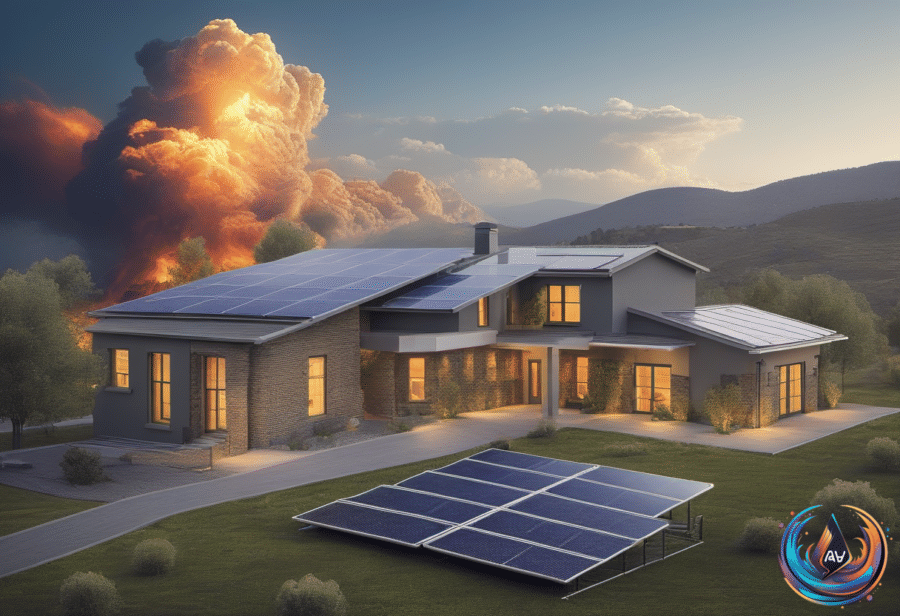
Planning a rooftop solar system involves more than counting how many panels fit on the roof. In the US, fire safety rules can limit the layout, create clear access routes, and change how much usable space remains for panels.
The rule is often called the 33 percent rule, but that name causes confusion because a separate inverter guideline uses it too. The rooftop version deals with firefighter access. The inverter version says an inverter can typically handle panels totaling up to 133 percent of its stated capacity.
What the 33 percent rooftop rule requires
The rooftop rule comes from residential fire and building codes in the US, including the International Residential Code, IRC Section R324.6, NFPA Section 11.12, and International Fire Code Section 1204. Because local building codes apply these requirements, a solar layout permitted in one town may not be allowed in another.
If a solar array covers 33 percent or less of the total roof area, you will need an 18-inch setback on each side of the ridge. When the array covers more than 33 percent, you will typically need a 36-inch setback on each side of the ridge.
The layout also needs one or more 36-inch-wide access pathways running from the eave to the ridge on every roof slope with panels. The local building department decides how many pathways are required and how wide they must be. Dormer windows also need a clearance zone around them.
The purpose is direct: if a rooftop fire starts, firefighters need a safe way to reach the roof and move across it while fighting the fire. The rule does not ban covering more than 33 percent of a roof with solar panels. It makes fire access part of the design.
Roof shape can matter as much as roof size
A simple flat or gabled roof is easier to plan because the setbacks and pathways are easier to place. That kind of layout may leave more usable space for panels, while a complex roof can lose more area once access routes and clearance zones are marked.
A useful free first step is to plot the ridge setbacks and access pathways before choosing any panels. This shows how much roof space remains, how many panels can fit, and how much energy the system may provide. It also gives you a better basis for deciding how to deploy solar panels across the property.
Limited roof space may push you toward more expensive, high-efficiency panels that capture more energy per square foot. A large roof may work better with cheaper, lower-efficiency panels. If the roof is older, solar panels may not be ideal unless you install a new roof first. Solar shingles offer another option, but they cost roughly twice the price per watt as standard panels.
Solar shingles cost between $21 and $25 per square foot installed. On a 2,500-square-foot home, that works out to between $52,500 and $62,500 before incentives. If the roof layout leaves too little usable space for a standard array, a balcony solar installation may suit the situation better.
Estimating output and the full project cost
The 33 percent rule gives you a framework for estimating how much power a rooftop system can produce, but the roof layout is only one part of the calculation. You also need to consider panel efficiency, panel degradation, replacement costs, and the amount of electricity your household uses.
The 20 percent rule is a separate rule of thumb for solar energy setups. It recommends sizing the system to produce 20 percent more electricity than your household typically uses. Once you know the available roof space and the efficiency of the panels, you can make a more accurate estimate of expected output and decide whether the project makes financial sense.
A typical home solar installation costs between $20,000 and $27,000, with a national benchmark of $3.36 per watt before incentives or rebates. Prior to 2026, homeowners could rely on a federal 30 percent tax credit, but the Trump administration terminated that incentive.
Electricity prices also differ by location. The 10 most expensive states listed are Hawaii, Maine, Massachusetts, California, Alaska, New York, Rhode Island, New Hampshire, New Jersey, and Connecticut. Net metering can give homeowners credits for excess energy, reducing or even erasing a monthly electric bill, but the program is not available everywhere and state rules differ.
Solar panels do not provide backup power by themselves
When a home loses power, rooftop panels do not simply keep the house running. A battery backup system must store excess solar energy and deliver it during an outage.
A single battery backup system costs between $10,000 and $16,000 and can power the average home’s lights, refrigerator, WiFi, and some power outlets. A whole-home, multi-battery system can power the HVAC system and all appliances, but the cost rises to between $22,000 and $40,000, plus routine maintenance.
Solar equipment can add resale value, but unpaid equipment can create problems. If the installation was financed or placed under a power purchase agreement, the buyer must agree to assume the remaining contract. The buyer also needs approval for the solar lease, which is separate from mortgage approval.
Most solar leasing companies file a UCC-1 against the equipment with local land registries. Because it appears in property title searches, a lender may refuse to close while it remains active. Lease approval can take up to two months, and if the buyer is not approved, the entire sale could fall apart.
The main lesson is simple: measure the roof around the safety routes before shopping for panels. The 33 percent figure is not a blanket limit on solar coverage. It is a planning rule that connects panel placement, firefighter access, local codes, energy output, and the total cost of the project.
Based on
- What does the 33 percent rule mean for installing solar panels? — engadget.com
- The Drawbacks Of Adding Solar Panels To Your Home — engadget.com
- How To Use A Solar Panel To Charge Your Phone — engadget.com
- Best plug-in solar panels in the UK, reviewed by a tech expert | The Independent — independent.co.uk
- Republicans’ affordability agenda should start with solar energy — thehill.com