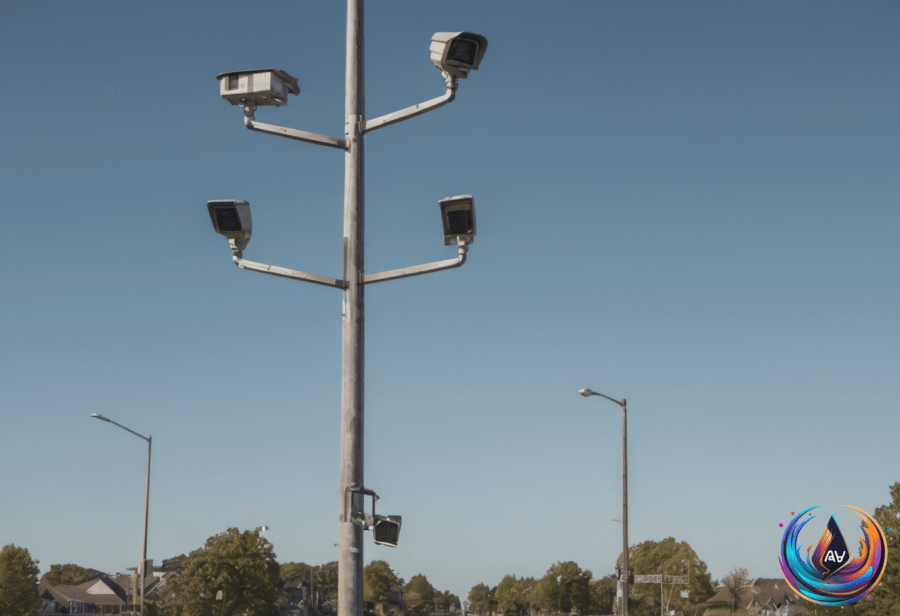
Surveillance cameras are multiplying across America, and small towns are feeling the heat. Imagine a town where Flock cameras outnumber police officers. That’s Irmo, South Carolina—a place with 12,000 residents and 33 Flock cameras. That’s one camera for every 300 people!
Dozens of cities are rushing to install these license plate readers. But it’s not just about catching criminals. It’s about the trade-offs we’re making. What happens when every entrance and exit is watched? When data is stored in a cloud and shared across states?
A Town Under the Lens: Irmo’s Surveillance Surge
Irmo’s city council voted to install 33 Flock cameras. Police Chief Bobby Dale says this coverage will “cover pretty much every nook and cranny” of the town. His goal? To keep everyone safe by monitoring all entrances and exits.
Chief Dale points to success stories. Flock cameras helped catch 15 adults in a sting operation targeting predators. Fourteen of those suspects traveled outside Irmo, showing how the cameras help catch criminals beyond city limits.
But the cameras stir strong feelings among residents. Over ten citizens spoke out at a city council meeting. One asked, “Is Irmo such a dangerous place that current law enforcement tools are not sufficient without this controversial technology?” Another warned, “If you give the government a tool, they will misuse it. Period. End of story.”
Behind the Tech: How Flock Cameras Work
Flock Safety, the company behind the cameras, has installed over 100,000 units across all 50 states. These aren’t simple cameras. They’re AI-powered devices on street poles. They scan license plates, record bumper stickers and dents, and log timestamped location data.
The system alerts police when a vehicle matches a hot list. The data stays searchable in a cloud database for 30 days. Flock claims their technology helps solve between 800,000 to 1 million crimes annually. That’s about 20 to 25 percent of reported crimes in the U.S.
These cameras have made a difference. For example, in Denver, they helped recover a stolen vehicle with a child inside. Aurora’s Police Chief Todd Chamberlain said, “Without that Flock technology, we might not have found that for two or three days later. That technology saved that 14-month-old baby’s life.”
Big Cities, Big Questions
But it’s not just small towns like Irmo. Columbus, Ohio, has nearly 600 cameras and ranks 641 out of 3,222 cities in cameras per capita. The city signed a two-year, $228,000 contract with Flock in 2024. Yet the police were ordered to stop sharing Flock data statewide after an audit found 15,000 searches linked to immigration enforcement. That’s a direct conflict with Columbus’ 2017 executive order banning city resources for federal immigration enforcement.
Columbus will hold a public hearing in August to examine police use of Flock cameras. Cleveland is also debating Flock’s role in public safety. Meanwhile, the Los Angeles Police Department decided not to renew its contract after finding 161 false matches in an internal audit.
Privacy Concerns and Public Backlash
Flock’s nationwide data sharing raises privacy alarms. Joseph Cox, a journalist focused on surveillance, noted, “When you have a national database of these cameras that can be queried by law enforcement without a warrant, that qualitatively shifts something about the surveillance.”
This means an officer in one state can search license plate data from another state. It’s a level of surveillance rarely seen before. The risk? Misuse and mistaken identity. Just ask Chrisanna Elser, a Denver resident falsely accused of theft because she was recorded driving near the crime scene. She said, “I gave them a Google map of where I was. I gave them the video from my truck that showed where I drove, gave them the video of the business I was at.”
Even Flock’s own cameras have been mistakenly set to public view, leaking feeds online. YouTuber Benn Jordan accessed over 60 Flock video feeds across multiple cities, proving the vulnerability.
Josh Thomas, a Flock representative, admitted a “very small number” of cameras had public-facing IP addresses but said they fixed those within 48 hours. He also acknowledged the camera’s benefits but said the trade-off question is “a very real one” for society to wrestle with.
What’s Next for Surveillance Tech?
Dozens of cities have canceled Flock contracts amid public backlash. Yet mayors like Bill Danielson of Irmo say Flock or similar tech is everywhere. “There was not a mayor at that conference that I touched bases with that did not use Flock or Motorola license plate readers,” he said. “Every one of those mayors either wanted Flock, was trying to figure out how to budget for Flock, or had Flock and was figuring out how to increase their presence.”
The future of surveillance is unfolding now. Will more cities embrace this tech or push back for privacy? Will lawmakers regulate it? Flock says it’s open to discussions about regulation.
One thing is clear: this surveillance wave is changing how towns and cities watch their streets. And the debate over safety versus privacy has never been louder.
Based on
- What Happened When Flock Came to My Town — 404media.co
- Columbus schedules a public hearing on Flock cameras – Axios Columbus — axios.com
- Police say Flock cameras help solve crimes, but critics call them an invasion of privacy | PBS News Hour Classroom — pbs.org
- Police say Flock cameras help solve crimes, but critics call them an invasion of privacy | PBS News — pbs.org
- Richmond County deputies charged with misusing Flock cameras — witness.usatoday.com