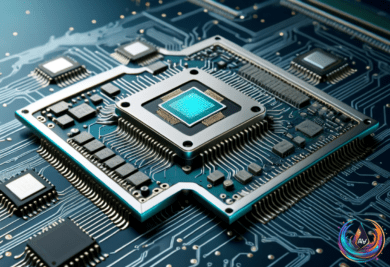
TPUs and GPUs both help computers handle demanding workloads, but they are built with different priorities. Google’s Tensor Processing Unit, or TPU, focuses on the mathematical calculations behind artificial intelligence and machine learning, while GPUs support graphical rendering, AI training, crypto mining, and other tasks depending on their power.
That difference matters as AI moves into data centers, laptops, smartphones, and desktop computers. Google uses TPUs for large-scale AI work, while Apple’s updated Mac mini and Mac Studio target local AI inference with faster chips and large CPU and GPU configurations.
What makes a TPU different?
Google designed the TPU as a proprietary AI accelerator for complex mathematical calculations used in AI and machine learning. Google first deployed the TPU internally in 2015, and the company now uses data center TPUs to accelerate large computations for large language models and deep learning tasks.
The data center TPU is not the same as the version used in a smartphone. It also differs from a traditional NPU and a GPU, although all of these chips can support AI workloads. The data center TPU is optimized for cloud-based AI and machine learning tasks inside Google’s data centers, where large models and deep learning workloads need dedicated processing power.
One key part of the TPU’s design is a hardware layout called a systolic array. In this layout, data moves from one unit to the next across a two-dimensional grid of multipliers. That structure helps the TPU handle the repeated mathematical operations found in AI workloads.
A TPU can also handle a small and well-defined local large language model, but its main role remains AI acceleration. GPUs, by contrast, can take on many kinds of work. They are used for graphical rendering, AI training, and crypto mining, with their capabilities shaped by the power of the particular GPU.
TPUs, NPUs, and AI on devices
NPUs are chips found in modern smartphones, Macs, and PCs. They handle generative and agentic AI tasks, while NPUs and Google’s on-device TPUs focus on low-power work inside smartphones, Internet of Things devices, and laptops.
These low-power tasks include camera effects and real-time translation. In the Pixel 11 series, the TPU replaces the NPU and handles camera processing, image processing, and local AI tasks. The Pixel 11 uses Google’s Tensor G6 chip, which packs 50 percent more TPU compute.
Google claims the Tensor G6 delivers “up to 3.5 times faster AI processing while using up to 3.5 times less energy.” Those figures describe Google’s claim for the Pixel 11 chip, showing how on-device TPU processing can support AI features without relying on the same hardware used for large cloud workloads.
The distinction comes down to where the work happens and what the chip must prioritize. A data center TPU targets large-scale computation for AI models. An on-device TPU or NPU targets tasks such as camera effects and translation while working within the power limits of a phone or laptop. A GPU covers a broader range of uses, from graphics to AI training.
How Apple’s updated Macs fit into local AI
Apple’s new Mac mini and Mac Studio are designed for local AI inference, meaning they process AI workloads on the computer rather than relying only on a remote data center. Apple’s M6 chip is built on 2-nanometer technology, while the Mac mini and Mac Studio offer different levels of CPU, GPU, memory, storage, and connectivity.
The base Mac mini has a 12-core CPU, a 12-core GPU, 16GB of RAM, and 256GB of storage. It starts at $899 and is “only 2 inches tall.” Buyers can upgrade it to a version with the M5 Pro chip, offering up to 18 CPU cores, 16 GPU cores, 64GB of RAM, and 8TB of SSD storage.
The Mac Studio starts at $2,499. Its base model has an M5 Max chip with 18 CPU cores and 32 GPU cores. The system can be configured with an M5 Ultra chip, “delivering up to 36 CPU cores and 80 GPU cores,” along with up to 512GB of RAM and 16TB of SSD storage.
The Mac Studio also offers more connections than the Mac mini. It has four Thunderbolt 5 ports, 10Gb Ethernet, HDMI, a headphone jack, two USB-A ports, and two front USB-C ports. The Mac mini has fewer ports, losing one Thunderbolt port and both USB-A ports.
These Macs do not turn a GPU into a TPU, and they do not use the same role as Google’s data center hardware. Instead, their faster chips and large configurations give users local computing options for AI inference. The Mac mini provides a lower starting price and smaller design, while the Mac Studio offers more CPU and GPU cores, memory, storage, and ports.
So, the simplest answer is this: a TPU is a focused AI accelerator, a GPU is a flexible processor used for graphics and several demanding workloads, and an NPU or on-device TPU brings low-power AI features to personal devices. The best choice depends on whether the work happens in a data center, on a phone, or on a desktop computer.
Based on