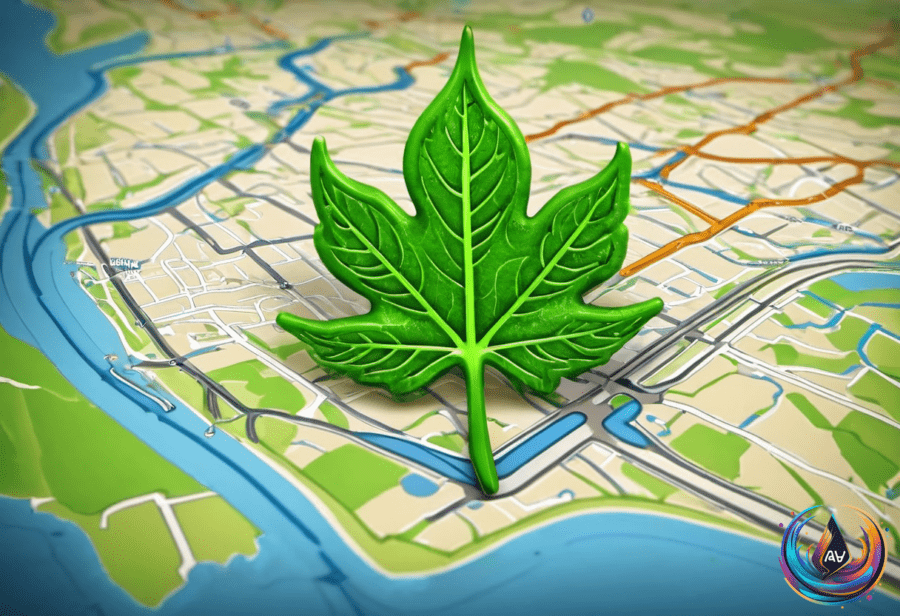
If you use Google Maps, you might have noticed a little leaf icon on some routes. This icon points to a fuel-efficient route. Google Maps uses this to help you save fuel and cut emissions.
Fuel-efficient routes are turned on by default in Google Maps. The app pulls live traffic data to predict where congestion might build up. It also looks at road types, junctions, road layouts, and even topography. This helps it pick routes that use less fuel.
Sometimes, these greener routes take longer than faster alternatives. Google Maps may skip motorways if it means using roads with steadier speeds. That steady pace reduces fuel use, even if it adds minutes to your journey.
One thing to keep in mind is these routes don’t consider how comfortable your trip will be. They also ignore severe weather conditions. So, a fuel-efficient route might not always be the easiest or safest if the weather is bad.
To get the best from Google Maps’ fuel-saving feature, you should tell the app what kind of engine your vehicle has. Just go to Settings, then Your vehicles, and select the right engine type. This helps the app tailor routes better for your car.
Changes Ahead for Electric Vehicle Drivers
Electric vehicles (EVs) are growing in popularity, but the way we pay for road use is about to change. From April 2028, the government plans to launch a pay-per-mile scheme for EVs. This will replace the current system that mainly taxes petrol and diesel vehicles through fuel duty.
Under this new system, fully electric cars will pay 3p per mile. Plug-in hybrids will pay 1.5p per mile. That’s a big difference compared to the current 6p per mile fuel duty for petrol and diesel cars.
The scheme, called eVED, will charge EV owners upfront based on estimated mileage. There will be options for monthly payments. Each year, the charges will be adjusted to match actual mileage. This will happen through MOT checks or registration anniversaries.
Electric vehicle owners will also pay eVED charges when driving abroad. The government ruled out taxing based on when and where you drive. Instead, the system will track mileage regardless of location.
Other Navigation App Updates and Traffic Insights
Google’s other navigation app, Waze, is also getting smarter. It’s adding AI-powered features that make riding a motorcycle easier and reduce annoying voice directions. A new Motorcycle mode uses AI to spot hazards like potholes, speed bumps, raised crosswalks, shoulder endings, and narrow bridges.
This mode is already live in countries like Argentina, Brazil, Colombia, Malaysia, Mexico, Peru, and the Philippines. Waze also introduced a ‘Less Chatty’ mode. It cuts down voice prompts to only critical directions and reminders.
Waze started testing “Conversational Reporting” in October 2024. This lets users report traffic incidents using natural language. The integration with Google’s Gemini AI supports voice searches and natural language commands. For example, you can ask for gas stations with the cheapest prices.
Traffic jams often happen for strange reasons. Phantom traffic jams arise when small, repeated braking in a queue of cars causes waves of slowing and stopping. Mathematics shows there is an optimal traffic density. If too many cars crowd the road, flow drops and journey times rise.
Aggressive driving and frequent lane changes make congestion worse. They increase stop-start waves that slow everyone down. Interestingly, adding even a few autonomous vehicles can smooth traffic. These cars drive consistently and reduce stop-start behaviors.
EV Range Facts to Know Before You Drive
Looking ahead to July 2026, some EV models will have shorter ranges than others. The Fiat 500e will top the low end at 149 miles. The Hyundai Kona Electric SE offers 200 miles, while the Mini Countryman SE ALL4 has 216 miles.
The Lexus RZ 550e F Sport AWD will provide 229 miles. The Toyota bZ is rated for 235 miles, and the Kia EV6 can drive 237 miles on a full charge. Knowing these numbers helps drivers plan trips and charging stops better.
Google Maps and Waze are evolving fast to support greener, safer travel. New policies like the pay-per-mile charge will change how EV owners think about road costs. And smarter traffic apps will help everyone move smoother and save fuel.
Based on
- What the leaf icon on Google Maps really means (and why it confuses so many users) — engadget.com
- What is the new pay-per-mile tax for electric vehicles and how will it work? | The Independent — independent.co.uk
- Waze Rolls Out New AI Features Including Motorcycle And ‘Less Chatty’ Modes — engadget.com
- The fastest way out of the traffic jam, according to mathematics | The Independent — independent.co.uk
- Not 300 Miles, Not 250 Miles: These EVs Have The Worst Range In 2026 — engadget.com