AI tokens are moving into daily commerce. Banks, cafes, telecom operators, restaurants, and online marketplaces in China are giving them away, selling them in bundles, or attaching them to ordinary purchases. The strategy is simple: make access to AI feel less like a software subscription and more like mobile data, credit card points, or free Wi-Fi.
An AI token is a unit of computing that an AI model uses to process text. Most ordinary users still encounter AI through an app or feature, without seeing a token balance. “Most ordinary users still encounter AI through an app or feature, without seeing a token balance,” Poe Zhao said.
That invisible layer is expanding at a remarkable scale. Daily token consumption in China surged from 100 billion in early 2024 to 500 trillion in mid-2026, turning token prices into a new front in the global AI race.
Credit Cards and Mobile Plans Become AI Distribution
U.S. and Chinese AI companies are lowering token prices to win wider adoption of their models. Chinese open-source and open-weight models can cost 60% to 90% less than comparable models from OpenAI and Anthropic, giving businesses room to use tokens as customer incentives without treating every giveaway like a financial crime.
Chinese banks are putting those incentives directly onto credit cards. In June 2026, China Merchants Bank launched a card targeting AI developers, offering new cardholders up to 1.8 billion tokens for use on MiniMax models. Shanghai Pudong Development Bank launched another developer card with subsidies worth up to 3 billion tokens for Alibaba Qwen models.
In July, Chinese AI startup Moonshot AI launched a credit card named after its Kimi model in partnership with the Agricultural Bank of China and American Express. The cards turn model access into a banking benefit — because apparently reward points needed a compiler.
China’s three major telecom operators have packaged AI use much like mobile data plans. China Telecom offers consumer plans starting at 9.9 yuan ($1.40) a month for 10 million tokens, while China Mobile offered 400,000 tokens for 1 yuan (14 cents) in Shanghai.
China Unicom introduced monthly business plans ranging from 15 yuan ($2.10) for 6 million tokens to 45 yuan ($6.30) for 18 million tokens. These offers give customers a familiar way to buy model access, even if the underlying product remains far more technical than a standard data allowance.
Restaurants and Marketplaces Join the Token Trade
Chinese restaurants, cafes, and bars are also handing out free AI computing as a promotional incentive. At Beijing’s AGI Bar, customers who buy a drink and connect to Wi-Fi can get unlimited access to DeepSeek V4 Flash.
On August 9, 2026, a customer looked at a menu board at AGI Bar. The offer makes the bar’s Wi-Fi part of a larger pitch: order something, connect, and receive computing access instead of the usual forgettable loyalty stamp.
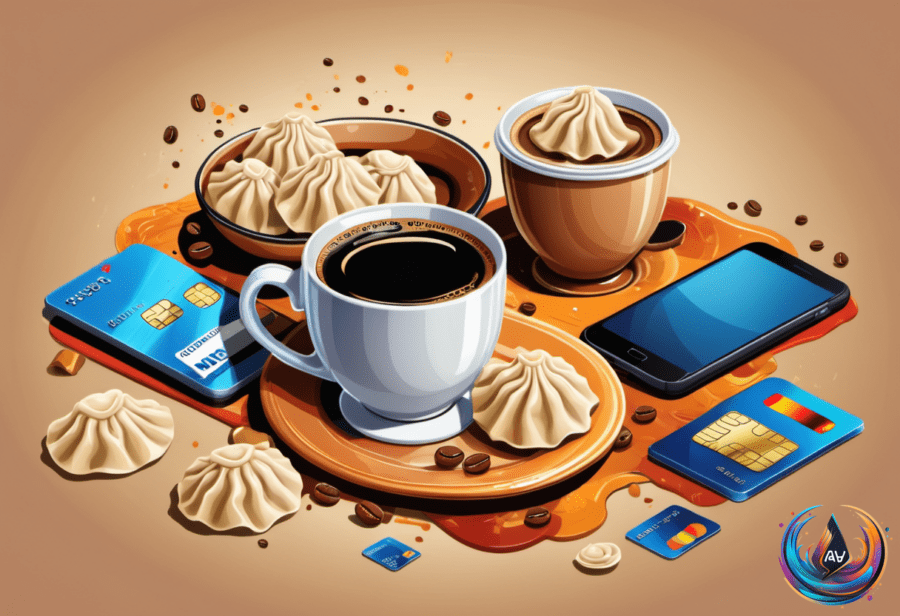
Beijing’s Jingu Yuan dumpling restaurant gives customers 10 yuan ($1.40) worth of computing credits after a meal. Cards on the tables tell diners to collect tokens at the cashier for their AI agents, and the restaurant’s two stores have been handing out more than 100 vouchers a day.
A 24-hour coffee shop in Changsha offers customers AI tokens with their coffee. The arrangement is another sign that tokens are becoming a promotional currency across daily spending, not just a billing detail hidden inside developer tools.
Tokens are also available on Xianyu, Alibaba’s marketplace for selling used phones, furniture, and clothes. Listings offer millions of tokens for a few dollars through day passes or monthly subscriptions, while some sellers break up model allowances and resell them to students, independent developers, and small businesses.
Token Use Reaches Business Lending
Guangzhou banks are experimenting with tokens to boost business for AI startups. The Bank of China, China CITIC Bank, and Bank of Guangzhou are involved in the token loan experiment.
In August, Guangzhou’s Haizhu district launched a financial product called “token loan.” It allows banks to measure a company’s token production and consumption when deciding its borrowing capacity, linking access to credit with how much AI activity a business generates and uses.
The shift gives tokens several jobs at once: a product businesses can sell, a reward banks can attach to cards, a perk restaurants can offer, and a metric lenders can use. AI is no longer confined to the app window. In China, its basic unit is showing up on menus, in mobile plans, and beside the dumplings.
Based on