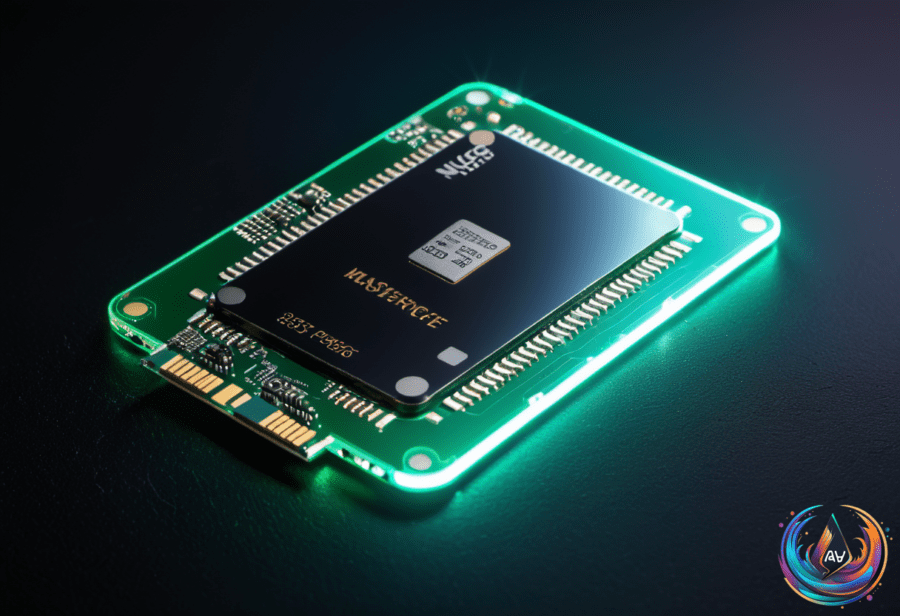
Flash memory is fast, compact and everywhere. It stores data in SSDs, smartphones, memory cards and many other gadgets, giving modern electronics a small storage option that keeps information even after the power is turned off.
That convenience comes with tradeoffs. Flash costs more per gigabyte than a hard drive, and it wears down as data is written and erased. It also cannot match the speed of system RAM, which handles temporary working data. Flash storage, by contrast, gives devices persistent storage that remains available after shutdown.
Why NAND Flash Powers So Many Devices
Most high-capacity flash storage uses NAND flash. The technology works well in portable electronics because it takes up little space and has no reliance on the moving parts found in a hard drive. An SSD offers lower access latency, handles bumps better and fits thinner devices than a hard drive.
Flash memory is sometimes called flash ROM, but that name is misleading. ROM suggests that data cannot change, while flash can be erased and rewritten. That ability makes it useful for storage, but repeated writing and erasing also creates a limit: each NAND cell supports only a limited number of program-and-erase cycles.
Manufacturers have pushed capacity higher by storing more data in each cell and stacking cells vertically. Modern NAND can store multiple bits per cell, while 3D NAND builds upward instead of spreading cells across a flat plane. Commercial 3D NAND already exceeds 300 layers, showing how much storage can fit into a small physical space.
TLC designs store three bits per cell, while QLC designs store four. Putting more bits into each cell raises density and lowers cost, but it also narrows the electrical margin between the different data states. QLC NAND typically offers lower endurance and performance than simpler designs, making the choice of flash type part of the storage tradeoff.
The Limits Behind Flash Storage
Flash has a clear speed advantage over a hard drive in access latency, but it is nowhere near as fast as system RAM. RAM serves as the system’s much faster temporary workspace, while NAND holds files and other data for the long term. These two types of memory serve different jobs rather than replacing one another.
Endurance is another concern. Every program-and-erase cycle adds wear to a NAND cell, and storing more bits in one cell can make that cell less tolerant of changes. SSD makers manage this problem with controllers that distribute writes, correct errors, retire unreliable blocks and maintain spare capacity.
TRIM and garbage collection also manage data writing and erasing in NAND storage. Together, these controls help SSDs use their available cells and blocks, but they do not remove the underlying limit on write cycles. Flash storage still wears down when data is repeatedly written and erased.
Warranty figures show how manufacturers describe that limit. Samsung warrants its 1TB 990 Pro SSD for five years or 600TB of writes. The measure does not mean every drive will stop working after that point; it defines the stated warranty coverage for time and written data.
Price adds another layer to the decision. Flash costs more per gigabyte than a hard drive, even though its compact size, lower access latency and resistance to bumps make it a strong fit for portable electronics. NAND contract prices are forecast to rise 70 to 75 percent quarter over quarter in Q2 2026, followed by another 10 to 15 percent increase in Q3 2026.
What Might Replace NAND?
Flash’s limits have inspired possible replacements, including phase-change memory, Intel’s Optane, MRAM and ferroelectric memory. These technologies aim to address parts of the flash tradeoff, such as endurance, speed or the way data is stored.
Intel began winding down Optane in 2022, showing how difficult it is to move a different memory technology from development into broad use. Research continues into MRAM, ferroelectric memory and other alternatives, but no clear candidate has emerged to replace NAND.
For now, NAND remains the central technology for high-capacity flash storage. Its ability to retain data without power, fit inside thin devices and scale through vertical stacking keeps it useful across SSDs, smartphones, memory cards and many other gadgets.
The picture is simple: flash offers compact, persistent storage with low access latency, but it costs more than a hard drive, trails system RAM in speed and has a finite write life. Controllers, spare capacity, TRIM and garbage collection help manage those weaknesses, while advances such as TLC, QLC and 3D NAND continue to increase what flash can store.