Factory problems rarely stay in one place. A suspected defect may begin with an automated inspection alert, move to a secondary check, require transport to a rework station, and end with an investigation into what caused it. NVIDIA’s Factory Operations Blueprint, or FOX, lays out a way to connect those steps through a factory manager agent and a group of specialized agents.
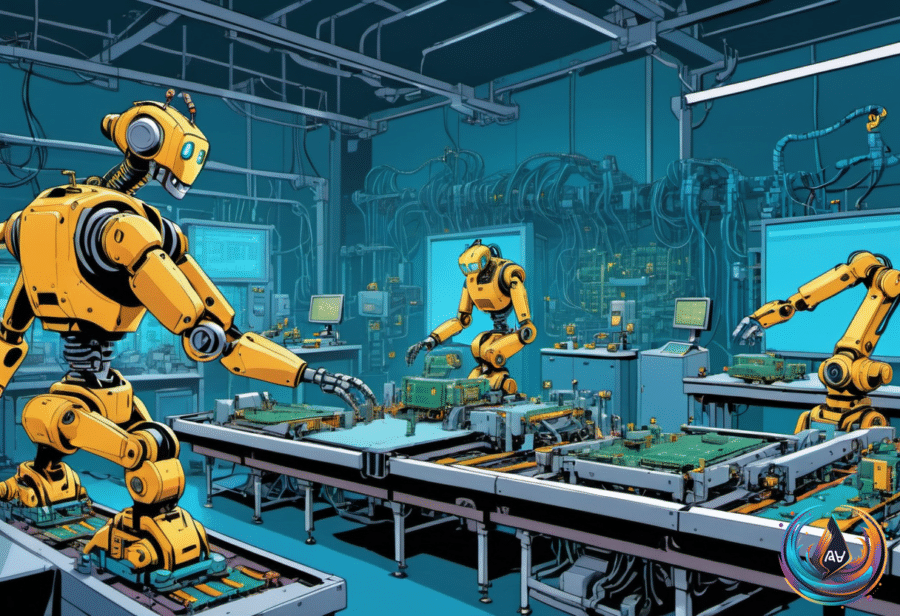
The goal is not to replace every factory tool. FOX provides a reference architecture for connecting existing factory data and equipment, coordinating specialist agents, and deciding which actions need operator review. The example focuses on a surface-mount technology assembly line used to produce printed circuit boards.
One Manager, Several Specialist Agents
The Factory Manager Agent acts as the system’s coordinator. It uses an LLM such as NVIDIA Nemotron, the NemoClaw agent harness, and NVIDIA OpenShell. The LLM interprets tasks, connects information across factory systems, develops plans, and assesses the results.
Developers build the long-running manager with the NVIDIA Agent Toolkit, then connect the data and tools already used by the factory. They also configure specialist agents and define where a human operator must review or approve a decision. That structure gives the system a clear role: it can coordinate work, but factory teams retain control over decisions that require review.
The specialist agents handle focused jobs. A Visual Inspection Agent calls NVIDIA Cosmos to inspect suspected defects. A Fleet Management Agent is demonstrated with NVIDIA Isaac Sim and ROS 2, while a Root Cause Analysis Agent uses Kumo Anomaly for time-series analysis.
Together, the agents can monitor operations in real time, identify bottlenecks, investigate errors or defects, and orchestrate robot fleets. The intended result is less downtime and better yield, with each agent working on a defined part of the factory workflow instead of forcing one system to handle every task.
Following a Defect Through the Production Line
In the SMT assembly line example, the process starts with an alert from automated optical inspection, or AOI. The system then follows the alert through secondary inspection, arranges robot transport to rework, and launches an investigation into the likely cause.
The Root Cause Analysis Agent examines time-series information and produces a PDF report. That report includes evidence and recommended corrective action, giving the factory team a record of what the investigation found and what action it recommends.
This workflow connects physical movement, visual checks, factory records, and analysis in one chain. Instead of treating inspection, rework, and root cause analysis as separate tasks, the Factory Manager Agent coordinates them as parts of the same response.
FOX also supports fully on-premises deployment on NVIDIA DGX Station. Production records, images, prompts, and investigation results remain within the factory network, which gives manufacturers a way to keep those materials inside their own operations.
Why Planning and Inspection Matter
The need for this kind of coordination is tied to the cost of interruptions. A Siemens report estimates that unplanned downtime costs an average large plant in the surveyed sectors $253 million per year. When production lines handle many products and frequent changes, the ability to find problems and organize a response becomes part of daily operations.
At the Siemens Electronics Factory in Erlangen, the factory produces more than a thousand products a year. Frequent changeovers for new products or orders make production planning and inspection important workflows for factory agents.
For rush orders, agents built with the FOX Blueprint and powered by NVIDIA Nemotron run simulations through Siemens Intelligence Center X. Those simulations balance costs, existing orders, supply levels, and line setups without requiring a planner to query each system by hand. The end-to-end agentic system can enable cost savings of up to 20%.
New product designs create a different challenge. Siemens is combining its product lifecycle management software and Process Preparation X with NVIDIA Cosmos and NVIDIA Omniverse to create a virtual prototype and synthetic training data.
That preparation helps electronics manufacturers build and optimize AOI processes before physical production begins. Virtual production preparation can reduce time to market by up to 40%, giving inspection teams a way to work with a new design before the line starts making it.
A Blueprint for Controlled Factory Automation
FOX presents factory automation as a coordinated system rather than a single all-purpose agent. The manager connects data and tools, the specialist agents handle inspection, fleet operations, and analysis, and operators define the decisions that still need their review.
That division matters because factory work combines software decisions with physical actions. A system may identify a defect or recommend corrective action, but the blueprint keeps the factory’s review rules inside the design. It also links the final investigation to a PDF report containing evidence and recommendations.
For manufacturers, the practical promise is a shorter path from an alert to an organized response. FOX brings existing systems, specialized agents, robots, simulations, and factory records into one workflow while supporting on-premises operation on NVIDIA DGX Station.
Based on
- How NVIDIA Factory Operations Blueprint Coordinates AI Agents to Investigate Production Issues — developer.nvidia.com
- Tag: Jensen Huang – Ars Technica — arstechnica.com
- Nvidia Archive for August 2020 – Page 1 | The Verge — theverge.com
- VentureBeat | AI News & Analysis for Enterprise Leaders — venturebeat.com