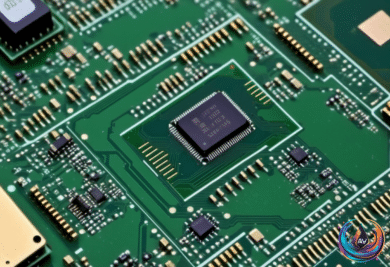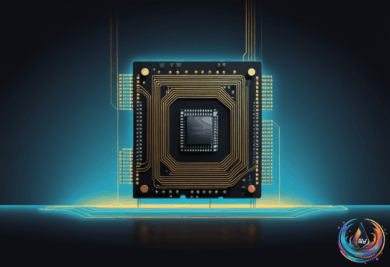
AI hardware is moving toward a crucial experiment: what happens when memory does more of the computing? Weebit Nano has launched the Weebit Matrix In-Memory Compute Research Program, giving academic and industry researchers access to ReRAM hardware for testing AI calculations where data is stored.
This is not a finished commercial AI accelerator. It is a research platform designed to move teams beyond models and simulations and into experiments on actual ReRAM hardware, with a controlled 32 × 32 crossbar array at the center of the program.
Putting AI Calculations Inside the Memory Array
In a conventional architecture, AI values move through a memory hierarchy before reaching a separate processor. Those repeated transfers consume bandwidth and energy, creating a major challenge for edge systems that must operate within tight power and thermal budgets.
In-memory computing, or IMC, seeks to perform part of that work inside the memory array itself. The question driving Weebit’s program is direct: how much energy and time can edge AI save when it reduces the movement between memory and processing hardware?
ReRAM, or resistive random-access memory, stores information through programmable electrical resistance. Weebit’s oxide-based cells contain a switching layer between electrodes, and applied voltages change the conductive path and the cell’s resistance.
The stored state persists without continuous power, making ReRAM non-volatile. An array can encode neural-network weights in its memory cells, then use the resulting electrical responses to participate in calculations. That physical behavior connects the memory itself to the multiply-and-accumulate operations used throughout neural networks.
The approach does not mean every part of an AI model runs inside the array, and it does not make data movement disappear from the complete system. Instead, the research program tests how memory-based operations can work with the rest of a computing pipeline.
Two Research Kits, One Controlled Hardware Platform
Weebit is offering two packages for researchers. Both include packaged chip samples, documentation, and an IMC board with a socket, but they serve different levels of hardware access.
- Matrix IMC Evaluation Package: A direct-access evaluation board for researchers who want closer access to the hardware.
- Matrix IMC Quick-Start Package: A complete IMC board, an FPGA subsystem, and sample code.
The 32 × 32 crossbar provides a controlled platform for investigating programming methods, AI algorithms, and neuromorphic architectures, including spiking neural networks. Researchers can also explore vector-matrix multiplication and convolution, two operations that sit at the heart of many neural-network workloads.
The FPGA subsystem in the quick-start package adds programmable digital hardware alongside the memory array. That creates room to test hybrid systems, where memory-based operations work with conventional processing instead of attempting to replace an entire computing pipeline.
The program targets research for sensors, industrial equipment, and other edge systems where power and heat place hard limits on AI performance. Participants will share ReRAM-related results, helping test the technology’s strengths and expose the technical challenges that remain before an in-memory computing solution reaches the commercial market.
AI Infrastructure Is Being Reworked From Memory to Inference
Weebit’s launch arrives alongside other efforts aimed at reshaping AI hardware. SambaNova and Supermicro are entering a strategic collaboration to develop SN50 inference racks and build and sell AI disaggregated inference systems for NeoClouds and sovereign clouds.
The SambaNova SN50 is the company’s fifth-generation Reconfigurable Dataflow Unit, or RDU, chip, purpose-built for high-performance inference. RDUs serve the largest models at high speed and high throughput without requiring extreme rack power density, making them easier to deploy in existing data centers.
These systems can also work alongside existing NVIDIA GPUs. The GPUs run the prefill phase, while the RDUs run the decode phase, allowing operators to add inference capacity without waiting for new data-center build-outs constrained by power and cooling. The design can also extend the useful life of GPUs already in service.
The collaboration targets 10,000 RDU chips, and SambaNova and Supermicro say the approach can deliver more high-performance inference capacity in 2027 than would otherwise be possible.
“Agentic AI is the next wave of inference, and it has to run everywhere,” said Rodrigo Liang, co-founder and CEO of SambaNova. Charles Liang, president and CEO of Supermicro, said the collaboration supports heterogeneous architectures that integrate GPU computing with specialized inference acceleration.
Memory capacity and bandwidth are another front in the same hardware race. Penguin Solutions, Inc. has announced its newest SMART Modular DDR5 Multi-Ranked Dual In-line Memory Module, or MRDIMM, for AI data centers.
These MRDIMMs run at DDR5-12800 speeds and address bandwidth demand from AI inference and agentic AI workloads. Their architecture multiplexes two physical ranks into a single logical rank, avoiding traditional speed limits and raising memory bandwidth compared with standard RDIMMs.
The modules include thermal and electrical protections, while optional Zefr high-reliability testing simulates demanding operating conditions to help identify timing and electrical signal integrity issues. That focus supports mission-critical AI infrastructure, including applications such as financial services.
Across these efforts, the direction is clear: AI performance depends on more than larger models or faster processors. ReRAM research tests whether memory can take on part of the computation, RDU systems separate inference tasks across specialized chips, and MRDIMMs push bandwidth without giving up reliability. Weebit’s research kits now give engineers a way to measure one of those ideas on real hardware, bringing the next debate in edge AI out of simulation and onto the circuit board.
Based on
- Weebit Nano Launches Matrix ReRAM Research Program for In-Memory AI Computing — unite.ai
- SambaNova SN50 Chips to Power Supermicro’s New Inference Racks, Delivering High-Performance Inference to Data Centers Worldwide | AFP.com — origin-zh9p7m-www.afp.com
- Penguin Solutions Introduces High-Bandwidth SMART Modular MRDIMMs for Next-Generation AI Data Centers | AFP.com — origin-zh9p7m-www.afp.com