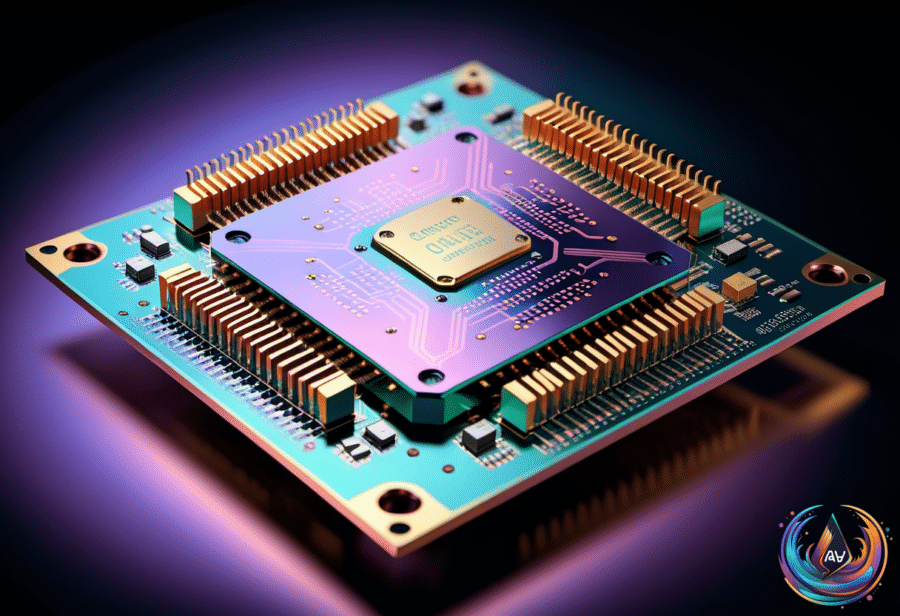
IBM has announced IBM Quantum Nighthawk r3, a next-generation superconducting quantum processor designed to run 10,000 quantum operations accurately across 520 programmable qubits. The chip is still a design, not shipping hardware, but it sets out IBM’s next step for expanding useful quantum workloads.
IBM plans to link two Nighthawk r3 chips into one 1,040-qubit system in 2027. The company expects that two-chip machine to support more than 1,000 programmable qubits while retaining the fast operations introduced with the Nighthawk family.
A bigger chip built on faster resets
Nighthawk is IBM’s square-lattice processor family, built for quantum advantage workloads. Most qubits connect to four nearest neighbors, compared with two or three on earlier designs. Nighthawk r3 keeps that square lattice and the fast operations used by the current production chip, Nighthawk r2.
Nighthawk r2 has 120 programmable qubits, 218 couplers and 120 reset elements, adding up to 458 physical quantum elements. IBM says the chip runs workloads up to 19 times faster than its earlier processors, with the biggest improvement coming from a hardware change that addresses the bottleneck in qubit reset.
Heron uses conditional reset: the system measures a qubit, then flips it if it finds the qubit in an excited state. That method cannot fix leaked qubits, so the chip must idle for hundreds of microseconds between shots. Nighthawk r2 replaces it with a dissipative reset gadget for each qubit.
Each gadget uses a tunable coupler to connect a qubit to a cold environment when needed. The design reduces effective T1 from about 200 microseconds to roughly 25 nanoseconds, cutting idle time between runs to as little as 1 microsecond. IBM says that allows Nighthawk r2 to run more than 100,000 circuits per second, compared with roughly 4,000 on Heron.
IBM also reports 25 times lower initialization error while leaving neighboring qubits undisturbed. Oliver Dial described the hardware addition this way: “This is an extra physical qubit that we include on the chip for each programmable qubit that lets us quickly remove the energy from one of our programmable qubits, returning it to the ground state.”
Early workloads show the performance gap
According to IBM, clients have run 34 billion circuits on Nighthawk r2 so far. E.ON recorded a 15-fold speedup in quantum machine learning for energy grid optimization compared with Heron, while Oak Ridge National Laboratory ran a magnetic materials simulation 12 times faster than before.
Algorithmiq’s circuits ran eight times faster than the original Heron experiment. IBM estimates that tensor-network methods would need 240 times more memory to match the result. Q-CTRL also ran a 60-qubit fermionic simulation using 4,497 two-qubit gates, reducing runtime from 4 minutes 25 seconds to 23 seconds.
The Q-CTRL result stayed within 1% of the Heron r3 baseline. IBM also reports accurate observable estimation on circuits with more than 7,500 gates, a milestone on its 2026 roadmap. These results connect the reset improvement to practical workloads instead of treating qubit count as the only measure of progress.
IBM and RIKEN reran a sample-based quantum diagonalization workflow roughly five times faster with 100 times more computations. Cleveland Clinic and RIKEN processed 608 million samples 33 times faster through workflow automation.
Two chips, ten links and one demanding target
Nighthawk r3 scales from r2’s 120 programmable qubits to 520 programmable qubits built from 2,034 physical qubits. It adds 10 chip-to-chip interconnects called l-couplers, which IBM plans to use as the path toward a 1,040-qubit machine.
IBM has already connected two Nighthawk r1 chips with four l-couplers, each using an 80-centimeter cable. State transfer fidelity reached up to 99.3% in the testing described for the link, with an average of 99%. Dial said another demonstration reached up to 99.4% fidelity, close to IBM’s long-term target of 99.9%.
“Showing four L-couplers joining two Nighthawk R1 processors in the same refrigerator, reaching state transfer fidelities of up to 99.4 percent, very close to our long-term target of 99.9 percent,” Dial said. Operations through the couplers take approximately 100 nanoseconds.
IBM also linked two cryogenic modules and reached temperatures below 15 millikelvin in under 5 days. The company once intended to link nine systems, but the current plan calls for two linked chips. That leaves the planned total at 1,040 qubits for 2027, while simplifying the route to the larger machine.
Platform work supports the hardware roadmap
IBM Quantum Platform now runs high-performance computing and quantum jobs in one managed environment. Users can attach classical computing from a laptop, a supercomputer or the platform itself, giving quantum workloads access to different types of supporting computation.
IBM also offers pulse-level controls for error-correction research. The company aims to build error-corrected quantum computers before the decade is out, with Starling planned as a fault-tolerant quantum computer for 2029.
Nighthawk r3 is not available as a shipped processor yet, and its chip-to-chip links remain short of the 99.9% fidelity target. Still, the design combines a larger programmable system with the reset technology that helped Nighthawk r2 reach more than 100,000 circuits per second. IBM’s 2027 goal is clear: two 520-qubit chips, 10,000 accurate operations and a 1,040-qubit system.
Based on
- IBM Announces IBM Quantum Nighthawk r3: A New Processor to Support 10k Quantum Operations on 520 Programmable Qubits — marktechpost.com
- IBM to offer access to a dual-processor quantum system in 2027 – Ars Technica — arstechnica.com
- IBM quiere superar los 1,000 cúbits en 2027 con ayuda de este nuevo chip cuántico | WIRED — es.wired.com
- IBM to offer access to a dual-processor quantum system in 2027 | Ars OpenForum — arstechnica.com