Jensen Huang is out at NVIDIA. The company announced on November 12 that its co-founder resigned as president, Chief Executive Officer, and board member, effective immediately. The decision follows allegations of personal misconduct, investigations tied to national security concerns, and a second reported affair involving an NVIDIA executive.
Colette Kress, NVIDIA’s executive vice president and Chief Financial Officer, will serve as interim CEO while the board searches for a permanent successor. She will continue overseeing finance operations as directors consider internal and external candidates — a search that now carries more weight than the usual executive reshuffle.
The company’s board met on Wednesday after reports emerged that Huang faced another extramarital relationship with an NVIDIA vice president who reports to him. The board had already announced an independent investigation on November 8 over national security concerns, though NVIDIA said it had no reason to believe its secrets or US national security had been compromised.
A personal scandal with national security consequences
The crisis centers on Alice Huang, a former executive at Singapore-based Megaspeed, NVIDIA’s primary business partner in Southeast Asia. US intelligence agencies concluded that Jensen Huang had a “close relationship” with Alice Huang, who was suspected of being recruited by China’s Ministry of State Security; Huang later admitted to the affair in an internal memo to employees, acknowledging that he had been unfaithful to his wife.
The US Congress and FBI are investigating Huang’s relationships. The New York Times later reported a relationship between Huang and Kimberly Powell, NVIDIA’s vice president of healthcare, deepening a scandal that had already placed the company’s leadership under scrutiny.
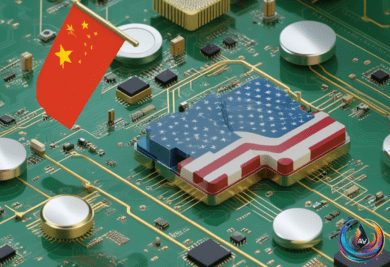
Megaspeed, founded in 2023, has also faced investigation over whether it helped Chinese companies access its $4.8bn stock of powerful NVIDIA chips. Beijing denies the spying claims and has accused Washington of using them as a pretext for a technological “blockade” against China.
Huang, 63, has maintained a close relationship with US President Donald Trump and spent years pushing to ease restrictions on advanced chip exports to China. Trump said earlier this week that Huang told him he had “absolutely no idea” he was in a relationship with an intelligence operative.
The political fallout could reach beyond Huang’s personal conduct. Senior Democratic senators Elizabeth Warren and Chris Coons have asked the Trump administration to preserve documents related to NVIDIA’s chip exports to China, while a weakened company could face tighter export controls and lose influence over US AI and semiconductor policy.
The succession problem lands on NVIDIA
Kress is the clearest immediate answer because she already runs NVIDIA’s finances and has been with the company since September 2013. Before joining, she spent nearly 25 years in finance roles at technology companies, including Cisco and Microsoft, and she has helped guide NVIDIA through its significant growth.
“Colette has helped lead NVIDIA through a period of extraordinary growth and has a deep understanding of our business, customers, operations, and financial position,” said Harvey C Jones, NVIDIA’s first chair of the board of directors.
Kress said she would build on the foundation Huang created during his 33 years at the company. “NVIDIA’s strength has always come from its people, and together with our leadership team, I am committed to building on the extraordinary foundation Jensen created over the last 33 years,” she said.
The permanent succession picture is less settled. Martin Peers of The Information said “there are no obvious internal candidates,” while possible names mentioned include AMD chief executive Lisa Su, Arm CEO Rene Haas, and Intel CEO Lip-Bu Tan. Huang’s daughter Madison and son Spencer, who both hold management roles at NVIDIA, have also been mentioned.
Under NVIDIA’s bylaws, a majority of the 11 board directors is required to remove Huang as CEO. He would keep his board seat unless shareholders removed him, but his resignation from the board leaves that question moot — at least for now.
The market has already delivered its verdict on the uncertainty. NVIDIA shares plunged 10% in premarket trading Thursday, fell more than $600bn in market value this week, and are down around 25 percent from their all-time high in early October; Reuters reported the stock had reached a 14-year low.
Huang owns about 3.6 percent of NVIDIA’s stock, making him one of the richest people in the world. Investors now have to separate the company’s chip business from the executive who became its public symbol, which is less tidy than a quarterly earnings presentation would suggest.
Why the shock matters beyond NVIDIA
Investors worry that a leadership shakeup could hinder NVIDIA’s ability to deliver its next generations of AI chips. Mandeep Singh, global head of technology research at Bloomberg Intelligence, said NVIDIA was unlikely to be “as aggressive” under new leadership, creating room for rivals as customers diversify their suppliers.
Charu Chanana of Saxo Markets said losing some market share would be “manageable,” but warned that delayed customer orders, infrastructure investment, or financing decisions could carry “much broader” implications. “AI leadership could broaden, rather than the boom ending,” she said, naming AMD, Broadcom, Alphabet, and Samsung as potential beneficiaries.
The larger concern is the AI spending cycle itself. Chanana said the “bigger risk is a disruption to AI spending itself,” because NVIDIA sits at the center of an interconnected ecosystem already facing scrutiny over financing, hyperscaler capital spending, valuations, and returns on AI investment.
The timing adds another pressure point: the crisis comes days before the stock market debut of Anthropic, an event viewed as a crucial test of investor appetite for the AI sector. Stephen Innes of SPI Asset Management said investors have effectively been buying into NVIDIA’s technology and Huang’s vision in equal measure.
“The market has spent years assigning Nvidia a premium for exceptional execution,” Innes said. “It may now have to calculate how much of that premium was attached to one individual.” The company now has an interim CEO, an active investigation, and a permanent succession decision ahead — a remarkably large bill for one board meeting.
Based on
- In a Stunning Fall, Jensen Huang Resigns as NVIDIA Chief After 33 Years — analyticsindiamag.com
- Nvidia CEO Jensen Huang resigns after his affair raises national security concerns | PBS News — pbs.org
- What comes next for Nvidia and AI industry after spy scandal | AFP.com — afp.com
- Jensen Huang resigns as Nvidia CEO | CBC.ca — cbc.ca
- Nvidia CEO Jensen Huang steps down amid spy scandal and market loss | Donald Trump News | Al Jazeera — aljazeera.com