Miniature brains become working research systems
Mini human brains are being grown in laboratories around the world, giving researchers living tissue for experiments that once relied on other methods. These brain organoids live short lives as neural guinea pigs, testing the effects of diseases, toxins, and pharmaceuticals.
The organoids begin with skin cells. Biologists manipulate those cells until they return to an embryonic state, then guide them as they mature into brain tissue. The result is not a full human brain, but a living collection of neurons that can develop electrical activity and respond to its surroundings.
At the University of San Diego, organoids have guided robots through mazes and taken psychedelics. At Johns Hopkins, organoids form the basis of biocomputing systems. Those projects place living neurons inside systems that connect biology with machines, turning brain tissue into part of the experiment rather than only the subject of observation.
Alysson Muotri, a Brazilian developmental biologist who studies brain organoids and autism, described connection as a basic feature of the brain: “Connect with the dishes, connect with the electrodes, connect to each other. This is an intrinsic property of our brain, to connect.”
That connection can also produce recognizable patterns. Organoids can generate repetitive oscillations similar to the brain waves of a premature baby, showing that small collections of developing neurons can organize electrical activity without becoming a complete brain.
Teaching neurons and mapping the brain
Biologists are also cultivating living neurons and teaching them to program with electrical signals and dopamine. The work treats neurons as biological components that can receive signals, change their activity, and take part in a system built around learning.
This research sits beside a growing group of digital brain projects. One digital brain platform simulated cellular-level spiking networks across 86 billion neurons and 47.8 trillion synapses. Another project created a human-scale cerebellar spiking network model on the K computer.
Studies by Wang, H. E. et al., Deco, G. et al., and Lu, W. et al. examine virtual brain twins, whole-brain models, and the simulation and assimilation of the digital human brain. Their work represents different ways to reproduce brain activity in computing systems, from models of whole brains to networks built from individual spikes between neurons.
Researchers are also reconstructing real brain tissue at a much smaller scale. A cubic millimetre of human temporal cortex was rebuilt at nanoscale resolution, creating the largest dense reconstruction of human brain tissue to date. The dataset contains approximately 75,000 neurons, giving researchers a detailed view of how cells and connections are arranged inside that tiny piece of cortex.
Organoids and digital models approach the brain from opposite directions. Organoids use living tissue and produce activity inside a laboratory dish. Digital twins use computer simulations to represent neurons, synapses, and networks at scales that physical experiments cannot easily reach.
Brains are not the only distributed nervous systems
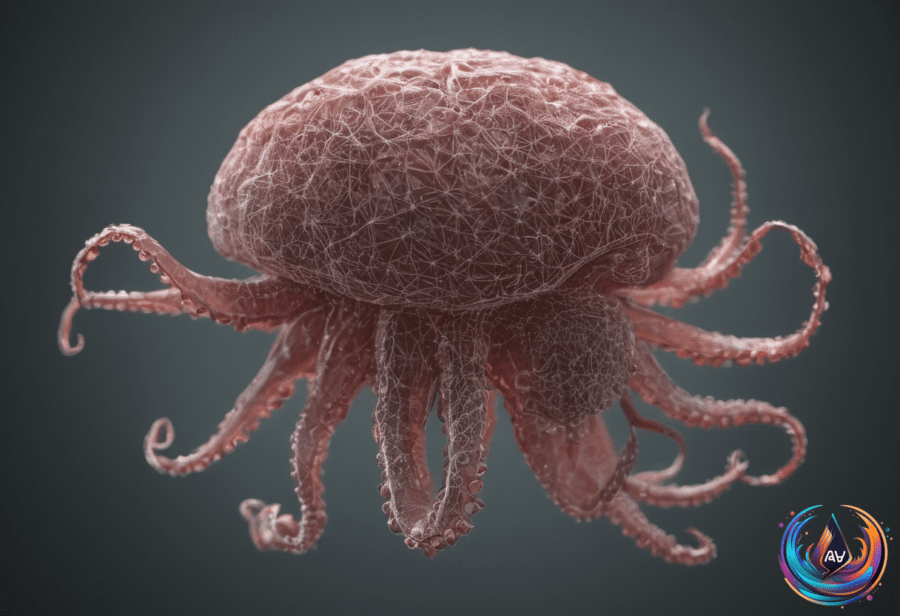
The octopus offers another way to think about neural organization. An octopus has roughly 500 million neurons, and more than two-thirds of them reside in its eight arms. That distribution places much of its nervous system outside the central brain.
The contrast with human brain models is striking without requiring the same design. Digital platforms focus on networks containing 86 billion neurons, while octopus biology places most of its neurons across eight arms. Both examples show how nervous systems can spread computation through connected structures.
The same period of research has also produced systems that use artificial intelligence for biological discovery. One artificial intelligence system created 16 previously unknown viruses capable of infecting bacteria. Fernanda González contributed to discussion of the AI-created viruses, adding another example of computing systems being used to explore living biology.
Taken together, these developments cover several kinds of biological and digital experimentation: living neurons connected to electrodes, organoids placed in robotic systems, detailed maps of human cortex, computer models of entire neural networks, and AI systems creating previously unknown viruses. The projects do not turn one method into a replacement for the others. They build different ways to study how cells connect, communicate, and produce organized activity.
Brain organoids remain small and short-lived, while digital brain platforms can represent networks across billions of neurons and trillions of synapses. The octopus shows a nervous system with most neurons distributed through its arms, and the reconstructed cortex shows what researchers can learn from a cubic millimetre of tissue. Together, these examples make one point clear: brain research now extends from living cells in dishes to digital networks at human scale.
Based on
- AI Is Dead. Organoids Are Alive — wired.com
- Why Each Octopus Arm Has a Mind of Its Own | WIRED — wired.com
- AI Hacks Are Bad. AI Worms and Viruses Will Be Worse | WIRED — wired.com
- Scientists Used AI to Create 16 New Viruses | WIRED — wired.com
- Building digital twin brains at the limits of measurement | Nature Reviews Electrical Engineering — nature.com