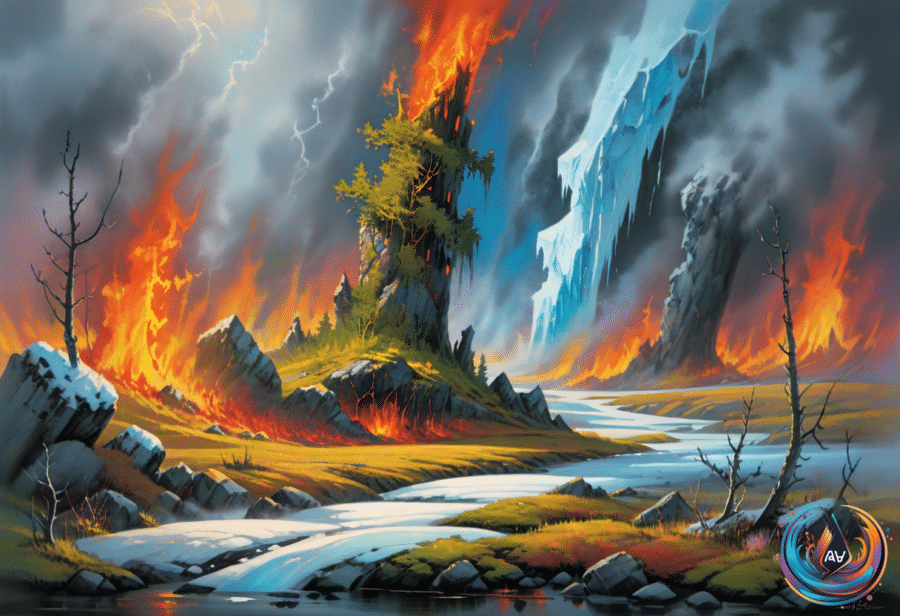
A wildfire can burn through a forest in hours, but its impact on frozen ground can last for decades. Researchers are investigating how stopping Arctic fires might slow permafrost thaw before the land releases vast stores of greenhouse gases.
The warning is visible at the University of Alaska, Fairbanks, where a wildfire tore through campus forest in July 2021. The fire was possibly sparked by lightning, raced across a dry carpet of feather mosses and lichen, then climbed into the crowns of the trees. Flames reached 12 feet in length and sent a 500-foot column of smoke into the sky.
A Fire That Changed the Ground Below
After the flames passed, researchers tested the ground around the burn scar. Just outside the scar, a probe hit a concrete-like layer about a foot below the surface. Inside the burned area, where the fire had removed the moss and organic-rich topsoil, the probe plunged at least three times deeper.
That difference showed how fast fire can alter the frozen ground beneath a forest. “That was an immediate effect of the fire,” said Alison York. “When we monitored right after, it had already thawed quite a bit.”
Eric Miller recorded the thaw depth, while Hilary Shook and Alison York worked as coordinators with the Alaska Fire Science Consortium. In 2024, researchers turned the burned area into an educational walking trail, giving visitors a direct view of how wildfire changed the forest floor.
The fire exposed a major climate risk. Permafrost underlies 15% of the land around the Northern Hemisphere and stores roughly twice as much carbon as the atmosphere. The permafrost encircling northern latitudes holds around 1.5 trillion tons of carbon, yet it has shrunk by about 12% since 1850.
The Arctic Carbon Threat Is Accelerating
The far north is warming as much as four times faster than the rest of the planet, and that heat is reshaping wildfire behavior. Lightning strikes that set off fires have increased sharply because warmer air creates more convective energy. Wildfire emissions have risen 60% worldwide since 2001, while emissions from boreal forests in the far north have nearly tripled.
Canada’s 2023 wildfires released more carbon than the nation’s combined fossil fuel emissions. That figure shows how fire can erase years of progress when forests and frozen ground release carbon in the same cycle.
If fires and warming continue unchecked, the world’s boreal forests and permafrost could shift from carbon sinks into carbon sources. By 2100, fire-driven permafrost thaw could release about 80 billion tons of carbon dioxide. That amount is more than half the emissions from direct vegetation combustion and would come on top of 400 billion tons from warming-induced thawing.
Most climate models do not include the gradual loss of permafrost or the abrupt collapse that follows fires and heat waves. Brian Buma described warming-driven emissions as a “massive blind spot” in climate modeling, a gap that makes the future carbon balance harder to see.
Can Fire Management Protect Frozen Carbon?
A 2022 paper found that efforts to put out boreal fires could offer a cost-effective climate solution. Woodwell Climate Research Center researchers have discussed fire emission mitigation with Alaska forest managers and agencies for several years, working with the University of Victoria’s Polis Institute for Ecological Governance and the Alaska Venture Fund.
The challenge is policy as much as science. Alaska’s general policy allows fires in remote areas to burn unless they threaten communities. That approach focuses limited resources on immediate threats to people and settlements, but a remote fire can still damage permafrost and release carbon long after the flames disappear.
Brendan Rogers, a senior scientist at the Woodwell Climate Research Center, captured the pressure facing fire managers: “We need to figure out a better way to live with wildfire.”
Fire ecologist Randi Jandt of Alaska Fire Science and Kate Hayes, an assistant professor at Western Washington University, are part of the wider effort to understand what intervention can achieve. Hayes offered a stark assessment of the problem: “We’ve already intervened, arguably. And so from here, it’s a little bit of a Band-Aid on a bullet wound.”
That question now reaches beyond a single burned campus forest. Researchers must determine where fighting fires can protect communities, where it can preserve permafrost, and how those choices should shape climate models. The University of Alaska, Fairbanks trail turns an invisible process into something people can see: remove the surface layer, and frozen ground can begin to thaw almost at once.
The next phase of Arctic fire research will connect field measurements, fire policy, and climate projections. As flames spread farther across northern forests, that connection may decide whether permafrost remains a carbon vault or becomes another source of atmospheric emissions.
Based on