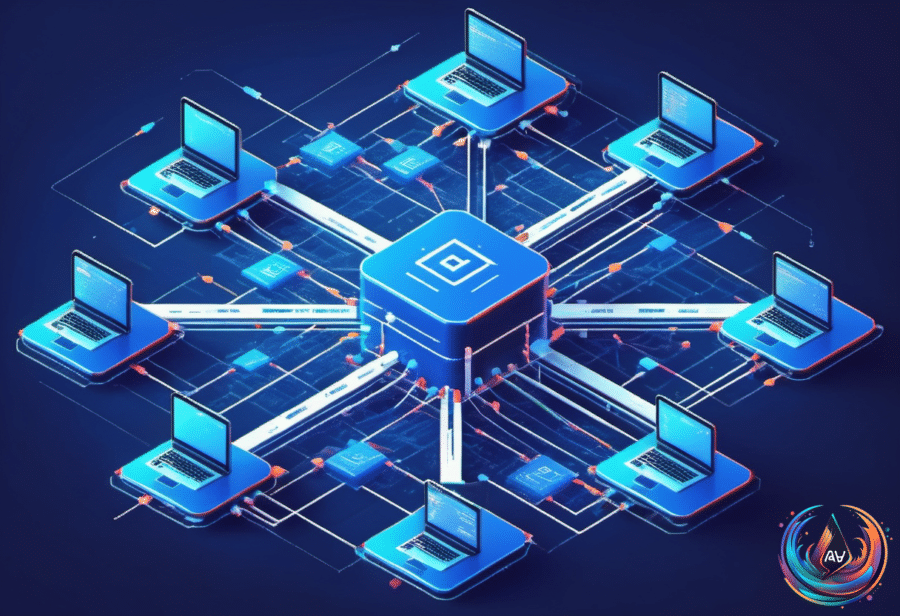
Microsoft is removing the manager from multi-agent coding. Microsoft Research has open-sourced Agensh, a decentralized harness for large teams of coding agents that coordinates many LLM agents without a lead agent. Its central claim is simple: let workers choose tasks, exchange findings, and merge code into a common Git repo instead of routing every decision through one central orchestrator.
In the usual orchestrator-worker design, a lead agent plans, assigns, and merges all work. Agensh lets the workers handle that coordination themselves, with each worker running the same 5-step loop concurrently and asynchronously: Gather context, Claim a sub-task, Take action, Verify results, and Merge progress.
The system uses three services to keep that swarm from becoming a collection of isolated coding sessions. Gitea hosts the shared workspace, branches, pull requests, and merge conflicts; Mattermost provides a team channel and direct messages for urgent collisions; and a shared context board adapted from DeLM stores typed notes marked OBSERVED, FACT, FAIL, CLAIM, and PATCH_SUMMARY.
The loop lives in the prompt, not in runtime code. Every worker receives the same prompt except for its ID, and Agensh sits on top of a single-agent harness. The experiments used GitHub Copilot CLI, while the research paper states that thin adapters can connect other harnesses, such as Claude Code.
Scaling from one agent to 1,024
Microsoft tested Agensh on the five hardest ProgramBench tasks: FFmpeg, gromacs, pandoc, PHP-src, and ctags. Agents rebuilt each program from its observed behavior, worked offline within 6 hours, and tackled reference repositories ranging from 2,767 files for pandoc to 26,266 files for PHP-src.
Using GPT-5.6-sol at high reasoning effort, the mean final test-pass rate rose from 19.31% with 1 agent to 20.68% with 8, 26.52% with 32, and 28.78% with 128. That is a 9.47-point gain, or about 49% relative. The first jump was modest—1 to 8 agents added 1.37 points—but the broader pattern held across all five tasks, with more agents raising scores and reaching those results sooner.
Pandoc produced the clearest scaling curve. Scores moved from 33.89% with 1 agent to 41.75% with 8, 43.11% with 32, 50.94% with 128, and 55.06% with 1,024 agents. At the 30-minute checkpoint, 128 agents had passed 30%; 32 agents needed 60 minutes, while 8 agents needed 90 minutes. The swarm did not merely add meetings to the calendar—it finished sooner.
The setup runs on Linux with Docker Compose, using a single node by default with 8 workers. The 1,024-agent run used 16 nodes with 64 agents each, within a 64 GiB memory ceiling, and handled a 272,000-token input with a 128,000-token output limit.
Coordination emerged instead of being assigned
The research team traced worker trajectories at each scale and found new coordination patterns as the groups grew. At 8 agents, peers agreed on interfaces and resolved overlapping claims themselves. At 32, peers reviewed shared work, and one approval was withdrawn after a counterexample.
At 128 agents, workers reused trusted reviewers and standardized an integration protocol. At 1,024, several workers acted as integrators while peers recovered failed work. None of these roles was hard-coded, which is the interesting part—apparently the agents can invent bureaucracy without being asked.
The README adds a newer model result that does not appear in the v1 paper. With GPT-6.1-sol, pandoc rose from 56.19% with 1 agent to 79.59% with 32 agents, a 41.64% relative gain. Those figures do not replace the GPT-5.6-sol scaling results; they show how the harness behaves under a different model and configuration.
Agensh is still a harness rather than a claim that every coding problem wants 1,024 workers. Its value lies in removing the single point of control, giving agents shared state, and allowing coordination patterns to form through prompts, messages, claims, reviews, and merges. The experiment suggests that large coding teams may scale through distributed judgment—not by building one very impressive manager and hoping it never gets confused.
Based on
- Microsoft Open-Sources Agensh: A Multi-Agent Harness for 1,024 Agents — marktechpost.com
- Researchers made AI agents better by turning academic papers into working code — no retraining required | VentureBeat — venturebeat.com
- Agentic AI Foundation Announces Four New Projects: Agent Skills, Open Responses, OpenEnv, and OpenSandbox | AP News — apnews.com
- A coding agent’s harness can triple its cost without making it more accurate, study finds | VentureBeat — venturebeat.com
- 97% of Developers Express Concerns About Cloud Access for AI Agents but 79% Grant Access Regardless, According to 2026 State of AI in Cloud Development Report | Markets Insider — markets.businessinsider.com