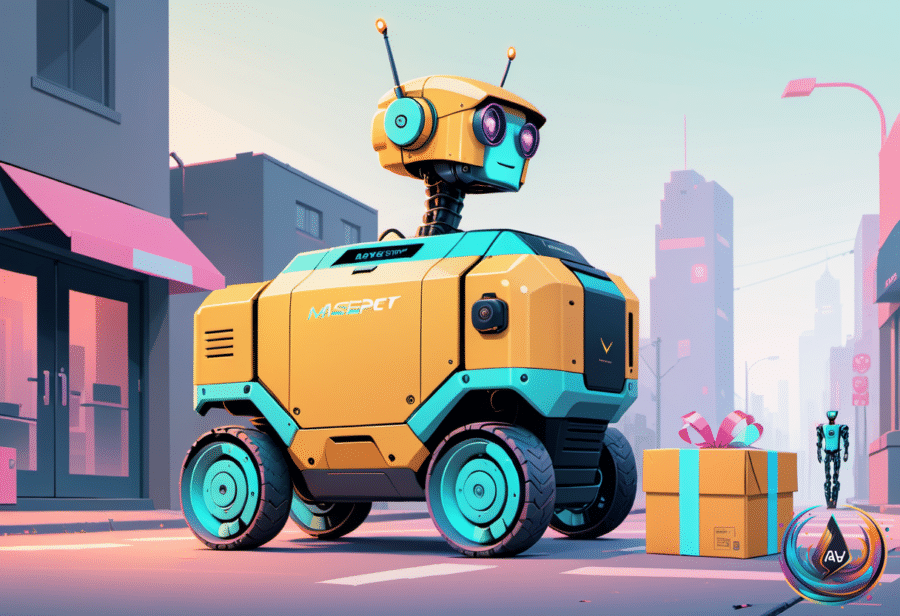
Serve is opening its sidewalk robots to software. On November 11, 2026, Serve Robotics launched the AV Delivery Developer Portal, giving independent developers, businesses and AI assistants access to a public API for its 2,000-robot sidewalk fleet. The portal also includes a sandbox where teams can test the full delivery process without sending a physical robot into the world.
That changes who can use Serve’s delivery network. The fleet had been available only through third-party delivery partners, but outside applications can now request deliveries without building an integration with a large delivery platform such as Uber Eats. Serve reports hundreds of thousands of completed deliveries across more than 150 neighborhoods in 20 U.S. cities, giving the API a real operating footprint instead of a glossy demo fleet that exists mainly in a presentation.
The new tools let local businesses add robot delivery to their own websites and checkout registers. Serve presents merchant deliveries to customers, inter-office transport, expanded local-business delivery and delivery features inside existing apps as possible uses; its examples also include personal errands and tasks assigned to AI assistants.
Availability still depends on the location, operating hours and item being sent. Deliveries must stay within active service areas and operating hours, and each item must fit inside the robot’s insulated compartment, which can hold up to four large pizza boxes plus drinks and sides.
An API Built Around Quotes, Jobs and Robot Tracking
The official Delivery API documentation describes three principal REST calls: request a quote, create a job from an accepted quote and poll the job until its status becomes dropoff_complete. A quote response includes an identifier, fee and estimated drop-off time, but each quote expires after five minutes and can be used only once.
Applications that always accept the quoted price can use an instant-jobs endpoint, which combines quoting and job creation. Developers can also retrieve a job’s planned route and display it on their own map, while the application or AI assistant supplies pickup and drop-off details, confirms the delivery and tracks the robot.
Serve keeps control of the hard physical work: dispatch, routing, navigation and supervision. That lets developers add physical delivery without operating robots themselves, a sensible division of labor unless someone has been waiting for an opportunity to debug a sidewalk robot at lunchtime.
The sandbox runs the complete delivery lifecycle against simulated robots. Developers can force eight rejection conditions, including pickup or drop-off locations a robot cannot traverse, excessive delivery distance, requests outside operating hours, unreachable pickup or drop-off deadlines, busy couriers and internal errors.
Sandbox access does not authorize live deliveries. Real-robot dispatch requires Serve’s approval, with early-access invitations opening one neighborhood at a time. Robots dispatched through the API remain subject to standard remote monitoring by trained supervisors and the safety systems built into each vehicle.
Serve Wants More Than Delivery Orders
The portal follows Serve’s November 5 launch of Physical AI Services, which opened the technology behind its robots to companies developing new types of robots. That business offers connectivity and data tools, including Serve Link for connecting robots in the field to AI systems running in data centers, a data curator tool for finding edge cases in real-world robot data and a real-world foundation-model data catalog built from Serve’s sidewalk robots.
Bedrock Robotics is a customer, and Serve is working with T-Mobile to bring AI computing power closer to robots. The company already makes a sidewalk delivery robot and a hospital robot acquired through Diligent Robotics, so the strategy reaches beyond one cute machine with googly eyes and a compartment for pizza.
Serve CEO and co-founder Ali Kashani described the broader move as “the AWS moment where we are taking the technology we’ve built for us, and we’re opening it up for more people to build on.” He also said, “We are solving the problem of robots in human spaces,” which is a useful description of the engineering challenge—and a less useful promise if the robot cannot reach the address.
For Serve, the business case is also about reducing dependence on major delivery apps. Kashani said, “The reality of food delivery platforms is that usually they dominate their markets,” adding, “Food is generally very picky.” Lunch and dinner create demand, he said, “But then there are times in between. So again, having that diversification helps.”
Delivery apps such as DoorDash and Uber Eats take 15 percent to 30 percent of every order. Serve says its direct tools can help local shops avoid those middleman fees, while Kashani argues that robot delivery “would be a fraction of that cost.”
Serve was spun out of Postmates in 2021 and went public in 2024. Its sidewalk robots, which have a top speed of around 6 mph, have made Uber Eats deliveries in Los Angeles, Miami, Dallas and dozens of other cities, while the company’s delivery business shifts toward partners including DoorDash and Wonder.
The portal does not make autonomous delivery universal, cheap or available everywhere. It does make Serve’s fleet into infrastructure that software developers can call, test and build around—provided Serve approves the neighborhood, the route works and the robot is not already busy doing something else.
Based on
- Serve Robotics Opens Delivery Fleet to Developers and AI Agents — unite.ai
- Serve Robotics Opens Its Robot Delivery Network for Anyone to Build On | Markets Insider — markets.businessinsider.com
- Serve Robotics wants to democratize sidewalk delivery robots | The Verge — theverge.com
- Serve Robotics launches new business to become the AWS for robots | TechCrunch — techcrunch.com
- Arrive AI Announces Strategic Investment in Ottonomy to Accelerate Autonomous Delivery Network Expansion – USA Today — usatoday.com