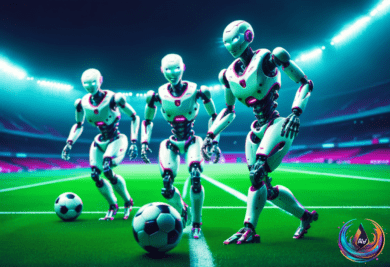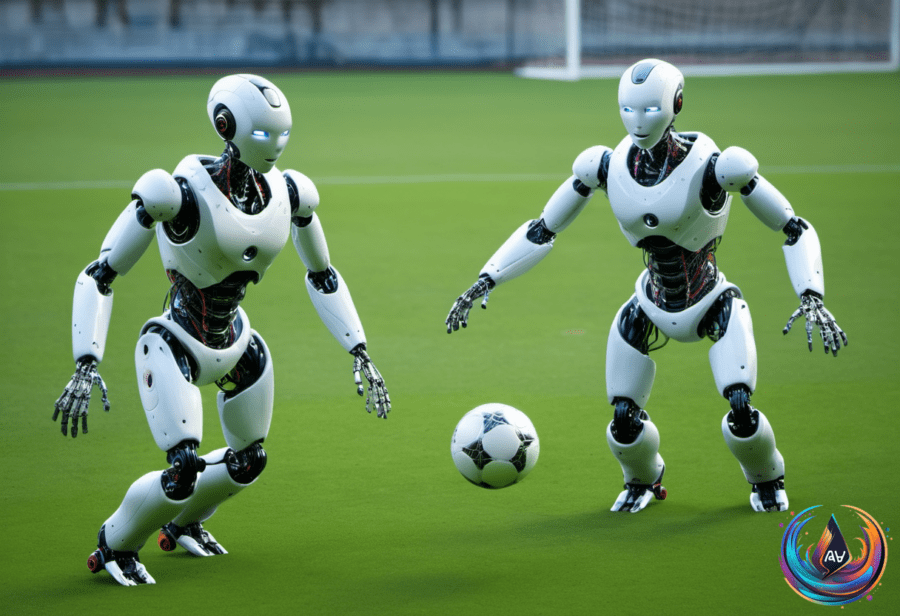
Robots just scored a major milestone! Imagine two full teams of humanoid robots playing an 11-vs-11 soccer match. That’s right—an entire robotic soccer game unfolded for the first time ever. This isn’t just a game. It’s a glimpse of where robotics is headed: real-world coordination, agility, and teamwork.
And it doesn’t stop on the field. Meet the new wave of robotic marvels. MIT and EPFL teamed up to build a robot that swims underwater and then flaps out of the water to fly through the air. This hybrid mobility breaks barriers between water and sky. It’s a robot that masters multiple environments.
Robotic Hands and Feet That Feel and Adapt
Boston Dynamics just raised the bar again. Their latest robotic hands have 25 fully actuated degrees of freedom. These hands are tendon-driven, packed with tactile sensors, and built to be compliant. That means they sense touch and adjust grip strength like living hands. Perfect for handling fragile or complex objects.
On the ground, quadruped robots now walk safer and smarter. Proximity sensors embedded in their feet let them seek out terrain without stumbling. This terrain-seeking autonomous locomotion is a game changer for robots navigating rough or unpredictable surfaces.
Even Atlas, Boston Dynamics’ famous humanoid, got in on the action. It kicked off the second half of a recent soccer match at NYNJ Stadium by delivering the match ball. This moment showcased humanoid robots stepping into real-world social settings.
GEN-1: AI That Speeds Up Robot Learning and Success
What if robots could learn tasks with barely any data? GEN-1 is a general-purpose AI model that does just that. It boosts success rates on certain tasks up to 99%. It also finishes tasks about three times faster than previous methods. And here’s the kicker—it needs only one hour of robot data to achieve those results.
This breakthrough slashes training time and increases robot efficiency. Robots become smarter faster, making them more useful in factories, homes, and beyond.
Optical Interconnects: The Future of AI Hardware Networking
On the hardware side, Nvidia is revolutionizing AI system design. In 2025, they introduced NVLink Fusion. This new tech lets hyperscalers and cloud providers build custom AI systems using a mix of optical and electrical interconnects. Think of it as a supercharged data highway for AI processors.
Today, Nvidia connects up to 72 GPUs in systems. By 2027, they plan to scale this to as many as 576 interconnected processors. The jump is massive. To pull this off, they’re tapping into optical interconnects—moving data as light instead of electricity.
Optical systems depend on cutting-edge manufacturing. Advances in hybrid bonding now allow electronic and photonic chiplets to be made separately. Then, they integrate these chiplets into a single optical engine. This method boosts performance and reduces complexity.
Lightmatter, a key partner, designed a 3D photonic connector. It packs input and output ports across the entire chip area. They’re also building a photonic interposer. This acts as a packaging substrate that lets processors stack directly on top of silicon photonics engines.
This innovation means AI systems can scale up bandwidth and processor counts without hitting traditional copper wiring limits. As Keren Bergman, a professor of electrical engineering, said, “More than any other time that I recall, I think it’s concluded that the co-packaged optics will happen.”
Industry experts expect multiple optical scale-up systems to hit high-volume production by 2028. Vishal Chandrasekar of Ayar Labs confirms, “There are going to be multiple implementations in the 2028 time frame in very high volume.”
Jesse Clayton, an industry researcher, explains why Nvidia’s approach matters: “Starting at the scale-out space, and then in the future moving to scale-up is kind of a sensible, measured approach from our perspective.”
What’s Next for Robotics and AI Hardware?
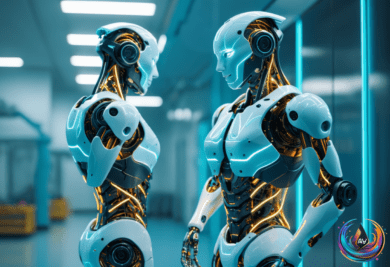
Robots are teaming up on the field and mastering new environments. Hands that feel, feet that sense, and AI that learns fast are pushing robotics closer to everyday use. Meanwhile, AI hardware is gearing up with optical interconnects to handle massive data flows.
The race is on. Will robots soon become as agile and smart as humans? Will AI chips light up with photonics to power the next wave of breakthroughs? One thing’s clear: robotics and AI hardware are evolving together at lightning speed. The future just got brighter—and faster.
Based on
- Building a Foundation Stack for General-Purpose Robots — spectrum.ieee.org
- Nvlink Fusion Optics Push Past the Copper Wall – IEEE Spectrum — spectrum.ieee.org
- Videos: Robot World Cup, Fighting Robots, and More – IEEE Spectrum — spectrum.ieee.org
- Robot workers rising: How AI may drive general-purpose autonomy in robotics | Ars OpenForum — arstechnica.com