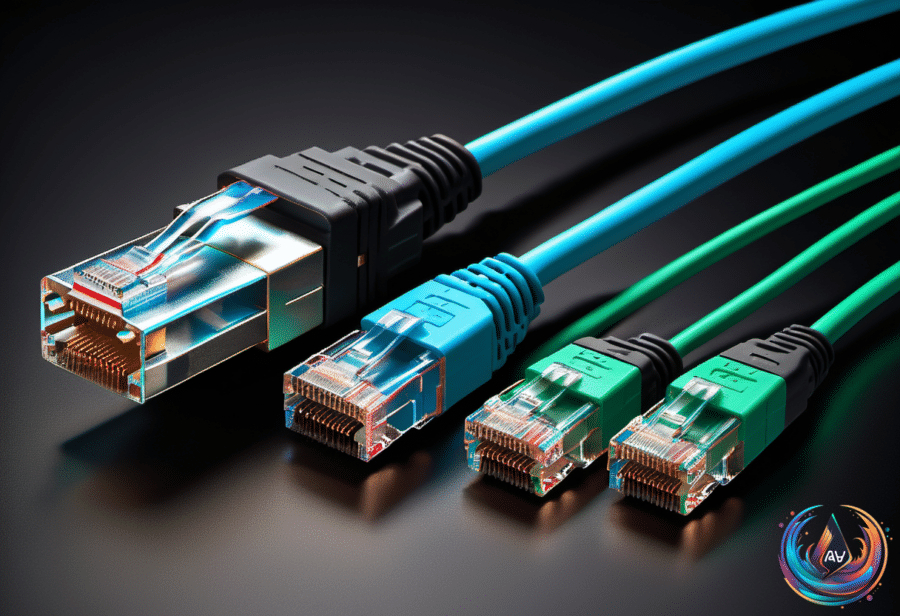
The most expensive Ethernet cable is not necessarily the fastest one for your setup. Ethernet performance follows the limits of the entire connection, so a premium cable cannot push a network beyond what its ports and other links can handle.
That makes cable shopping less about chasing the highest category number and more about matching the cable to the equipment, distance, and construction quality. Price and speed simply do not move in lockstep.
Your Ports Set the First Speed Limit
Connect two 1GbE devices, and the link still tops out at 1Gbps. Ethernet devices negotiate based on the capabilities at both ends, which means the cable cannot overrule the ports.
This principle applies across the connection. The speed you actually see is limited by the slowest link in the chain, so installing a cable with a higher category rating will not create a faster link when the connected devices support a lower speed.
The result is a simple but important warning: buying the most expensive cable does not guarantee a higher speed. A cable can support a higher data rate, but the equipment at each end must support that rate too.
What Cat5e, Cat6, Cat6A, and Cat8 Can Handle
Category ratings still matter because different cable types support different performance levels and distances. Cat5e can support more than Gigabit Ethernet, and the Telecommunications Industry Association has issued guidance for running 2.5Gbps and 5Gbps Ethernet over existing Cat5e and Cat6 cabling.
Cat6 can support 10Gbps over shorter distances. That 10Gbps connection should operate over Cat6 up to 37 meters, then between 37 and 55 meters depending on interference.
For a full 100-meter 10Gbps run, Cat6A is the cleaner choice. The distance changes the decision, so a cable that fits one setup may not fit another, even when both cables carry the same category label.
Cat8 moves into a different class of capability. It can support 25Gbps and 40Gbps over a maximum channel length of 30 meters, and it is shielded by design.
Networking needed a boss level, which is why Cat8 was designed. But its impressive capabilities do not change the limits created by the ports at each end, and its maximum channel length remains 30 meters.
Cat7 adds another wrinkle to the category labels. It is recognized under ISO standards, while the Telecommunications Industry Association decided not to include Category 7 in its North American cabling standard.
That makes a higher category number a poor shopping strategy. The number alone does not tell you whether the cable matches the equipment, distance, or standards relevant to your setup.
Construction Matters More Than a Big Price Tag
Low-cost Ethernet cables can do just fine, but shoppers still need to inspect how a cable is built. A cable that takes shortcuts in construction, especially one made with copper-clad aluminum, is a red flag.
Aluminum has approximately 55 percent greater resistance than copper of the same diameter. That higher resistance can lead to more heat and lower voltage available at Power over Ethernet devices such as cameras, access points, and phones.
US and international twisted-pair cabling standards require 100 percent copper conductors. The conductor material therefore matters for more than a label or a price comparison, especially when Power over Ethernet devices depend on the cable.
Certification can offer another way to check whether a category claim reflects tested performance. UL Solutions, the testing and certification organization behind the familiar UL mark, has a performance verification program for Category 5e, 6, 6A, and 8 cabling.
A UL Verification Mark offers a better indication that the category listed on the jacket is not just for show. It does not turn a cable into a faster connection than the network ports support, but it helps separate legitimate construction from shortcuts.
Legitimate cables are not necessarily expensive. Monoprice offers 10-foot Cat6 cables with pure bare copper conductors and gold-plated contacts for less than $5, while a shielded 10-foot Cat6A cable is available for less than $10.
The smarter upgrade starts with the slowest link, then checks the required distance and conductor material. Match those details to the cable, and the network can get the capability the equipment is ready to use without treating a bigger price tag as a speed guarantee.