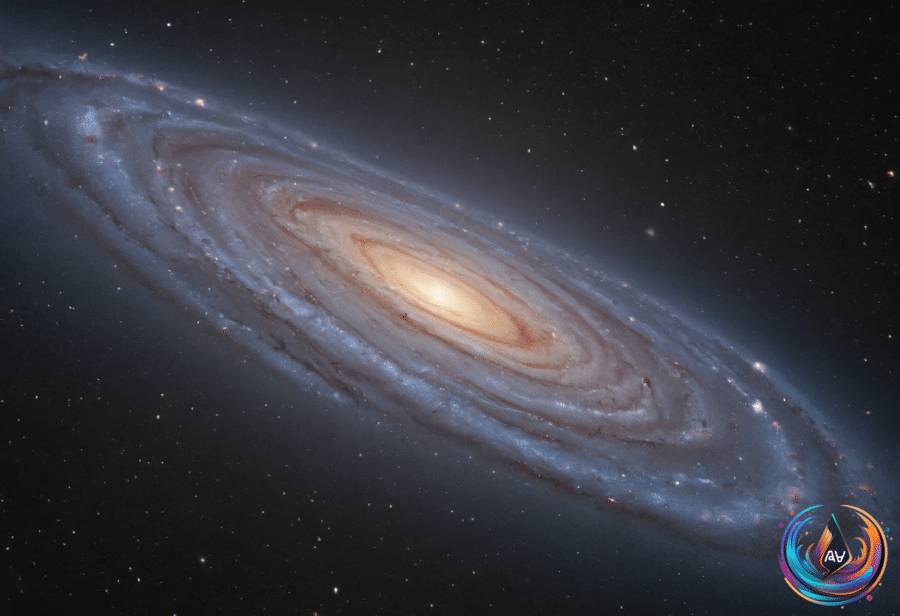
A brief radio signal that crossed 10 billion light years before reaching Earth is giving scientists a rare look at the young universe. Known as FRB 20240304B, the burst came from a galaxy at redshift 2.148, making it the most distant fast radio burst detected to date.
The signal reached Earth in 2024 after traveling across a large part of cosmic history. Its discovery was announced in a paper published in Science, marking a major step in the study of fast radio bursts, or FRBs.
A signal from the early universe
The MeerTRAP Project found FRB 20240304B using South Africa’s MeerKAT radio telescope. The burst was detected in March 2024, and its large amount of dispersion showed that it had traveled an immense distance before reaching Earth.
Dispersion happens as a radio signal moves through matter. Different parts of the signal spread out during the journey, leaving information about the material between its source and Earth. In this case, the effect pointed to a source far beyond most known FRB host galaxies.
Scientists used the signal’s spectrum and the stretching of its light caused by the expansion of the universe to calculate its distance and age. The burst came from a galaxy that existed 10.6 billion years ago, or about 10 billion years old. The discovery shows that fast radio bursts were already being produced around three billion years after the Big Bang.
Manisha Caleb of the Sydney Institute for Astronomy said, “Approximately one hundred FRBs have identified host galaxies with measured redshifts, with the vast majority at redshifts z ≲ 0.5.” Only a small number of host galaxies have been identified at redshifts z ≳ 1, which makes FRB 20240304B stand out.
Finding a galaxy too faint for ground telescopes
Follow-up observations with the James Webb Space Telescope pinpointed the burst’s host galaxy at redshift 2.148. The galaxy was too faint to be seen with large ground-based telescopes such as the Keck Telescopes, but JWST identified it in the distant universe.
The host is a low-mass, star-forming galaxy with low metallicity. It contains about 10 million times the mass of the Sun, a small amount compared with many galaxies observed closer to Earth. Its high star formation and low metal content offer clues about the conditions around the source of the burst.
That setting also fits the theory that some FRBs come from magnetars. These objects are linked to powerful magnetic fields, and the signal itself carried an imprint of the magnetic fields and matter it traveled through. Studying that imprint gives scientists a way to examine the material spread between galaxies.
The host galaxy’s properties also help narrow the possible origin of the burst. Caleb said, “Our work suggests that it’s very unlikely that this [fast radio burst] was produced by a merger.” The galaxy’s youth, low metal content, and high star formation instead fit an environment where magnetars could form.
Using radio bursts as cosmic probes
FRB 20240304B is valuable for more than its distance. Because the signal crossed such a large stretch of space, scientists can use it to study electrically charged matter across approximately 80 percent of cosmic history. That includes material that can be difficult to observe through other methods.
Nanayakkara described the finding as “an extraordinary glimpse into the distant Universe.” The burst connects a rare event in a small, young galaxy with the larger question of how matter was spread through the universe over time.
Each distant FRB can add another measurement to that picture. As the signals travel, their radio waves record traces of the matter and magnetic fields along their paths. Comparing bursts from different distances can reveal how those conditions changed across cosmic history.
Nanayakkara said, “Our discovery is particularly important because we have shown that we can do this across approximately 80 percent of cosmic history.” That reach gives the discovery importance beyond a single record.
The next goal is to find more distant bursts and identify their host galaxies. Nanayakkara said, “The more distant FRBs we find, the stronger the constraints we can place on the objects and emission mechanisms that produce them, the environments in which they occur and the distribution of matter across the universe.”
FRB 20240304B shows what that approach can reveal: a signal from 10 billion light years away, a galaxy that existed 10.6 billion years ago, and a record of the matter crossed along the way. A short radio burst has become a tool for studying both the galaxies that produced it and the space between them.
Based on
- Scientists Detect Record-Breaking Radio Signal from the Ancient Universe — 404media.co
- Webb Telescope Detects Galaxy Origin Of The Farthest Fast Radio Burst We’ve Seen To Date — engadget.com
- Astronomers find mysterious signal coming to us from the early universe | The Independent — independent.co.uk
- Scientists trace radio burst to a 10 billion-year-old distant galaxy | The Independent — independent.co.uk
- Astronomers discover record-breaking ancient cosmic outburst | Scientific American — scientificamerican.com