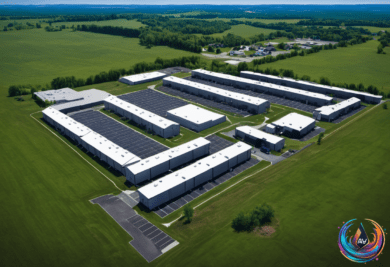
Data centers are everywhere now. The United States alone has about 4,600 of them. That’s roughly 1,000 more than the next 10 countries combined. Almost 40% of Americans live within five miles of at least one data center. These facilities power everything from social media to AI, but they come with big costs for local communities.
Take Dowagiac, Michigan, for example. Neighbors there live with a constant screeching noise. It sounds like a vacuum cleaner left on and forgotten. One resident described it as “someone set up a vacuum, like in your living room… and they just left it on and walked out.” Billy Finn, who lives nearby, said the noise “is like torture.” He added, “You’ve seen movies where someone is tortured with sound. That’s basically what it is.” The data center causing this is a 30 megawatt tech facility.
In Loudoun County, Virginia, data centers cover more than 53 million square feet now. That footprint has more than doubled in five years. Virginia alone has around 640 data centers. This growth forms a pattern across states with many data centers. They use huge amounts of electricity—equal to what 100,000 households need. The power for new data centers under construction could be 20 times that. Data centers already use 4.4% of all U.S. electricity. Experts project that will rise to 8.5% by 2027.
Communities Push Back Against Data Center Expansion
Many communities are pushing back. Frederick County, Maryland, has seen protests against new data centers. Residents worry about dust, pollution, and water shortages. They also want farmland to stay farmland, not become industrial sites. One planned data center there would have 99 diesel generators. That raised alarm bells for air quality and noise.
Elizabeth Bauer, a Frederick County resident, helped gather signatures for a referendum to pause data center growth. The effort aimed to give people a voice in local decisions. She said, “The whole effort was not to fight data centers, it was to give people a voice.” The Maryland Supreme Court blocked this referendum. Bauer worries the new local council could change zoning maps and allow more centers.
New York state took a different approach. Governor Kathy Hochul imposed a one-year moratorium on building new large-scale data centers. This pause gives officials time to study impacts before approving more projects.
OpenAI’s Massive Georgia Project and Resource Concerns
Not all data center news is about conflict. OpenAI announced a $20 billion data center near Savannah, Georgia. It will sit on a 1,400-acre campus in Effingham County. The project requires 3.2 gigawatts of power delivered in phases from 2028 to 2032. OpenAI promises minimal water use thanks to a closed-loop system. This system recycles water to avoid waste.
The company pledged $80 million in community benefits and up to $71 million in Codex credits for local students. They expect to create thousands of construction jobs and over 1,000 permanent roles. Still, OpenAI’s CEO Sam Altman admitted, “AI is not very popular in the US right now.”
Water use is a big concern. Data centers can consume up to five million gallons daily. Harvard biostatistics professor Francesca Dominici pointed out that companies often pick sites with cheap land and quick political approvals. She said, “They’re not looking at the water issues at all.” This pushes local resources and raises environmental questions.
Wider Impact and Growing Opposition
Electricity prices have surged in states with many data centers. They saw a 267% increase over five years. This rise worries residents who face higher utility bills. More than 1,500 data center sites are under construction nationwide. But opposition is growing too. By May 2026, over 430 Facebook groups opposing AI data centers had more than 525,000 members.
Early in 2026, at least 75 data center proposals worth about $130 billion were delayed or blocked. Residents in Virginia’s Loudoun County, Maryland, and the District of Columbia have been particularly vocal. Many call for better regulations to protect communities and resources.
Data centers are the backbone of modern technology. Yet their impact on neighbors and the environment is hard to ignore. Noise, water use, power demands, and land changes all add up. The pushback shows people want a say in how these giants grow. The future will likely include more debates about balancing technology with community needs.
Based on
- You Are Entirely Unprepared for the Noise This Data Center Constantly Blasts at Neighbors’ Homes — futurism.com
- Virginia ‘Data Center Alley’ residents ask who the AI boom helps — nbcnews.com
- OpenAI’s latest proposal shows it’s very aware that data centers are unpopular | Business Insider Africa — africa.businessinsider.com
- Beyond the noise in the data center debate — nbcnews.com
- US citizens are ramping up pressure on data centers — dw.com