Flood protection often has to happen before there is time to build anything permanent. WaveSave, a Dutch company developed in the Netherlands in 2013, is taking a different approach with SlamDam, a portable rubber barrier that can be installed during the early hours of a flood.
The system is designed for places that need protection fast, including farmland, personal property, hospitals, and water treatment plants. It has already been deployed during floods on three continents, and WaveSave has expanded into Africa and Southeast Asia, with SlamDam now used in at least a dozen countries.
How SlamDam Creates a Flood Barrier
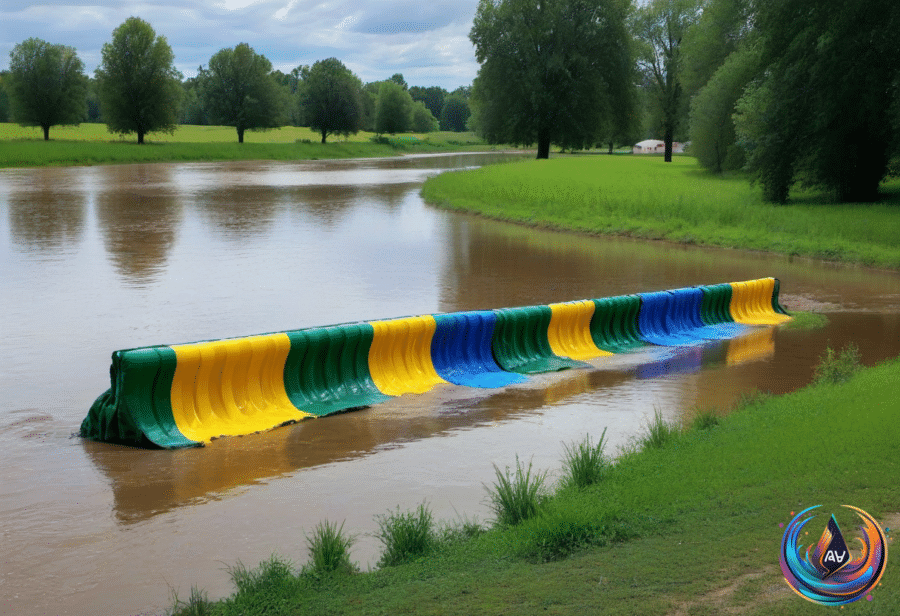
SlamDam arrives as a portable rubber dam that can be unfurled on the ground along a riverbank or shoreline. Users then pump it full of water, causing the barrier to swell into place. The process lets customers position a barrier where rising water threatens nearby property or structures without first constructing a permanent wall.
Once filled, the SlamDam can stand up to 1.3 meters high. That height is intended to shield homes, farms, hospitals, water treatment plants, and other facilities as floodwaters rise. The barrier can also be arranged around a site, depending on the area that needs protection.
The amount of SlamDam needed depends on the target. Protecting one entrance to a home or facility might require only 10 meters of barrier. Surrounding a facility or shielding a farm or neighborhood might require 200 to 300 meters.
That difference matters because the cost is tied to the length used. A five-meter section costs between €1,000 and €3,000, or about $1,140 to $3,400. A small installation can focus on one vulnerable opening, while a larger project can create a boundary around a much wider area.
Expansion From Demonstrations to Larger Projects
WaveSave is demoing SlamDam on New York City’s Governors Island as one of seven winners in a competition for urban climate adaptations. The demonstration places the portable barrier in a city setting, alongside the company’s work protecting farms and critical facilities in other parts of the world.
The need for tools like this is tied to the number of people facing flood risk. By 2100, nearly 2 billion people will be exposed to floods because of climate change and population growth. That is an increase of 300 million people from 2020.
Those figures help explain why WaveSave is pursuing both direct projects and new ways to make SlamDam available. The company’s managing director, Omar Saleh, says WaveSave is looking into offering SlamDam as a service and deploying it on demand to make protection more affordable.
A service model could give communities access to flood barriers without requiring them to purchase and store every section themselves. The idea also fits the system’s purpose: putting protection in place when flooding threatens, then directing it where the need is greatest.
WaveSave has recently won contracts for four new projects in Burundi, Djibouti, and Guinea. Together, those projects total about $5.3 million, adding to the company’s work across Africa and showing that its expansion includes both product deployment and larger flood protection contracts.
Production Plans in Southeast Asia and East Africa
WaveSave aims to open a local production facility for SlamDams in Southeast Asia in early 2027. The company plans to follow that facility with a similar one in East Africa.
Local production would place manufacturing closer to regions where WaveSave has already expanded and where SlamDam has been deployed. The plan also supports the company’s push to serve more communities with a barrier that can be transported, unfurled, and filled with water when floods arrive.
SlamDam does not remove the threat of rising water, but it gives customers a way to respond during the first hours of a flood. For a single doorway, that may mean 10 meters of protection. For a farm, neighborhood, or facility, the response may stretch to hundreds of meters.
WaveSave’s work now covers demonstrations in New York City, flood deployments across three continents, contracts in Burundi, Djibouti, and Guinea, and planned production in Southeast Asia and East Africa. The company’s portable rubber dam is built around a simple idea: move the barrier to the water, fill it, and create protection before the flood reaches the property.