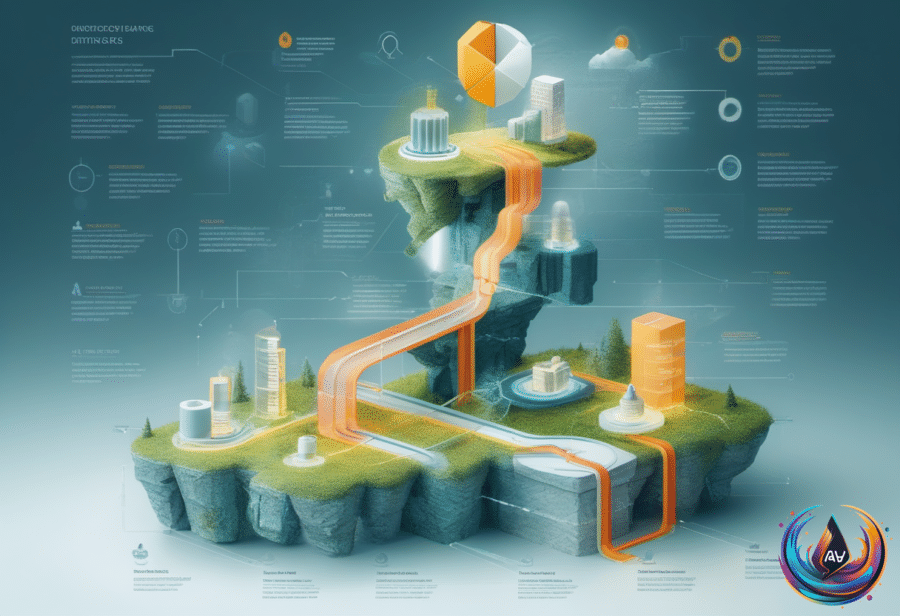
RAG systems do not search a document as one solid block. They divide source material into retrievable units, then decide which units should reach the model when someone asks a question. Those boundaries and the metadata attached to them shape what evidence the system can find and present together.
That makes chunking more than a technical setup choice. It affects answer quality, cost, testing, security, and the way information reaches people through AI-generated answers. The same basic issue appears in enterprise agents and AI visibility: a system can only use the information it receives, and the surrounding controls decide what happens next.
Chunking Is an Information Flow, Not a Buzzword
RAG chunking deserves a precise explanation because its name identifies a particular information flow, training choice, runtime mechanism, or governance boundary. Treating it as a synonym for “advanced AI” makes claims impossible to test.
A useful definition has three practical commitments. There must be an identifiable input, a transformation or decision that belongs to RAG chunking, and an outcome that can be measured against a stated objective. If one element is missing, the label may describe an aspiration instead of an implemented mechanism.
The nearest misleading shortcut is putting an entire document, or every sentence, into an index unchanged. That approach may share a visible feature with RAG chunking, but it changes the causal story. Different evidence would prove success, different resources would dominate cost, and different controls would prevent harm. The boundary is operational, not terminological.
Retrieval systems are pipelines. Parsing, representation, indexing, candidate generation, ranking, context assembly, and answer generation can each create or remove evidence. For RAG chunking, this system view matters because performance can depend on data, interfaces, hardware, permissions, and people even when the underlying model stays the same.
What the Chunking Pipeline Must Make Visible
RAG chunking transforms an input into an outcome through five observable operations. The map is a compact causal guide, not a claim that every implementation uses five software components. Some systems combine stages, while others repeat them in a loop.
The map remains useful because it forces every change in information or authority to have an owner, an input, an output, and a test. At the first stage, the system must parse the document’s real structure. That structure helps determine whether a retrieved unit carries the evidence needed to answer a question without losing its surrounding meaning.
Boundaries also affect context assembly. A useful answer may require several related pieces to appear together, while unrelated material can crowd them out. Metadata gives the system another way to distinguish those pieces, but each stage can still remove evidence before answer generation begins.
This is why companies can build RAG in days but face a harder task when they need it to run the business. Reliability requires evaluation and controls across the pipeline, not only a capable model. A useful test must connect the chosen chunking approach to a stated objective and show whether the resulting answer contains the right evidence.
The model’s learned behavior is only one part of the product. The product decides when and where that behavior is used, what information it can access, and what authority it has. That distinction becomes critical when retrieval feeds AI agents that can invoke tools, access enterprise applications, coordinate with other agents, and complete multi-step workflows with minimal human intervention.
Why Retrieval Quality Connects to Visibility and Risk
AI visibility refers to how often and in what context a brand appears in responses generated by artificial intelligence systems. These responses may name a business, recommend its products, summarize its services, or cite its website as an information source.
Traditional SEO focuses on website position in search results, but AI-powered discovery works differently. Conversational tools synthesize information from multiple sources into one response, so a strong website ranking does not guarantee that a brand will appear. Visibility varies by platform, prompt wording, available sources, and the question’s context.
A Pew Research Center analysis of browsing activity from March 2025 found that when a Google AI summary appeared, users clicked a traditional search result in 8% of visits, compared with 15% of visits without one. Only 1% of visits to pages featuring an AI summary produced a click on a link inside that summary.
That shift makes information quality important. Missing information, outdated product details, or an incorrect description can lead potential customers to consider alternatives. With the new Universal Shopping Cart, appearing accurately in search results matters more than ever.
Businesses can establish a baseline by testing questions their customers are likely to ask. For each prompt, they can record whether the brand appears, whether it receives a recommendation, which sources are cited, and whether the information is accurate. They can also test multiple versions of the same question across AI-powered platforms and repeat the process over time.
AI visibility tools can organize these observations, compare results, and reveal gaps, but the results are indicators rather than a universal ranking. Visibility, referral traffic, and business outcomes measure different things. Search rankings, website engagement, conversions, and AI-generated brand mentions should be read together.
Enterprise Controls Matter After Retrieval
Chunking is only one control in a larger system. AI agents can execute every tool call correctly and still break an enterprise rule if the surrounding control layer is weak. In multi-agent systems, one agent’s output becomes another agent’s context, so information can be lost or misread during a handoff, shared state can drift, and agents can enter loops or deadlocks.
Several agents using the same underlying model may even reinforce the same mistakes instead of catching them. Long-running workflows create another problem: a multi-day master data validation task may ingest thousands of records, while governance rules placed in the system prompt at the start disappear from active memory by day three. A larger context window does not fix that control problem.
Pipeline monitoring also needs to test meaning, not just completion. InMarket’s pipeline ran without errors but produced 40% wrong audience counts after a silent schema change. The lesson is direct: a job can finish while its numbers are wrong.
Security risks can appear between the data agents read and the systems they can change. That is why enterprise AI discussions now cover identity, permissions, tool access, and governance alongside model alignment, jailbreaking, and hallucinations. MCP’s largest revision since its initial launch shipped on July 28, with a 12-month deprecation policy keeping the changes in place through at least mid-2027.
The practical takeaway is simple: define the input, make each transformation visible, test the outcome, and assign authority at every stage. For RAG, that means treating chunking as part of a measurable retrieval pipeline. For AI visibility, it means checking whether information appears in the right context and with the right facts. For enterprise agents, it means ensuring that access and control do not disappear after the model receives the data.
Based on