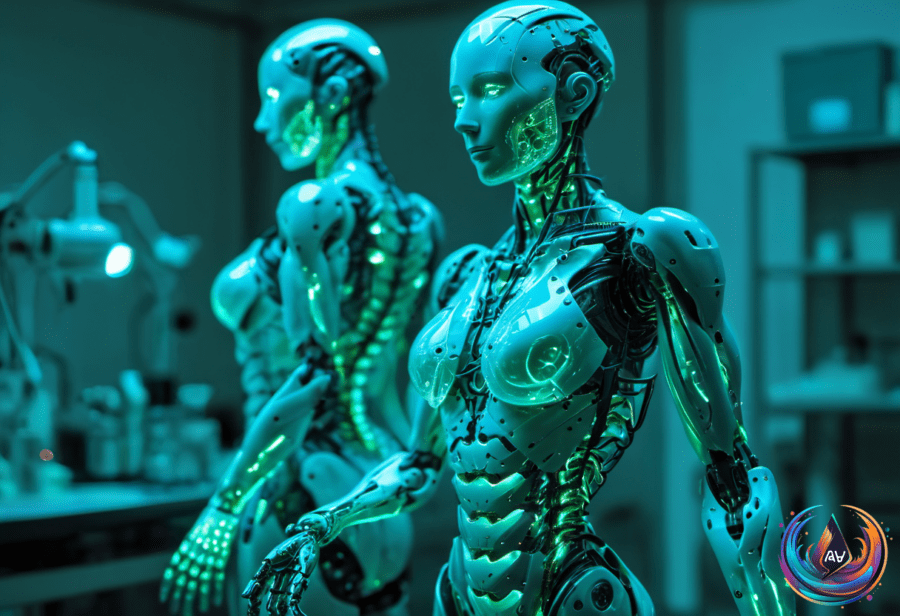
Ant Group’s AI division Robbyant just dropped LingBot-VA 2.0, a video-action foundation model built for physical AI. The announcement came on July 11, 2026, signaling a step forward in robot perception and interaction.
Two days earlier, on July 7, Robbyant revealed LingBot-Depth 2.0 and LingBot-Vision. LingBot-Vision outperformed the 7-billion-parameter DINOv3 model on the NYUv2 depth-estimation benchmark. It used only one-seventh of the parameters and less than a third of DINOv3’s training data. Efficiency without sacrificing accuracy is the name of the game here.
Meanwhile, UBTECH unveiled its full-sized ultra-bionic humanoid robot U1 series on the same day. The company plans to ramp production to 10,000 units annually by 2026. UBTECH’s founder Zhou Jian is clearly betting on humanoid robotics becoming a mass-market product sooner than many expect.
Industry watchers are taking note. ABI Research published a report on July 8 forecasting a $150 billion global market for robotics powered by foundation models by 2036. Manufacturing alone is expected to command a $30 billion total addressable market. Warehousing and logistics follow with $21 billion, healthcare with $16 billion, and restaurants, retail, and hospitality combined will hit $27 billion.
George Chowdhury, principal analyst at ABI Research, said, “Robotics foundation models represent a major shift in what enterprises can realistically automate.” That’s not just hype. The leap in model efficiency and the surge in humanoid robot production hint at an automation wave ready to roll.
Hardware and cloud ecosystems are circling the opportunity. NVIDIA leads on-device robotics compute with Jetson. Intel, AMD, Qualcomm, and Ambarella are building edge hardware and software stacks. Cloud providers like AWS, Microsoft Azure, and Google Cloud support the training and deployment of these models. The stage is set for a robust infrastructure to power robotics AI at scale.
Ant Group’s Robbyant is not just tinkering with algorithms; it’s crafting the building blocks for robots that see, act, and navigate the physical world efficiently. LingBot-VA 2.0 and LingBot-Vision push the boundaries of how much can be achieved with less data and smaller models. This efficiency is critical for real-world robotics, where hardware constraints and response times matter.
UBTECH’s U1 series signals confidence in humanoid form factors for broader applications. Mass production at scale means these robots could move beyond research labs and pilot projects soon. With foundation models improving perception and action, the robots will become smarter, faster, and more autonomous.
The convergence of efficient AI models, humanoid robotics, and massive market demand is reshaping automation’s future. By 2036, robots powered by these foundation models will reshape manufacturing floors, warehouses, hospitals, and even hospitality venues. The question is no longer if robots will take on these roles, but how fast they will arrive.
Based on
- Ant Group’s Robbyant Unveils LingBot-VA 2.0: A Causal Video-Action Model Built Natively for Physical AI — marktechpost.com
- Glass crashes slashed? Ant Group embodied AI unit claims breakthrough in robot sensing | South China Morning Post — scmp.com
- The next frontier of AI: how ‘world models’ are simulating reality and virtual spaces | South China Morning Post — scmp.com
- China’s UBTECH unveils full-sized ultra-bionic humanoid robot U1 series | Markets Insider — markets.businessinsider.com
- AI-Powered Robotics Set to Unlock US$150 Billion Opportunity as Foundation Models Transform Automation | Markets Insider — markets.businessinsider.com