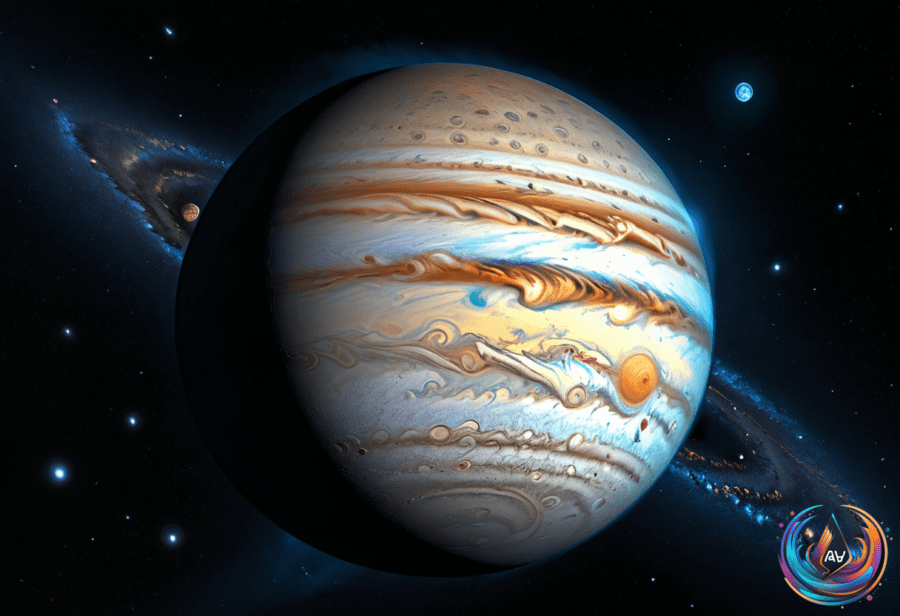
A Jupiter-sized planet is orbiting a white dwarf star, a discovery that challenges what we know about planets surviving after their stars die. This planet, named WD 1856 b, was spotted by the James Webb Space Telescope during observations in April 2023. It orbits extremely close to its white dwarf host, just about 0.02 astronomical units away.
WD 1856 b’s atmosphere contains methane and is covered by thick aerosol hazes. Surprisingly, the planet emits about 25 times more energy than it receives from its star. Its temperature hovers around 400 Kelvin, much hotter than expected. Scientists say this glow must come from heat inside the planet itself, not just from the star’s light.
The white dwarf, WD 1856, has been cooling for roughly 6 billion years. This long cooling time means the planet must have migrated inward after the star died. That idea upends previous theories, which didn’t expect such close orbits around dead stars. Christopher O’Connor, who studied the planet, said, “As soon as they looked at it, they said, okay, that’s weird.”
A Hidden Giant Nearly 40,000 Light-Years Away
Another exciting find comes from NASA’s Transiting Exoplanet Survey Satellite, or TESS. It detected a super-Jupiter planet through a method called gravitational microlensing. This planet is 1.6 times the mass of Jupiter and lies nearly 40,000 light-years from Earth.
The discovery was confirmed with data from the Gaia space observatory in 2023. Gaia spotted the planet during a microlensing event named Gaia23bra b. This event happens when a massive object bends light from a more distant star, revealing the hidden planet’s presence. Diana Dragomir, a co-author of the study, said the discovery shows “there are probably other so-called microlensing planets hiding in TESS’s data.”
Euclid Telescope Uncovers Ancient Quasars From the Early Universe
Launched in July 2024 by the European Space Agency, the Euclid space telescope has been mapping the universe with a sharp eye. Within just one year, it found more than ten quasars with redshifts of 7 or higher. These quasars are incredibly distant and come from the universe’s early days.
Two of the oldest quasars discovered are named EUCL J172902.75+641018.1 and EUCL J125308.55+705432.3. Their high redshifts mean they shine from a time billions of years ago, long before our sun and solar system formed. Daming Yang, who led the quasar research, explained that Euclid lets scientists “search far more efficiently across huge areas of [the night sky] to capture much fainter light.”
With its unique ability to spot faint light, Euclid is opening new doors to understanding how the earliest galaxies and black holes evolved. This is a huge step beyond earlier telescopes that could find only the brightest, oldest quasars.
Mysterious Chemistry on Pluto and Titan
The James Webb Space Telescope also spotted something unusual closer to home. It detected a chemical signature on Pluto and Titan that doesn’t match any known compounds in spectroscopic databases. This strange finding hints at new chemistry happening on these icy worlds, but scientists have yet to identify the mystery molecule.
These discoveries—from planets surviving star death to ancient quasars and strange chemicals—show how much more there is to learn about our universe. New tools like JWST, TESS, Gaia, and Euclid are helping us see the cosmos in ways never possible before.
Based on
- A Jupiter-size planet that escaped its star’s death — arstechnica.com
- NASA’s planet-hunting spacecraft discovered a “super-Jupiter” with a new method. | The Verge — theverge.com
- NASA’s exoplanet mission accidentally discovers a world it was never meant to find | Scientific American — scientificamerican.com
- Mysterious Compound Detected on Pluto and Titan | WIRED — wired.com
- European space telescope Euclid spots oldest quasars yet — dw.com