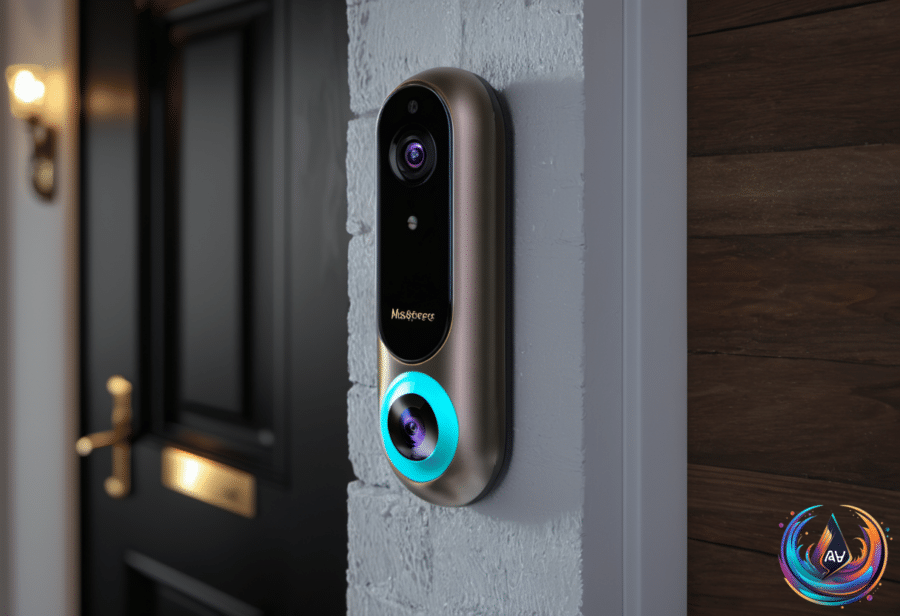
Apple’s smart home ambitions are about to move from promise to purchase. Pre-orders for select Apple Home Collection accessories open November 13, bringing LG-made security cameras and a video doorbell into the lineup before they begin arriving in December.
The timing gives the launch extra momentum: the same day, Apple HomeView and the refreshed Apple TV 4K hit stores. Suddenly, Apple’s home strategy has a centerpiece, a security layer, and a clearer path into everyday routines.
Three Home Collection Devices Lead the Charge
Apple and LG collaborated on the first Apple Home Collection accessories to ship: an indoor camera, an outdoor camera, and a video doorbell. Apple has not revealed exactly when the other products will arrive, including thermostats and door locks, but some are expected next month and the rest are scheduled to debut in early 2027.
The indoor camera costs $200 and captures 2.5K video, giving homeowners a view of what is happening while they are away. It combines low-light color night vision with infrared night vision, and it can detect people and pets inside the home.
Its physical design adds a clever privacy touch. The camera can tilt up when you are away and down when you are home, with the movement managed automatically through the Home app or controlled manually by pressing a button. The same camera is listed at £179.95 in the UK.
The outdoor camera pushes the feature set further. It captures 2.5K video, recognizes faces, pets, and deliveries, and supports both low-light color night vision and infrared night vision. IP65-rated protection shields it from rain and dust, while two-way talk lets you speak with someone outside.
Owners receive 10 days of event video history through iCloud+, and the camera also includes built-in storage. The standard outdoor model costs $300, while a floodlight version costs $400. UK pricing lists the outdoor camera at £279.95 and the floodlight camera at £349.95.
The $250 video doorbell focuses on the two things homeowners most want to see: visitors and packages. Its dual-camera design handles both at once, pairing a forward-facing 2.5K camera with a downward-facing Full HD camera.
You can view either feed separately in the Home app, speak with whoever is at the door through two-way talk, and receive alerts on other Apple devices. When someone rings, HomeView and HomePod devices sound a chime. The doorbell also detects people, pets, vehicles, and packages, with low-light color night vision, infrared night vision, a dimmable spotlight, built-in storage, and event video history through iCloud+.
HomeView Puts Siri at the Center
HomeView is a $299 smart display and Siri-powered home hub with a 7-inch Liquid Retina display. It earned a rating of 8.4 / 10, and its purpose reaches beyond showing information: it can link with smart lights, video cameras, and other home devices while displaying your calendar, reporting your latest appointment, and playing music from Spotify and Apple Music.
The device has two main parts: a cylindrical, domed base and a square display mounted on a shiny stainless-steel arm that tips up and down. A wall-mounted version includes only the screen, but it requires a mount costing at least $59.95; the USB-C wall mount costs $59.99.
Both HomeView models cost $299. The table or countertop version comes in Silver, Starlight, Rose Pink, and Space Gray, while the wall-mounted version is available in Silver and Space Gray. The standard version includes a USB-C to USB-C cable and a 30-watt power adapter.
Apple also sells a 40W dynamic power adapter with support for up to 60W for $39, while the minimum required 20W power supply costs $19. HomeView uses a single USB-C jack for power, keeping the hardware setup simple.
- Display resolution: 1,088 x 1,088
- Pixel density: 200 pixels per inch, with a separate specification listing 220ppi
- Brightness: 500 nits in direct sunlight and 0.3 nits at night
- Processor: Apple A18
- Camera: 12MP front-facing camera with Centre Stage
- Weight: 952g for the standard model and 286g for the wall-mounted version
The display uses an LED-backlit multi-touch IPS panel, an ambient light sensor, and an oleophobic fingerprint-resistant coating. Its camera supports FaceTime calls and recognizes who is standing in front of it, but it is not a Face ID camera and cannot authorize Apple Pay transactions.
Privacy Drives Apple’s Home Strategy
Apple is making privacy a major selling point across the collection. The security products use end-to-end encryption, meaning neither Apple nor LG can access the data. You can control the cameras with an iPhone or HomeView, view live feeds, and manage features through the Home app.
HomeView runs on Apple’s A18 chip and uses Secure Exclaves to process camera and microphone feeds on the device in a way Apple cannot access. That lets the display recognize faces and voices without exposing that information to the operating system.
Siri AI can also work with personal context from Messages, Calendar invites, and other apps, but this requires opting in by enabling Apple Intelligence on an iPhone or iPad. Users can limit which apps Siri can index.
That intelligence reaches into the kitchen. Hold an iPhone near HomeView to show a recipe link in Safari, then tap the cooking icon to open a streamlined kitchen mode. Ingredients become a checklist, Siri can add items to Reminders, and the display shows the new shopping-list entry.
When cooking begins, recipe steps appear as swipeable slides with inline shortcuts for timers, while a Live Activities shortcut provides a quick route back to the recipe. Guests and family members without an iPhone or iPad can still control smart home devices, check the weather, play music, and ask Siri basic questions.
Pre-orders begin November 13, with availability starting in December. Apple’s first wave puts cameras, a doorbell, and a Siri-powered display on the same stage, setting up a smart home collection that will expand again when the thermostats and door locks arrive.
Based on
- Pre-orders for some Apple Home Collection devices will open November 13 — engadget.com
- Apple will open preorders for some of its new smart home collection tomorrow. | The Verge — theverge.com
- Apple HomeView Review: A Versatile Smart Display And Siri-Powered Home Hub — engadget.com
- Apple HomeView, reviewed by a tech critic | The Independent — independent.co.uk
- Building A Smart Home Across Different Brands? Here’s What You Should Know — engadget.com