Dogs are becoming cancer-screening instruments. Bengaluru deeptech startup Dognosis combines trained sniffer dogs with artificial intelligence to build an at-home pre-screening test based on volatile organic compounds, or VOCs, in human breath. The company says its test has been validated in a clinical trial published in the Journal of Clinical Oncology.
The idea rests on a biological advantage dogs have carried for a very long time: roughly 300 million olfactory receptors. Those receptors help them detect subtle chemical changes in humans, including VOC patterns associated with cancer. Based on gas chromatography and mass spectrometry analyses, researchers have identified 1,840 VOCs in human breath.
Dogs have been considered a possible non-invasive cancer screening method for decades, but their performance has a stubborn weakness. Fatigue and environmental distractions can change how accurately they respond, which is a problem when the goal is to turn a dog’s nose into a repeatable medical test.
AI Standardises What Dogs Detect
Dognosis was founded in 2023 by Akash Kulgod and Itamar Bitan. Kulgod said his curiosity began when he “learned that dogs were sniffing COVID-19 all across the world.” Bitan brought experience from the Israel Defense Forces’ canine special operations unit, where he worked on bomb detection, and later spent two years training dogs to detect Parkinson’s and breast cancer at another organisation in Israel.
The startup developed DogSense, a brain-computer interface, after winning a $75,000 contract with the Singapore government to create a 3D map of explosive residues in post-blast scenes using scent-trained dogs. That work gave Dognosis a foundation for monitoring dogs as they examine an affected person’s mask and translating their responses into data.
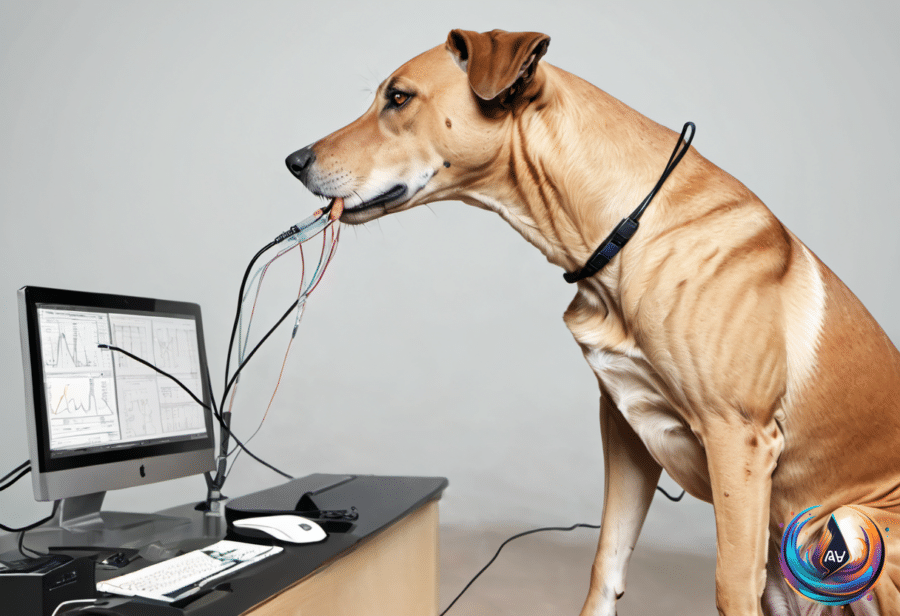
The dogs are trained to detect VOC patterns that correspond to cancer. Each dog gives behavioural cues when it finds what it thinks is cancer, while sensors also capture brain activity and respiration patterns. Dognosis’s AI then converts those signals into a prediction from 0 to 100, with several dogs sniffing each sample before their scores are combined.
“The AI quantifies their cognitive state,” Kulgod says. That process is intended to standardise and scale cancer screening instead of leaving the result to one animal, one handler, and whatever distractions happen to be nearby.
Dognosis built its own model because large language models “can’t yet read dogs from their body language and their brainwaves,” according to Kulgod. The system belongs to Meta’s V-JEPA class of video and world models, takes video as its main input, and embeds sensor data from the dogs’ brain activity and respiratory patterns to identify cancer-related VOCs.
A Screening Signal, Not a Diagnosis
The clinical trial included 3,000 participants, with 1,500 people in a test set and 283 people with cancer. About 100 participants had stage one and stage two cancers. Dognosis has analysed 10,000 samples so far, and the company claims its model detects about 80% of cancers that occur in India.
The cancers covered include head and neck, breast, cervical and other gynaecological, and upper and lower gastrointestinal cancers. The remaining cancers are rare, so Dognosis does not have enough samples to show statistical significance, though Kulgod says the system “might also be detecting others.”
Kulgod is careful about what the test can and cannot do. “It is a pre-screening tool that can be done at home, is non-invasive, and flags whether a person needs a follow-up,” he says.
A high score leads to a follow-up at a partner site involving imaging. The imaging determines whether a biopsy is needed, and the biopsy confirms whether the person has cancer. That distinction matters—an early warning system is useful, but calling it a diagnosis would be medical overreach dressed up as product marketing.
Dognosis plans to offer memberships that include a free-of-cost follow-up, although pricing has not been released and the details are still being finalised. “The goal is to fix a cost that everyone in India can afford,” Kulgod says.
Access begins with a waitlist open to everyone above 35, and the startup plans to launch in Bengaluru early next year. It intends to serve consumers and businesses while keeping a direct-to-consumer channel in both India and the United States. In the US, Dognosis is still doing customer discovery and plans to enter late next year.
Venture capital firm Boost VC came in early with what Kulgod calls a “plus check” in January 2024. Dognosis has raised two rounds, with Accel India leading the startup’s $1.5 million second round earlier this year.
The pitch is straightforward: use dogs to detect chemistry humans struggle to see, then use AI to make the result more consistent. The difficult part is proving that consistency across real homes, real samples, and real patients—because cancer screening does not get safer merely because the detector has four legs.
Based on
- This Bengaluru Deeptech Startup Pairs Sniffer Dogs With AI to Screen for Cancer — analyticsindiamag.com
- Many owners don’t know when their dog is in pain. Here’s how to tell | The Independent — independent.co.uk
- Experimental cancer drug shows promise – CTVNews — ctvnews.ca
- Beware of apps claiming to diagnose skin cancer – CTVNews — ctvnews.ca